
#germany #worldcup #soccer #korea #futbol #futebol
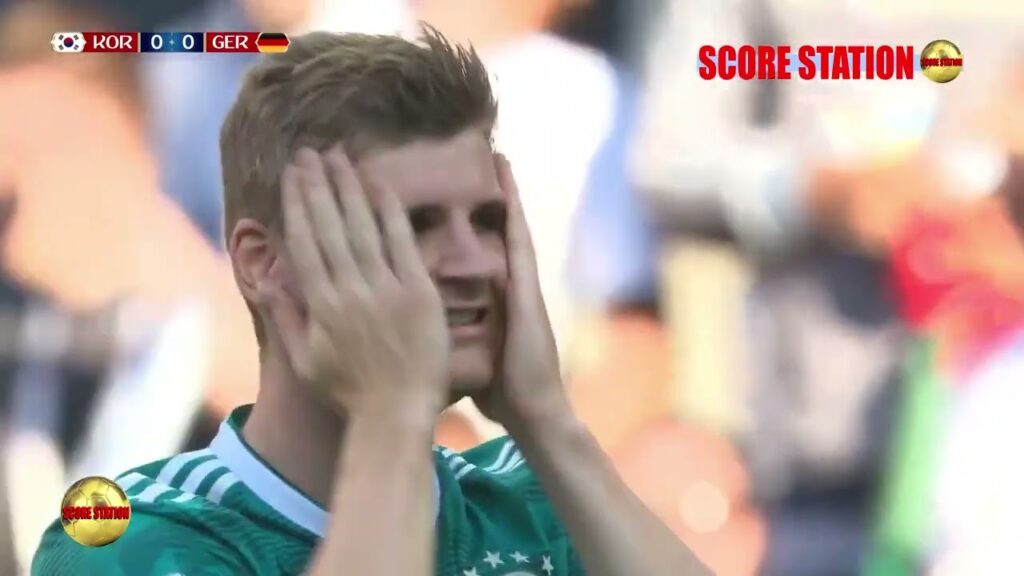
The two teams had faced each other three times, including two FIFA World Cup games, one at the 2002 FIFA World Cup semi-finals, which ended with a 1–0 victory for Germany, and one at the 1994 FIFA World Cup group stage, a Germany 3–2 victory.Despite South Korea’s two previous losses, they were not eliminated just yet. For South Korea to have any chance of advancing, Mexico would have to defeat Sweden in their match that same day, and South Korea would then have to defeat Germany by at least two goals, a feat predicted to be highly improbable going in, with the South Korean coach before the game predicting that it had a “one percent” chance of happening.
Son Heung-min shot wide from the edge of the penalty area before Marco Reus shot one towards goal at the other end only to see it blocked. Leon Goretzka drew a one-handed save from Jo Hyeon-woo with a header from the middle of the penalty area, the South Korean goalkeeper diving to his right and pushing the ball away at full stretch. Two minutes into the second-half’s stoppage time, Son’s corner from the left reached Kim Young-gwon at the far post who scored into the right corner from six yards out with his left foot, the offside decision that followed was overruled by a VAR decision.Ju Se-jong won the ball off Manuel Neuer who had been at the other end of the pitch in order to join the German attack, thus leaving the goal undefended, and hit a long ball to Son, who ran onto the ball and tapped into an empty net from close range to score the second.
Had Mexico defeated Sweden in their final group stage match that same day, a South Korean victory over Germany by at least two goals would have advanced South Korea to the round of 16 based on goal differential, at the expense of Sweden. However, since Sweden defeated Mexico 3–0, the South Koreans were eliminated despite their 2–0 victory over Germany. This marked the second time that South Korea failed to qualify for the knockout stage in consecutive World Cups, having been eliminated in the group stage at the previous tournament and in four consecutive World Cups from 1986 to 1998.
Germany were the fourth defending champions to be eliminated from the group stage at the World Cup in the last five tournaments, following France in 2002, Italy in 2010, and Spain in 2014; and since the new millennium, all champions eliminated in the group stage had been UEFA members. This was only the second time that Germany had been eliminated from the first round at the World Cup, having done so in 1938, while also being the first time since then that Germany failed to finish among the best eight teams of the tournament. However, this was the first time it happened after the first round was converted back to a group stage format in 1950. This was Germany’s first ever defeat against an Asian nation in a World Cup match in what was their sixth such match. This was South Korea’s first victory (and clean sheet) at the World Cup since their 2–0 win over Greece in 2010. Son’s goal for South Korea (95:52) was the latest goal Germany had ever conceded in a 90-minute World Cup match. This was also the first time Germany finished bottom in the World Cup’s group stage, one of the worst performances in their history; having been eliminated from the group stage of UEFA Euro 2000 and 2004. South Korea’s win also meant that Australia was the only team from the Asian Football Confederation that failed to win a game in their 2018 World Cup campaign.
Notwithstanding the provisions of sections 106 and 106A, the fair use of a copyrighted work, including such use by reproduction in copies or phonorecords or by any other means specified by that section, for purposes such as criticism, comment, news reporting, teaching (including multiple copies for classroom use), scholarship, or research, is not an infringement of copyright. In determining whether the use made of a work in any particular case is a fair use the factors to be considered shall include—
(1) the purpose and character of the use, including whether such use is of a commercial nature or is for nonprofit educational purposes;
(2) the nature of the copyrighted work;
(3) the amount and substantiality of the portion used in relation to the copyrighted work as a whole; and
(4) the effect of the use upon the potential market for or value of the copyrighted work.
The fact that a work is unpublished shall not itself bar a finding of fair use if such finding is made upon consideration of all the above factors.
(Pub. L. 94–553, title I, § 101, Oct. 19, 1976, 90 Stat. 2546; Pub. L. 101–650, title VI, § 607, Dec. 1, 1990, 104 Stat. 5132; Pub. L. 102–492, Oct. 24, 1992, 106 Stat. 3145.)