
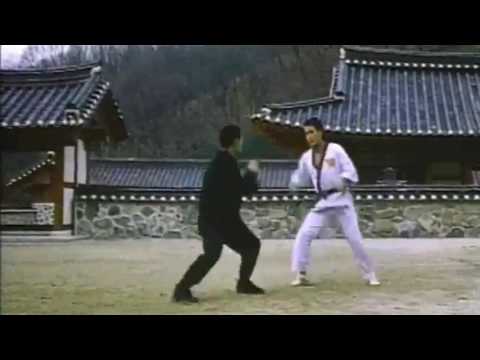
Movie fight scene
https://www.youtube.com/watch?v=sEnjkwDNYAM (Full Movie courtesy of #WuTangCollection)
https://www.facebook.com/kookhyun.jung.1
http://www.worldtaekwondofederation.net/new-wtf-technical-committee-chairman-jung-kook-hyun-master-with-a-mission/
http://www.kmdb.or.kr/eng/vod/vod_basic.asp?nation=K&p_dataid=04752#url
Jung grew up in Jeolla-do, the southwestern Korean province famed for its pungent cuisine, cheery attitudes and hardy men. Remarkably – given his later stellar competitive career in taekwondo – he was a reluctant convert to the way of foot and fist.
At middle-school, he was a keen volleyball player when, one day, his coach lined up his players by height and cut the line in half. Those on the tall side of the line made the team; those on the short side were dismissed. Jung fell into the latter category. That event prodded him toward a different sport – taekwondo. “It was a good decision by my teacher,” Jung reminisced, laughing.
Even so, he was hardly super keen. Less than a year after getting started, he was attracted to a new sport – wrestling. Only after his wrestling coach unexpectedly relocated to another school did Jung return to taekwondo and persevere with it.
“So many things are needed to be a good player: good physique and good techniques,” he said. “But it is also intellectual: You have to understand the training, you have to understand the referees’ approach.” Jung soon discovered a fearsome talent.
Assessing his personal strengths as a fighter, he cites extreme physical fitness (which he maintains to this day) and explosiveness: “It is not simply muscle power, it is power through the neuro-muscular system – sudden power, all in one moment!” He also considers spirit of premium value. “Part of it came from my parents, part of it came from my own power,” he said.
The rest is history. Jung won the world championships in 1982, 1983, 1985 and 1987 and seized an Olympic gold in Seoul in 1988 – that pivotal year which was the “coming-out party” for the newly prosperous, newly democratized South Korea, as well as for its national sport.
Even so, his memories of 1988 are bittersweet.
“I never thought I could compete in the Olympics in a taekwondo event, I will never forget that, it was an honor,” he recalled. “But at that time taekwondo was just a demonstration sport, not a program sport and in Korea, the government, the media – none of them were that interested.”
The “trembling shock,” KO-focused taekwondo of those days was a rougher art than its modern cousin and Jung believes it has lost something in the process. “Some changes have been good, some have been bad,” he said. “But frankly, I prefer my generation’s competition: It had more power, it was a more serious game!”
He stands up and adopts a combat stance to demonstrate how today’s taekwondo is less ambidextrous than yesterday’s. “Now it is only the front leg – 80 percent of it is front leg kicking!” he said. “Biomechanically, this is wrong: It should be the whole body, the center of gravity has to move.”He leans backward with his torso, showing how, in this stance, only the front foot can be used to fire short jabs.
While jackhammer push kicks may jam the opponent’s forward motion and rack up points on the body protector, fighting on the back foot is a no-no in virtually any contact sport as it erodes power generation. Moreover, a rear-weighted, backward leaning stance obviates many of taekwondo’s signature spinning kicks.
He acknowledges that, with the Summer Olympics upcoming, there is little that can be done between now and summer 2016. However, he does think that by removing the sensors from the sole of the foot, front-leg push-kicks will become less prevalent. He also plans, over the next 11 months, to canvas opinion from across the global taekwondo family. “I want to listen rather than speak,” he said. Post-Rio, he plans significant changes. “I want it to be more like a martial sport,” he said.
Physically, Jung is a walking advertisement for taekwondo.
He plays golf and badminton. He runs, lifts weights, conditions his core and is constantly stretching: “Whenever I sit on the floor I stretch out; I think that as you get older, you need to practice flexibility.” He practices taekwondo two to three mornings a week, and as a professor at Korea National Sports University in southern Seoul, kicks the paddle, shield and heavy bag, demonstrating to his students the full technical repertoire that made him a repeat champion. “I tell my students, ‘Until I die, if I can walk, I will still be kicking.”
Although Korea is the birthplace of taekwondo, he says the nation’s frenetic modern culture explains why so many practitioners quit in their 30s or 40s. “Because of social factors like job and family and because after work, you have to go out eating and drinking,” he said. “People in their 60s recognize that exercise is very important and then they start, but then it may be too late.”
33 Comments
The guy in black dress has very good movements. Enjoyed watching. Old classic.
Welp! that was a lot of waisted energy.
힌도복 입은 두목 저거 이주철님 아닌가요? 젊은 시절이라 모르겠네..
https://www.youtube.com/watch?v=FaPfQol1i-o
Jung Kook Hyun in 88 Olympic
Wow I never knew this movie existed! Looks cool. I like how they yell masculine and tough and not like how todays effeminate weak Olympic competitors who do high pitched girly squeals and shrills. Taekwondo lost all of it's toughness and seriousness.
Taekwondo 👊
Suxx Korean movie
Amazing! Thanks for uploading 🙂
Super 👍🏻👍🏻👍🏻👍🏻
Looks kind of like the Tae kwon do, Jido kwon style for which I was awarded a black belt in 1969 in Kunsan, South Korea. My master made me captain of our team/class. I volunteered for permanent midnight shift as a cop in the US Air Force so that I could practice four times per day, seven days per week including two classes, between those classes, and during my midnight shift as I would be alone at one post or another on base in South Korea. My master's name is/was Kim Hyok Nae, a 7th Degree Master then. Mr. Cho, a 5th Degree and three times in a row All Korean Champion and former presidenial bodyguard was one of my master's assistants. Mr. Cho's style was UNLIKE any other style I've ever seen before or since. And I saw many "styles" while in South Korea and another strange Korean style at the gym on base in Austin, Texas before I was stationed in South Korea that I have never seen before or since and that was extremely impressive and unique … and was only defensive movements making a perfect circle of side-stepping motion against a much larger/powerful black-belt guy who was all about scary powerful attacks all unsuccessful against the small stature of that Korean gentleman … amazing!!! After my return to Texas at the Air Force base from South Korea, I recalled and then attempted something similar but modified to my lesser ability and it worked successfully but against a lesser opponent than I observed sparking against that Korean gentleman a couple of years earlier before my South Korea tour. My master's style was also quite different that suited his very short height. My master was absolutely amazing, and I don't think anyone in the world could have beaten him in a death match or street fight with no rules. Neither my master nor Mr. Cho showed their true abilities and techniques except very, very rarely and only to me. It's no longer officially practiced as of shortly after I left Korea, unfortunately. They unified into a single style, I understand. The style I received involved actual contact but with reduced power, but still hurt! and caused injuries sometimes. I loved it, as it is a martial art not playing around for show. Everyone my master invited to our class sparred differently and were extremely quick!!! Very impressive! I have added lots of Korean Hapkido joint locks and throws to my current way and stopped doing high kicks in my mid-sixties a decade ago. Medium high, middle, and low kicks plus stomping kicks etc and now with mostly or almost only vertical fist punching requiring the body to be sideways and leaning towards the target somewhat at the instant of contact and as the other hand and/or arm guarding my face or body part as appropriate, as well as striking techniques, pushing/tripping, plus joints locks, etc. Tricky fake attacks followed by actually attacking or allowing an opponent to attack me first that is his mistake (smile). Medium and long stick/staff techniques round off my current style. However, I stopped doing forms long ago and practice almost daily if not daily using only techniques that are effective in actually fighting not for forms or show. I put together a kick/punch/striking bag weighted at the bottom with water base and added a contraption of an old leather jacket hung over the top with a suspended bar supporting the jacket with pipe foam covering to fill out the arms of the jacket. This way, I can regularly practice joints locks to a point. I never counted the number of Hapkido/Qin-na or Chin-na joint techniques I practice daily. But it may be around 50 or so … maybe 100 or so. I do one or several techniques of Taekwondo kicks/punches/striking, joint locks, and staff/stick moves a little off and on throughout the day off and on … seconds, minutes, or several minutes at a time. It adds up a lot by day's end … about everyday. 😊
needs more grappling..ok….heck it needs SOME grappling!!
Not really. This is a cultural style.
Both are adept and understand the angles corresponding to a ranged fight.
It may be imbalanced in a global sense the same way a person can critique boxing or wrestling as being limited.
When a person endeavours to combine styles then we get MMA-type combat and IDK that this necessarily has cultural value in terms of continuity. Art and culture, synonymous with one another, loses the ancestors and traditions when
cage fighting is equated in global terms.
I am from Indonesia i like taekwondo martial art
This is the first time I've seen an all Korean martial arts flick.
Удары ногами красивые, но эти нелепые крики и последующие нереальные удары в воздухе реально бесят.
que lutinha sem graça, muito chata! Não falo do taekwondo mas dessa coreografia.
Nice fight but don't let students to go because they should learn the best from what expert and teacher do n fight to became good.
크아 정국현 선수가 영화도 찍었었네?!
Qual o nome desse filme?
КЛОУНЫ
Туфта
I like tang soo do..
Are you fighting with the rule that you can't hit the face with your fist?
Hwoarang vs Baek
😮❤
That sweet is of Tang Soo Do, a Korean Karate
This is brilliant in so many levels. Thank you for sharing!
100% kicks, 20% contact
O cara tomou um monte de chutes mas o dobok dele continua limpinho 😂
Bad choreography and too many kicks that miss by a long margin
I love the movie location
It's more classic than me
Le dicen LA LEYENDA al Maestro JUNG KOK