
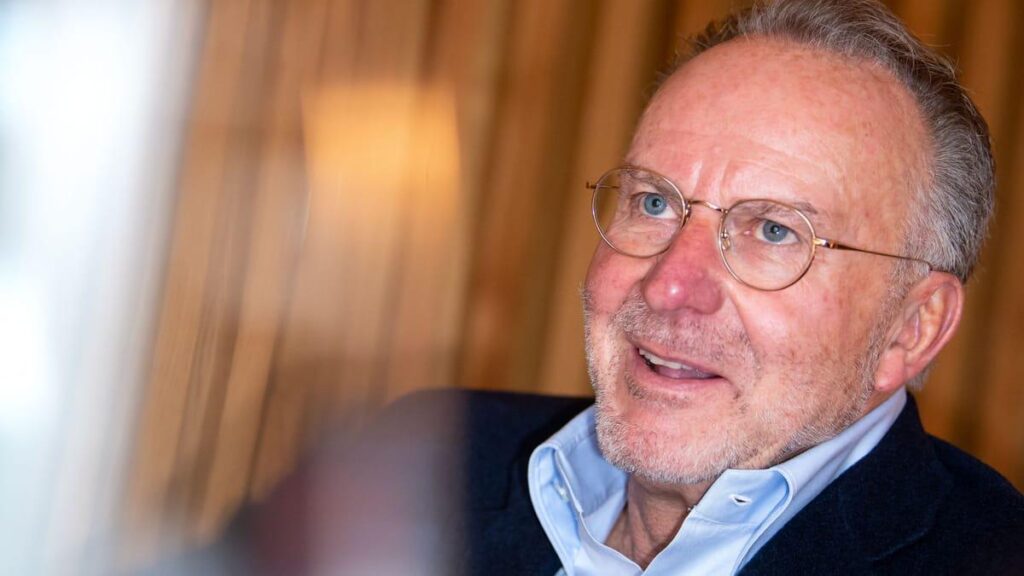
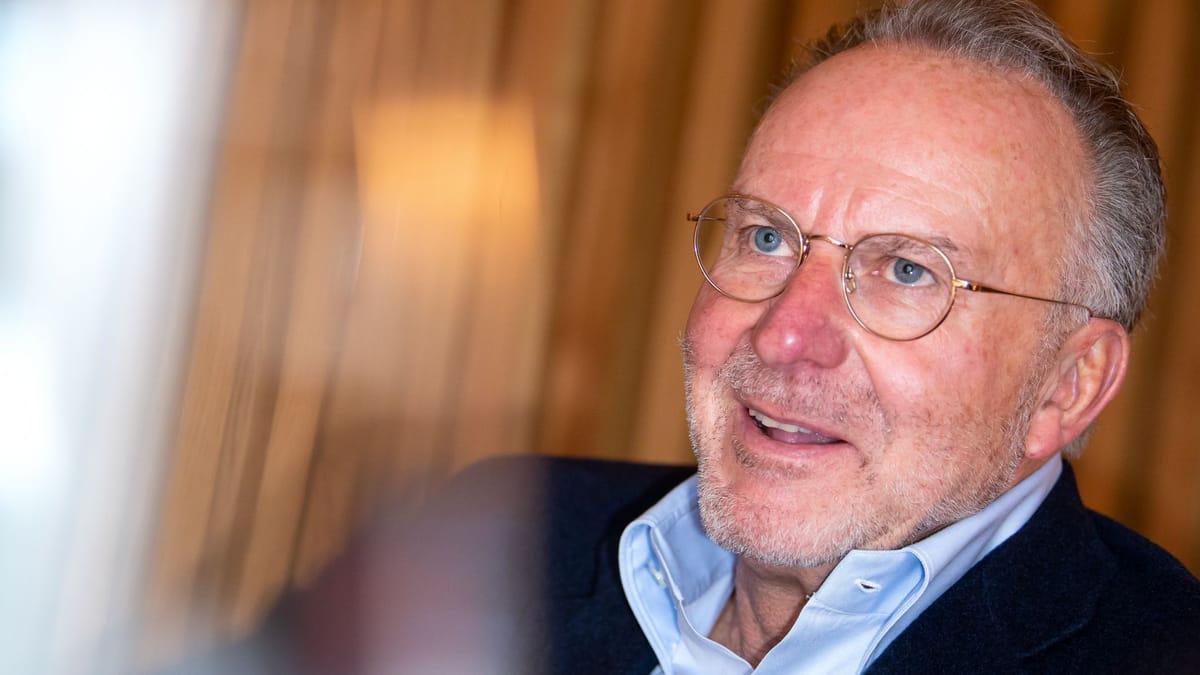
In an in-depth interview with t-online ahead of FC Bayern’s clash with Paris Saint-Germain, Karl-Heinz Rummenigge offers fascinating insights into the club’s future plans. He declares one star player to be unsellable.
It is a special fixture awaiting FC Bayern in the French capital: on Tuesday evening (9 pm in the live ticker on t-online), the German record champions will face defending champions Paris Saint-Germain at the Parc des Princes in the first leg of the Champions League semi-final. Eight days later, the return leg in Munich will decide who progresses to the final.
For many observers, the clash between the two top European clubs currently in the best form is already being treated as the final. Expectations are correspondingly high even before the first meeting between the two tournament favourites. Karl-Heinz Rummenigge is no exception. In an in-depth interview with t-online, the long-serving CEO and current member of Munich’s supervisory board looks ahead to Bayern’s crucial match on the road to a potential treble.
He offers fascinating insights into the club’s future plans and discusses, among other things, a potential €200 million bid for Michael Olise, as well as the club’s plans regarding captain Manuel Neuer, Harry Kane and Thomas Müller.
t-online: Mr Rummenigge, following their 2-0 win in Leverkusen, FC Bayern have reached the DFB Cup final for the first time since 2020, thereby breaking a bit of a curse. How relieved are you about this?
Karl-Heinz Rummenigge: FC Bayern isn’t used to not going to Berlin for six years. The fans are very happy, and I can tell from my circle of friends too – everyone wants to go to Berlin and is asking me if I can get tickets. The first half in Leverkusen was possibly one of the best I’ve seen from this team in a fantastic second half of the season – almost a masterclass in football.
By reaching the final, Bayern have taken the next step towards a potential treble. What do you expect from the team now in the Champions League semi-final against Paris Saint-Germain?
The two matches against PSG will demand everything from us. Everyone must be in top form and the team must repeat exactly what they showed in the 2-1 victory in the group stage in Paris – in both matches. They played fantastic football in the first half. And in the second half, after Luis Díaz was sent off, they defended in a way that reminded me a little of that old saying by Sepp Herberger (Germany’s 1954 World Cup-winning manager; Ed.).
Which one?
“One for all, all for one.”
It was exemplary how the team defended there, throwing themselves into every shot and every dribble. This match is now also the benchmark for the two semi-finals.
Is the clash between FC Bayern and Paris the anticipated final?
Of course, that could also be a great final, but right now it’s just the semi-final. Arsenal have been praised for a long time, but now, towards the end of the season, they seem to be faltering slightly in the league and could lose the Premier League lead back to Manchester City. Nevertheless, I wouldn’t underestimate the other two semi-final teams.
What makes PSG so dangerous?
Since Luis Enrique took over as manager there in 2023, it has been a team with top-class players and a very cleverly assembled squad. Paris has proven something crucial.
What?
That you can’t buy everything, but must also build a team with patience. When we beat them in the 2020 Champions League final, they had Neymar and Kylian Mbappé in their squad. A year later, Lionel Messi joined them. On paper, that was a fantastic team, but also clearly one that didn’t function as a unit as well as the current one. Now they are a shrewd outfit, boasting a great deal of quality, particularly in midfield and in attack.
Following the 2-0 win at Liverpool FC, PSG president Nasser Al-Khelaifi, who is the chairman of club investors Qatar Sports Investments (QSI), was loudly celebrated in front of the supporters’ stand and asked for selfies. Something like that would be unthinkable here in Germany, wouldn’t it?
I’m delighted for Nasser that he’s been received so positively by the fans. But they must also be indebted to him. After all, who was Paris Saint-Germain before Qatar Sports Investments took over? I can still remember: after they lost to us in the final in 2020, Nasser was completely devastated. I told him back then: Nasser, you have to be patient. In football, nothing is a given. You have to work hard for everything, make smart signings. It doesn’t all depend on money. There has to be a spirit in the dressing room that gives you that extra three to five per cent to win this trophy. It’s also no coincidence that they’re back in the semi-finals now. They’re playing some great football.
The club has still invested a lot of money, though: 822 million euros in the squad, which means a transfer deficit of 400 million euros over the past three years. How does that fit in with the Financial Fair Play rules?
When they signed Neymar, Mbappé and Messi, PSG were already putting the very big clubs in Europe under a lot of pressure – with their transfer spending and, in particular, with the wages. All three players are no longer playing in Paris, and so the club has also sorted out its finances quite a bit. And the manager has now brought a different spirit to the club.
Previously, players went to PSG for the money; now, it’s because it’s one of the top three destinations in Europe. They’ve done a good job there; you have to give them credit for that. European football can count itself lucky that such teams are no longer confined to England or Spain.
Can Bayern even stand a chance against the other top European clubs in this financially unequal competition?
These are completely different structures; FC Bayern has to earn every euro itself. Nevertheless, we’ve always managed to field a competitive team in recent years. It has won the German league title 13 times in the last 15 years and, alongside various other trophies, has also won the Champions League twice. Within the limits of our capabilities, we’re doing a good job: successful on the pitch, but please, with serious and sound financial backing. That is an important guiding principle. We had two or three years where we went a bit too far with transfers and, in particular, with players’ salaries.
Ousmane Dembélé (2016) and Désiré Doué (2024) were also on FC Bayern’s radar in the past. They now play for PSG. Are you annoyed that these transfers didn’t go through?
In Dembélé’s case, I was personally involved (as chairman; editor’s note). We, and above all our then sporting director Michael Reschke, were desperate to sign him, but unfortunately Dortmund beat us to it at the time.
Why?
Dembélé was playing for Stade Rennes at the time. The club owners were also the owners of Puma. Dortmund had an equipment sponsorship deal with Puma at the time. Consequently, it was clear that, as an Adidas club, we wouldn’t necessarily be given priority. He was a wonderful player, but as we saw, he quickly moved on from Dortmund to Barcelona. He is without question a very good player, but one who also needs to be managed well.
And Doué?
We would have liked to sign him; he would have been a great fit for us. But he opted for Paris because he wanted to stay in his native France. In future, too, we’ll occasionally miss out on one or two players because perhaps more money is being offered elsewhere. You have to accept that; it’s part of the business. As you can see, both Paris and we can still live with that quite comfortably.
So the Doué transfer didn’t fail because of a veto by the supervisory board, as was rumoured in some quarters?
No, anyone who says that is telling tall tales. The player would also have been a good fit for us in terms of value for money, considering the transfer fee and salary.
Uli Hoeneß spoke on Markus Söder’s podcast about disagreements during the last transfer window. One or two people apparently still wanted to spend big, up to 150 million. The ‘old guard’ then got their way with their strategy of giving the youngsters a chance. Was that the case?
I don’t generally discuss internal matters. When Vincent Kompany became our manager, we said from the outset that our youth academy should finally be raised to the level it deserves. The manager has implemented this vision perfectly. This season, he has helped ten young players make their professional debuts.
You can well imagine what it means for an 18-year-old to be allowed to play with this team in front of 75,000 spectators at the Allianz Arena. For these players, it’s confirmation that they have a real chance with us in the future. For us, that’s a conditio sine qua non – an indispensable prerequisite.
Why?
Firstly, because the campus cost over 100 million and continues to cost a considerable amount of money every year. We want to make deliberate use of this campus to train players ourselves. And at the moment, that is bearing fruit. Among others, with Josip Stanišić, Aleksandar Pavlović, Lennart Karl, as well as Alphonso Davies and Jamal Musiala, who have already played for our youth teams. And secondly, our fans like it when the head coach calls upon and promotes our own players. Anything else would not be in the spirit of FC Bayern.
Is the development that this has enabled, particularly for Lennart Karl, the prime example?
I would also include Tom Bischof in that, who joined us in the summer, even though he wasn’t trained by us. Without this philosophy that we are now implementing, both of them would have had far less playing time and would not have come to the fore in this way. Karl is in with a good chance of travelling to America for the World Cup. And Bischof is captain of the U21s and always one of the best players on the pitch there. Uli Hoeneß and I are the best proof of that.
You’ll have to explain that.
It was exactly the same for us back then. When I joined FC Bayern as a young player, there were eight World Cup winners in the squad, who were also German champions and European Cup winners. It was actually a suicide mission I’d taken on. But I managed it anyway. To do that, though, you need a manager who trusts you, and of course you have to give it your all. For me, it was Dettmar Cramer. That’s also the case with our young lads today and our manager.
On the other hand, FC Bayern also wanted to sign Florian Wirtz in the summer, who moved to Liverpool for €150 million, and Nick Woltemade, who went to Newcastle United for €85 million.
If Nick Woltemade had come, then the loan of Nicolas Jackson probably wouldn’t have happened. The crucial thing is always that the transfers actually make an impact. And this year, we can all thank not only the Lord, but also dear Vinnie, for bringing the squad to such fruition.
So will Vincent Kompany perhaps get one or two of his dream signings this summer after all – and not just apple pie from Uli Hoeneß?
(laughs) Uli is a Swabian, you mustn’t forget that. And the apple pie is cheaper than the expensive transfers. But Bayern Munich’s history does show that we’ve made expensive transfers from time to time. There is one decisive criterion, though.
Which one?
An expensive transfer must be a game-changer. Harry Kane is one such player; Arjen Robben and Franck Ribéry were. If you spend money, these players must make a difference on the pitch. We got it spot on with Harry, just as we did with Franck and Arjen. Occasionally there have been players who haven’t quite fitted in, but of course we’ll continue to attract superstars to FC Bayern.
Perhaps as early as this summer?
We’ve got a team that works perfectly, and since 2020 we haven’t played such fine, successful football that’s so much fun. I do read comments on Instagram from time to time.
Really?
Yes. Even the first of the former haters are starting to find FC Bayern likeable. I’m starting to find that a bit suspicious (laughs).
Pep Guardiola said at a press conference last week that he was certain Vincent Kompany would one day become his successor at Manchester City. Does that statement worry you?
At the moment, I’m very relaxed about it. Vincent deliberately extended his contract with us until 2029. Of course, his success is now being noticed across Europe. Almost a billion viewers watched our last match against Real Madrid. The way we play football, the many goals – that’s being seen everywhere. But I believe he’ll stay here for a long time yet.
What makes you so sure of that?
Because he’s happy here. He lives in Grünwald, just four houses away from me. I get the impression the family feels at home. The children too. I know this from my grandchildren, who go to the same school as two of his children. At the moment, we have paradise-like conditions here at FC Bayern. I’ve always said one thing: despite Franz Beckenbauer, the most important employee at Bayern Munich is the manager.
Do you hope that Manuel Neuer will continue to experience these “paradisiacal conditions” as a player next season and that his contract will be extended once more?
We all agree that we would very much welcome it if he stayed on for another year. He has won everything at FC Bayern and shaped an era spanning over 15 years. His performance remains at a high level. And the combination we have with him and the young Jonas Urbig is perfect. He could continue to support Urbig in his development. The entire goalkeeping squad, including Sven Ulreich and goalkeeping coach Michael Rechner, is a close-knit bunch. Accordingly, it would be lovely if they all stayed together.
Do you find it understandable that, as things stand, Neuer will not be in goal for the German national team at the World Cup?
To me, he remains the best German goalkeeper and one of the top three in the world. But I don’t know the reasons behind it – neither from Julian Nagelsmann (national team manager; editor’s note) nor from Manuel. He has made his decision, and one thing mustn’t be forgotten: he is already a World Cup winner and has won this tournament before.
Harry Kane is also actually indispensable to the team. Is the extension of his contract, which is valid until 2027, next on the agenda?
Signing Harry Kane for Bayern Munich was a major coup in the club’s history. It is well known that he had an exit clause. He didn’t invoke it, thereby signalling that he will definitely stay in Munich. And now the relevant operational managers – as agreed – will hold talks with him at some point after the season. With the clear aim of extending his contract. Because under Vincent Kompany, Harry has undergone another transformation.
In what way?
He’s always been a great striker who’s scored plenty of goals. But now he’s a playmaking striker who drops back into midfield and, from there, brings Michael Olise and Luis Díaz into the game with his wonderful long passes. That’s very important for our style of play.
You mention Olise. Many already see him as the new Arjen Robben and a Ballon d’Or contender. Do you agree?
He’s a wonderful player. Incidentally, I also like the fact that he’s so reserved and almost media-shy. That’s the exception in today’s world. He’s a good lad and, on the pitch, he’s naturally outstanding in the way he celebrates football and almost works magic. That’s why I’m not surprised that he’s so incredibly popular and hyped among our fans.
Could Bayern afford to turn down a potential offer of 200 million euros, which is already being speculated about?
Let me tell you a story from the past.
Please.
In 2009, we received an incredible offer from Chelsea FC for Franck Ribéry. That would have been a new world transfer record at the time. I then took it to our then-Chief Financial Officer Karl Hopfner and Uli Hoeneß. We spent two hours discussing what to do with this offer. On that day, we made a fundamental decision: that in future we would no longer sell any player whose sporting contribution we would miss. And this unwritten rule still applies today. For a player like Olise, there is no price tag that would make us flinch.
Let’s talk about the management at FC Bayern. Following the failed attempt with Oliver Kahn, have you now found a worthy successor to you as CEO in Jan-Christian Dreesen, so to speak, on the second attempt?
Looking back, one has to say that he should have been installed as my successor from the very start. I’ve always had an incredibly good relationship with him. He’s been responsible for finances, organisation and all those matters since 2013. And we’ve worked together very harmoniously, loyally and effectively. I involved him in pretty much every negotiation I’ve conducted; he’s been through it all with me. That worked wonderfully. It was only afterwards that a bit of unrest arose due to one or two decisions that didn’t quite work out as we’d hoped. But the club can count itself lucky again now. Jan has also worked extremely hard on the finances over the last two years, because we were completely on the wrong track with the payroll – and are now back on the right one. Thanks to him, calm has also returned to the club.
The relationship between sporting director Max Eberl and sporting director Christoph Freund was recently described in a ‘Kicker’ report as a ‘forced marriage’. Aren’t you and Uli Hoeneß the perfect example of how a certain amount of friction can actually be beneficial to FC Bayern’s success?
I don’t wish to comment on articles. Basically, the following applies: Uli Hoeneß and I have had the odd disagreement or two in the past, when he was president and I was chairman of the board. This so-called Bavarian culture of debate, which I, as someone from East Westphalia, first had to learn, is an important asset, including at FC Bayern. You don’t always have to be hugging each other, but our interests must be aligned: everything for the good of FC Bayern. There will always be issues where people hold differing views. These must be discussed thoroughly and, if necessary, argued through. Incidentally, I also see things somewhat differently from the general public when it comes to German politics.
In what way exactly?
Every disagreement is immediately dramatised. There are bound to be clashes and arguments now and then; that’s unavoidable when people have differing perspectives.
I think it’s better to argue in order to find good solutions than to settle for poor compromises.
Thomas Müller was already up in the stands visiting you and the other Bayern bosses back in December. Can you give us an update on his possible return to FC Bayern?
At the moment, there isn’t actually that much contact between him and us, because he’s started the season in the MLS with Vancouver. Whenever he’s in Germany, we’re always delighted when he visits us. As for his future, he needs to be clear about what he wants. There’s no point in dangling a carrot in front of him right now. It simply has to sink in for him. This job is incredibly demanding. And there’s one thing you mustn’t forget.
What?
Thomas Müller has now been a professional footballer for 18 years. I assume he is a very wealthy man who doesn’t necessarily need this job to ensure his financial future. Only someone prepared to work 24/7 can do this job. Anyone who thinks you can do it on the side, give a few interviews now and then and manage things practically just through communication is completely wrong. And that is what we need for the future. We must find people who are prepared to do everything for the good of FC Bayern – and not for themselves.
Finally: FC Bayern’s women’s team have also already secured the league title and are in the cup final as well as the Champions League semi-finals. Are you hoping for a double-triple from the men and women?
That would, of course, be the ultimate. But for now we’ll wait and see; there are still important matches to be played. Just like the men against Stuttgart, the women must face a formidable opponent in Wolfsburg in the cup final. And FC Barcelona, as our semi-final opponents in the Champions League, are also a real force to be reckoned with. But it would, of course, be a wonderful achievement if there were six trophies on the mantelpiece at the end of it all.
by BenderTime