
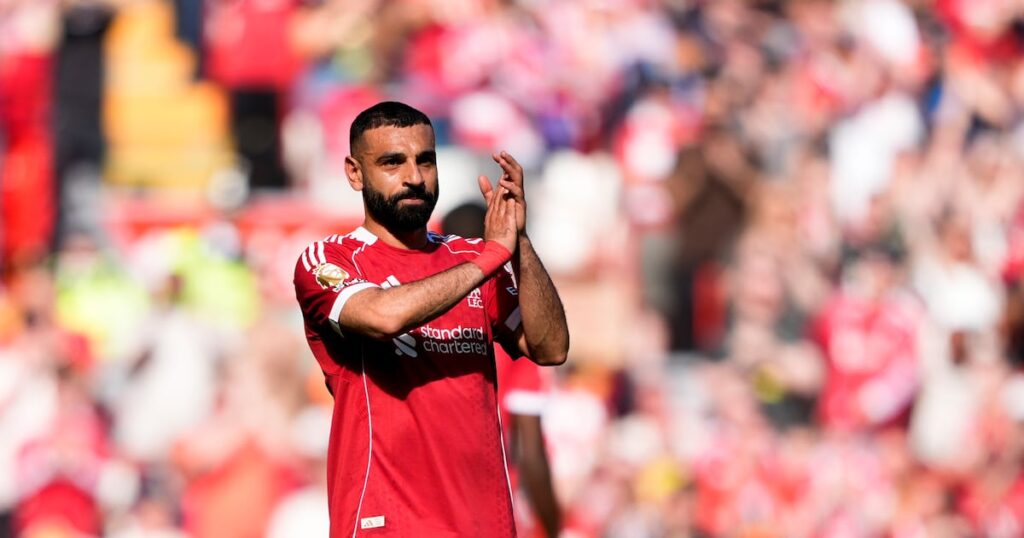
The end came in the 58th minute, not with a bang but a whimper. Mohamed Salah passed to Dominik Szoboszlai, darted for the return, brushed against Adam Wharton of Crystal Palace and fell.
The crowd roared for a free-kick, but the referee, as so often when Salah goes down, saw nothing wrong with the challenge. The only unusual thing was that Salah didn’t get back up. He was feeling the back of his left thigh and grimacing doubtfully.
Within seconds Jeremie Frimpong was getting ready to come on, and Salah and the crowd had belatedly recognised the significance of the moment. The pass to Szoboszlai could be the last ball Salah ever kicks for Liverpool. This moment – this sudden anticlimax – could be it.
He turned to applaud the four corners of the ground, but this was not some testimonial, the game had to continue. Within a few seconds he had left the Anfield pitch for what might be the last time.
There will still be goodbye ceremonies and photo ops, but meaningful action? Probably not. The World Cup starts in six weeks and Egypt will not want him taking pointless risks.
So ends the Liverpool story of the last member of the front three that was, for a few years, the greatest show in English football.
Roberto Firmino had a better goodbye. He scored a last-minute equaliser in front of the Kop, then stood with his family and cried as the crowd sang his name. Sadio Mané’s last game was the 2022 Champions League final against Real Madrid. He lost the game, but at least he went out at the top.
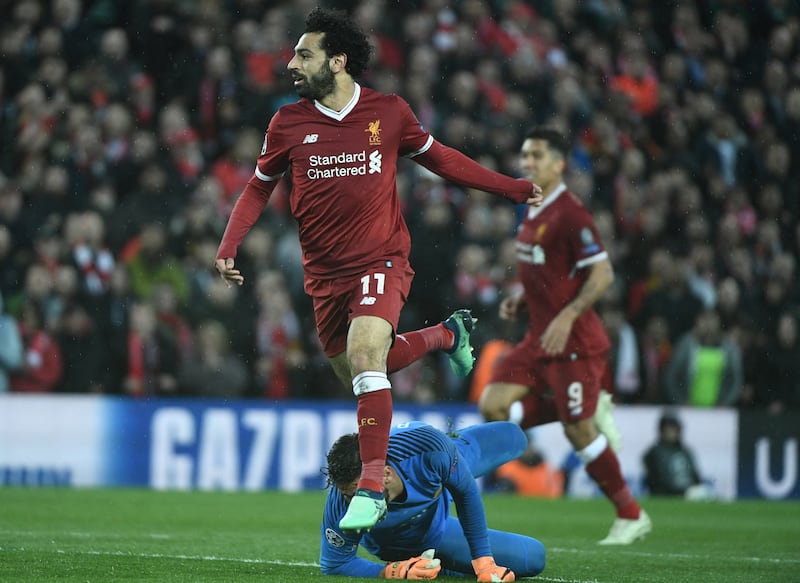 Mohamed Salah scores Liverpool’s second goal during a Champions League first leg semi-final against Roma in 2018. Photograph: Filippo Monteforte/Getty
Salah has reached the end abruptly, amid decline and anticlimax. It’s been a nightmare season in which he has fallen out with his coach, been dropped, lost probably his last chance to win an international tournament with his country, watched most of his last Champions League knock-out tie from the bench and been a pitiably reduced influence on the field − 29 league goals and 18 assists last season, seven and six this time.
It’s a long way from the heights he once scaled. If I think about the best individual displays I’ve been lucky enough to witness in person, I think first of a string of Lionel Messi performances at the 2022 World Cup.
But it’s not long before I think of Salah in the 2018 Champions League semi-final first-leg at Anfield against his former club Roma. He scored Liverpool’s first with a phenomenal jink and shot into the top corner, then 10 minutes later he ran through the middle on to a Firmino pass and casually chipped Alisson Becker from the edge of the box. In the second half he set up two more for Mané and Firmino. It felt that night like he could do anything.
This season it’s been said he has fallen off the age-cliff. But he is not noticeably slower or heavier than he was last season, when he was the Premier League’s top scorer, top assister and double Player of the Year.
Actually, the story of Salah’s stunning decline in his last season at Liverpool shows the extent to which football is a game played in the mind.
Salah appears in a current World Cup ad for Pepsi alongside David Beckham, Florian Wirtz, Gordon Ramsay and Vinicius Júnior. We can ignore the ad’s convoluted and ludicrous plot, but at one point a kid says: “Vini should be the ambassador of skill.” Another replies: “No way, Salah is the king of skill.” They argue – “Vini”, “Salah”, “Vini”, “Salah”.
It’s one of many irritating details of an ad that was evidently made by people who know nothing about the game. In terms of sheer skill – which most people would take to mean brilliance in one-on-one dribbling – there is no comparison between Vinicius Júnior and Salah. Vini is clearly streets ahead.
Vinicius Júnior ranks seventh in the top five leagues for completed dribbles per game, Salah is 354th. Even when Salah was fast he didn’t often beat a man one-on-one.
He’s never been a truly lethal finisher like Messi, Son Heung-Min or Harry Kane, who regularly outperform their xG (expected goals) every season. Salah was regularly around the top of the scoring charts not because he was the best finisher, but because he was the best at getting chances to score.
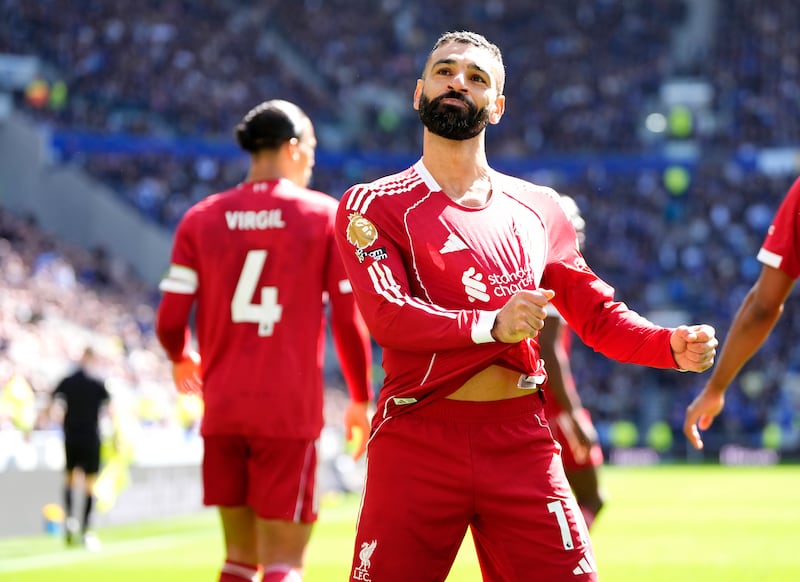 Mohamed Salah celebrates at Everton after scoring his 257th goal for Liverpool. Photograph: Nick Potts/PA
If he has consistently been a more influential and effective footballer than Vini, it’s because of his superior understanding of the game. He sees things before other players, a quality demonstrated by his 257th and probably last goal for Liverpool, which came against Everton last week. When Cody Gakpo wins possession on the far side Salah sees the chance immediately and is already running into the box before his marker, Vitaliy Mykolenko, has realised the danger.
With his vision of the game, his understanding of how to combine with team-mates and his ability to pick them out with passing that was often more consistent and accurate than his shooting, Salah had many of the same qualities people admired in Dennis Bergkamp. Indeed, his final total of league assists for Liverpool stands at 93, one fewer than Bergkamp in 10 more games. Because he scored more than twice as many league goals as Bergkamp, people have underrated him as a creator.
His top-scoring season for Liverpool was 2017-18, and 2019 saw the strongest Liverpool team of his era, but 2024-25 was his best season on a personal level. He was both the cutting edge and the creative inspiration of a team that looked up to him, pulling the strings in a style reminiscent of Messi in Qatar.
If 2024-25 showed us Salah playing with supreme clarity and focus, in 2025-26 we’ve seen the same player with a scrambled mind. Last summer brought drastic change. The shock of Diogo Jota’s sudden death was compounded by the departures of team-mates Salah had played well with and in some cases was close to personally, including Trent Alexander-Arnold, Luis Diaz, Darwin Nunez and Harvey Elliott. Remarkably, the senior player at the club suddenly seemed an outsider.
The signs of trouble were there from the Community Shield when he failed to link with his new team-mates or make himself relevant to the game. Denouncing the “disrespect” of fans who had described Florian Wirtz and Alexander Isak as “upgrades” on Diaz and Nunez was another ominous sign.
There ensued a collapse in form due to a crisis of confidence, a problem Arne Slot proved unable to deal with. When the coach eventually dropped Salah for poor performances, the player reacted with an angry outburst against him. From that point, it was only ever a matter of time until the confirmation that this would be his final season at Liverpool.
Slot’s handling of Salah was ham-fisted to the end. Picking the team for the Champions League quarter-final against Paris Saint-Germain, he should have recognised that Salah was more likely to contribute than the semi-fit Isak, and that he deserved to start. But Isak started, and Salah was denied a last chance to redeem the season.
He will be remembered as one of the best players to play for Liverpool long after Slot and all the bitterness of this season’s failure have faded into obscurity. Of all the players who have left Anfield in the last few years, Salah will be the hardest to replace.