
 Add as preferred source on Google
Fenway Sports Group have a cost control problem, not a revenue one, says football finance expert Kieran Maguire, discussing Liverpool’s controversial plan to hike ticket prices at Anfield.
Speaking exclusively to Rousing the Kop, the University of Liverpool academic pointed to soaring revenues across the Premier League, as well as even faster rising transfer and wage spending.
Liverpool spent £450m on signings last summer, most of whom are yet to hit the heights of which they are capable. Even accounting for the £200m or so of sales that the club made, it was still a huge outlay.
The club’s accounts for 2024-25, the last full season for which data is available, showed that Liverpool’s matchday income meanwhile was a club-record £116m, the fourth-highest in the division.
FSG are raising ticket prices – give us your views
Neccessary step or profiteering?
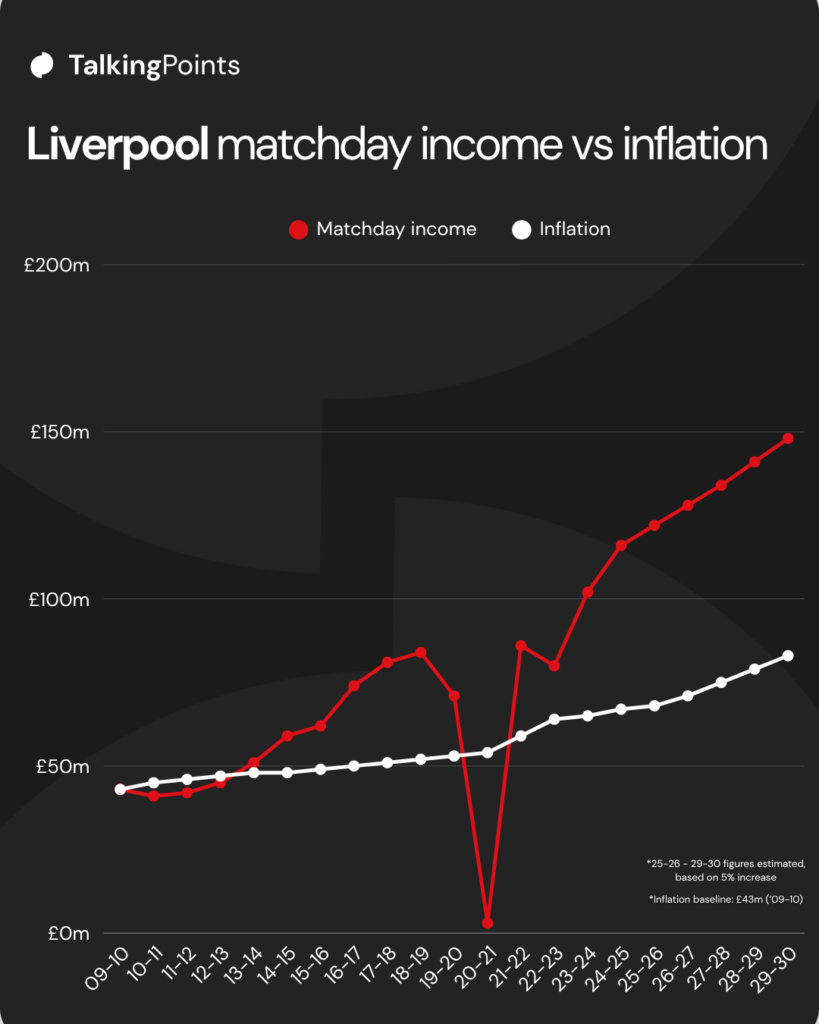 Liverpool matchday income vs inflation graphic
Credit: Adam Williams/GRV Media
FSG have invested hundreds of millions in expanding the Anfield Road and Main Stands. Aside from that money and investment in the training ground, however, the owners have rarely put money into the club.
Their decision to raise ticket prices in line with inflation – up to a maximum of five per cent annually – over the next three seasons is, they say, in keeping with their self-sufficient model of running the club, whereby whatever the club spends, it must first earn.
But the compounding effect of year-on-year rises during a cost of living crisis has provoked a backlash from bedrock supporters.
Spirit of Shankly plan further FSG protests; revenue isn’t the problem, says Kieran Maguire
Fan group Spirit of Shankly, whose representatives occupy 10 of 16 seats on Liverpool’s official Supporters Board, have organised protests that will continue when Arne Slot’s side host Crystal Palace on Saturday, where fans will ‘show FSG the yellow card’ with placards that warn ‘Anfield’s soul’ is at risk.
Liverpool’s wage bill was £428m at the last count, while their annual amortisation – which is how clubs account for transfer costs over players’ contract lengths – will be approaching £200m. Their revenue in the title-winning campaign meanwhile was £703m, the highest in England and fifth-highest in the world.
This, says Maguire, indicates that “the Premier League doesn’t have a revenue issue. Liverpool can’t use that as an excuse. What it really has is a cost control issue.
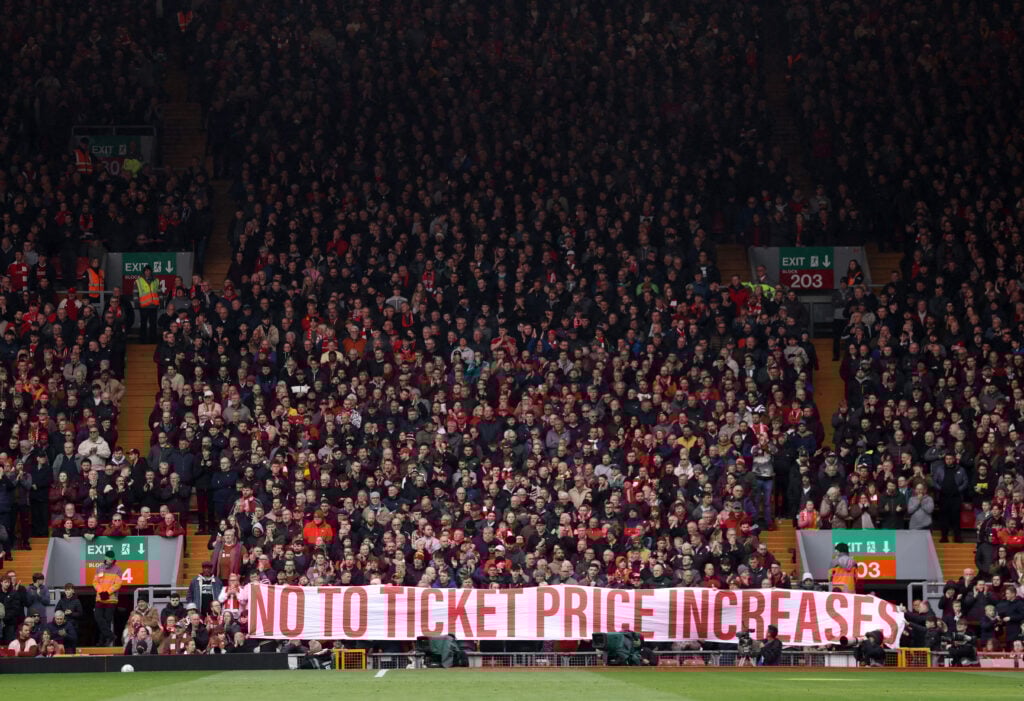 Photo by Carl Recine/Getty Images
“Revenue since it launched has gone up by 3,200 per cent, but wages have gone up by 4,300 per cent. That’s where the problem is. Transfer spending meanwhile is up by 4,500 per cent. There is a saying in finance: revenue is vanity, profit is sanity and cash is reality.
“The trouble with Liverpool is that their rivals aren’t small clubs, it’s the other big clubs in Europe, who are all increasing their prices. To be seen not to be following the herd is seen as a sign of weakness.
“So while Liverpool’s cost control is better than most, it’s a league-wide issue of cost control that they get dragged into. That’s the issue, not ticket prices.”
Join Our Newsletter
Receive a digest of our best Liverpool content each week direct to your mailbox