
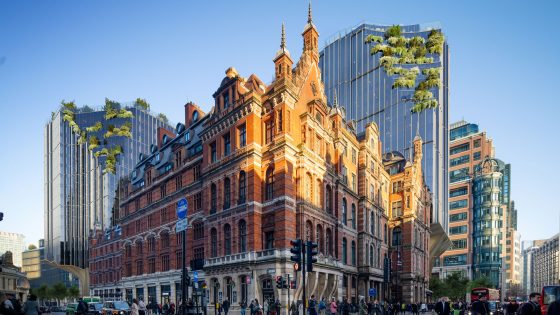
Plans to transform the station, adding a 19-storey overhead office development, were approved by the City of London in February despite thousands of objections, criticism from heritage groups, viability concerns, and a rival proposal.
Now, the Victorian Society, the Twentieth Century Society and SAVE Britain’s Heritage have urged the London mayor to call in the ACME scheme, which the AJ recently revealed was subject to a legal letter raising concerns about ACME’s procurement and the funding for the new designs.
Writing to the mayor, the heritage campaigners claimed the proposals risked ‘incurring additional unknown costs’.
The scheme was voted through by the City of London’s planning committee despite an alleged multimillion-pound black hole in Network Rail’s own financial viability assessment.
The letter argues that ACME’s designs would introduce harm to built heritage and cause a decade of unjustified disruption for commuters, while requiring a 97m-tall office tower over the concourse to fund around £500 million of improvements to the station.
Griff Rhys Jones, president of the Victorian Society, which is campaigning against the scheme, said: ‘Londoners do not want a vast office block plonked down on top of their beloved Liverpool Street Station, and the eye-watering harm it would cause.
‘The mayor has the power to ask for a less destructive and greener solution, and he should do so. We must all write to ask him to stop this planning application. On behalf of London and the railway capital of the world, the mayor must intercede. Make your feeling known.’
The society is leading the Liverpool Street Station Campaign (LISSCA), a group of mainly heritage bodies opposing major redevelopment of the terminus.
Last year, SAVE Britain’s Heritage and John McAslan + Partners – the architect behind the redevelopment of King’s Cross – unveiled an alternative scheme which, they claimed, would result in almost no demolition of the Grade II-listed 1990s station concourse.
The alternative vision, submitted to the City of London in February, proposed a nine-storey office which would hang from a lightweight steel arched frame and feature cross-laminated timber floors to float above the existing trainshed and platforms, the practice suggested.
McAslan claimed its low-carbon design, inspired by the station’s Victorian railway architecture, would cost ‘half the current £1.2 billion ACME scheme, take up two-thirds of the area, and take half the time to be delivered’, thanks to its anti-demolition and lightweight construction approach.
ACME defended its scheme and countered these claims in January.
The heritage lobby’s plea to the mayor comes after the AJ revealed that ‘serious concerns’, including about ACME’s appointment and the scheme’s funding, were raised in October 2024 by lawyers acting for Sellar and MTR – Network Rail’s one-time joint venture partners behind shelved redevelopment plans for the terminus drawn up by Herzog & de Meuron.
The letter from solicitor Herbert Smith Freehills also mentioned the rail body’s now former property boss, Robin Dobson, who left the company on 27 March to ‘pursue new opportunities’. The AJ has no evidence to suggest that Dobson’s departure was connected to ACME’s appointment.
As the AJ previously reported, Network Rail refused to answer a Freedom of Information request submitted by the joint venture partners in late 2024 seeking an explanation about how ACME’s service had been selected.
Asked about the allegations in the Sellar and MTR letter, a Network Rail spokesperson said: ‘A reply to Herbert Smith Freehills’ letter was provided in October 2024, responding to concerns made by Sellar and MTR Corporation at that time.’
A spokesperson for ACME subsequently said it had been appointed for works on the Liverpool Street planning application by Network Rail ‘via the LHC Framework’.
Lot 4 of this free-to-use framework – reserved for commercial and industrial projects valued above £10 million – is more usually employed for repair and maintenance of social housing. Architects on LHC Lot 4 include Karakusevic Carson Architects, Morris+Company, WilkinsonEyre and Panter Hudspith, as well as ACME.
The ACME spokesperson continued: ‘ACME has extensive experience of working on complex transport infrastructure projects, including rail.
‘In 2023, ACME was commissioned to review Liverpool Street station from an operational perspective, working closely with Network Rail, MTR and Sellar to ensure any planning application met the needs of the operational railway. This review was supported by all parties at the time.’
Network Rail was contacted about the call-in request.
Comments
James Hughes, director, the Victorian Society
This is a deeply flawed scheme. It proposes a high level of harm to a historic station and would set a staggering precedent, yet its delivery is uncertain and the claimed public benefits are therefore speculative.
In those circumstances, the harm cannot be justified – particularly when less damaging alternatives have not been properly assessed. The mayor now has a clear opportunity to step in and refuse it. London deserves better, and it is in his power to ensure that.
Henrietta Billings, director, SAVE Britain’s Heritage
We’re asking Sir Sadiq to put the brakes on the current proposal because of the unjustifiable damage and disruption it would cause to this crucial gateway to the city.
Station improvements are essential, but there is a less disruptive alternative worthy of a world-class city. The mayor has an opportunity to course correct and create a legacy of which all Londoners can be proud.