
The recent £6.5m funding commitment to the West London Orbital (WLO) scheme is set to unlock major housing development sites and opportunity areas, as populations along its corridor are projected to grow by 20 per cent over the next 15 years.
Transport for London (TfL) and four councils – including Brent – are hoping the investment will allow the public consultation on the WLO to open this summer, leading to a final decision by the end of 2027.
Brent Council has been campaigning for both the Government and TfL to allocate funding for the WLO project, calling transport infrastructure “the biggest driver of prosperity” across London and the difference between “opportunity and being left behind”.
One area that is set to be transformed over the coming years is Neasden, a corner of Brent the council acknowledges has been “overlooked for too long”. There is hope that the WLO will be the catalyst for a wave of development across the ward – including town centre improvements, thousands of new homes, and more student accommodation.
The WLO is a proposed new railway line. It is also fundamentally a “transport-led growth scheme” that will enable major developments to be brought forward “at scale”, according to Brent Council. If given the go ahead, it would utilise railway lines that are currently used for freight only, to become part of the London Overground network, serving customers in Brent, Barnet, Ealing and Hounslow.
The route would run from Hendon in the north to Hounslow in the south, through Brent Cross, Harlesden and Neasden, Old Oak Common, Acton and Brentford – providing new stations on the Dudding Hill line, as well as additional platforms and facilities at other existing stations along the route. The WLO will link up with the HS2 at Old Oak Common in Ealing, with up to six trains an hour running along the line.
TfL’s West London Tracker has calculated that the scheme has the potential to support up to 29,000 homes. With the population in its corridor projected to grow by 82,000 people by 2041, the WLO is set to provide the transport capacity needed to unlock a number of key development sites that are currently “constrained by a lack of orbital connectivity, limiting housing density and delivery”, Brent Council has said.
Over the coming months, Brent Council will be commissioning more up-to-date evidence to help strengthen the business case in terms of housing, jobs, and growth impacts – which will be followed by a public consultation beginning this summer. If funding and approvals are agreed, services could start in the 2030s.
Part of the council’s case to support the scheme will involve a number of key developments in Brent. These include housing projects at Dudden Hill and Neasden Goods Yard, as well as the civic partnership programme in the town centre.
First approved in December 2024, the Dudden Hill site is currently occupied by the College of North West London – a further education college which comprises a number of buildings. However, rising construction costs have delayed the development timeline but the implementation of the WLO would provide a stronger business case.
Plans show that the campus would be transformed to deliver 1,627 new homes – of which 18.1 per cent would be affordable – shops, a gym and nursery, as well as improvements to public green spaces on Dudden Hill Green and Selbie Avenue.
It would be completed in two phases, with Phase 1 seeing the delivery of 1,076 homes – of which 69 would be available at social rent – in 11 blocks ranging from four to 28 storeys, alongside the development of the gym, convenience store and a new central neighbourhood park.
Phase 2 will see the construction of a further 551 homes – 35.8 per cent of which would be affordable housing – in 11 blocks ranging from four to 17 storeys, as well as a new community centre, nursery, and additional commercial space.
The development would be entirely car free – apart from Blue Badge parking – and be a short walk from the proposed future West London Orbital station at Neasden. The project would also facilitate a £750,000 contribution towards local bus network improvements, as well as the delivery of a new permanent college site on Olympic Way in Wembley.
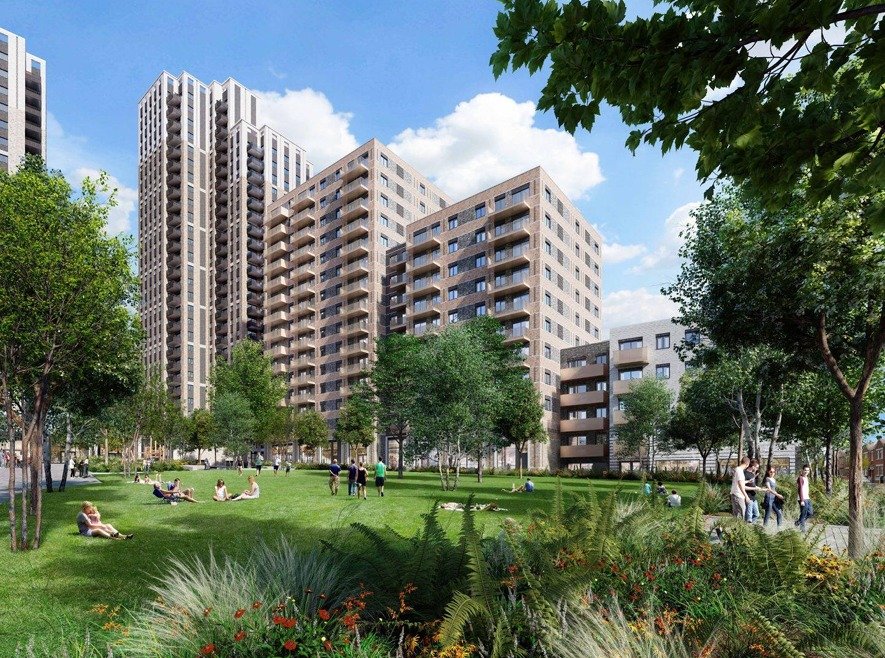 College Of North West London Development. The re-development of the College of North West London site is set to deliver 1,627 new homes. Image Credit: GRID Architects. Permission to use with all LDRS partners
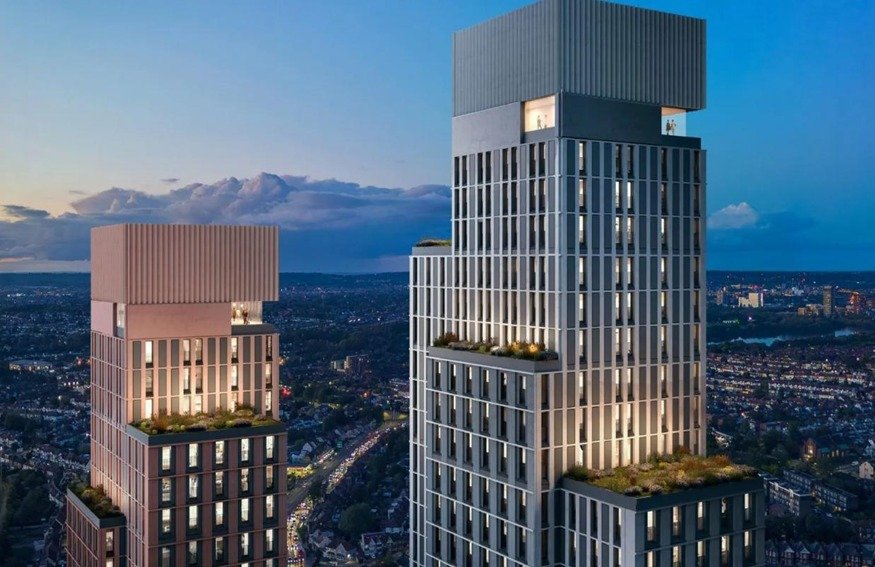
Late last year, property developers Hollybrook resubmitted plans to develop the Neasden Goods Yard site, which is situated next to Neasden Underground Station. Located in the designated Tall Building Zone, it currently comprises industrial uses, waste processing facilities and other buildings.
The plans involve demolishing the existing site to build a mixed-development including seven new tower blocks for more than 1,000 homes and in excess of 600 student rooms, alongside shops, restaurants, and a new community centre. The buildings will range from five to 45 storeys, making it the tallest residential development in the borough.
Of the total 1,151 homes proposed on the site, 161 would be available at affordable rent – with 105 at social rent and 56 at intermediate rent.
Planning documents also outline improvements that would be made to the “accessibility and capacity” of the nearby Neasden Station, which sits on the Jubilee line. Land at the southern end of the site would also be safeguarded for the delivery of a future West London Orbital rail station. A footpath connecting the two stations is suggested as part of the scheme.
The Neasden Civic Partnership Programme (NCPP) focuses on Neasden Town Centre, which is located in an area “in need of regeneration and designated for growth”, according to the council. The vision is to revitalise Neasden Town Centre and create better links with neighbouring communities and surrounding developments.
Early last year, the council revealed plans for a £10.5 million makeover of Neasden as it prepares for thousands of new people moving to the area. The changes put forward include an ‘urban food court’, a ‘lighthouse’ pavilion, and permanent street market, as well as ‘pocket forests’ and more security measures to tackle crime and antisocial behaviour.
The Neasden Forum, established in May last year, meets monthly to ensure local stakeholders are actively involved throughout the project.
Using grant funding from the Mayor of London, alongside council Community Infrastructure Levy (CIL) money, the programme will deliver public space, community, and highway improvements over the next four years. The council has said the works are “on track” to meet this timetable.
Using currently underused space in the town centre, one of the proposals is to create The Ritz urban rooms and kitchen comprising a new multicultural food court and training kitchens on the ground floor, with workspaces, a gym, therapy rooms and podcast studios on the upper floors.
Longer-term, the council is looking at the possibility of using the roof to either host a small garden with beehives or a place for outdoor yoga during the warmer months.
Further community space would be available for skills and training workshops used by local groups, as well as a community garden where residents can get horticultural training and education.
Another design proposed is The Lighthouse – a demountable, multi-functioned beacon to “celebrate community and culture”. Set to be built within the town centre car park, the tall, brightly coloured building is expected to be an “identifiable landmark and gateway for Neasden Town Centre”.
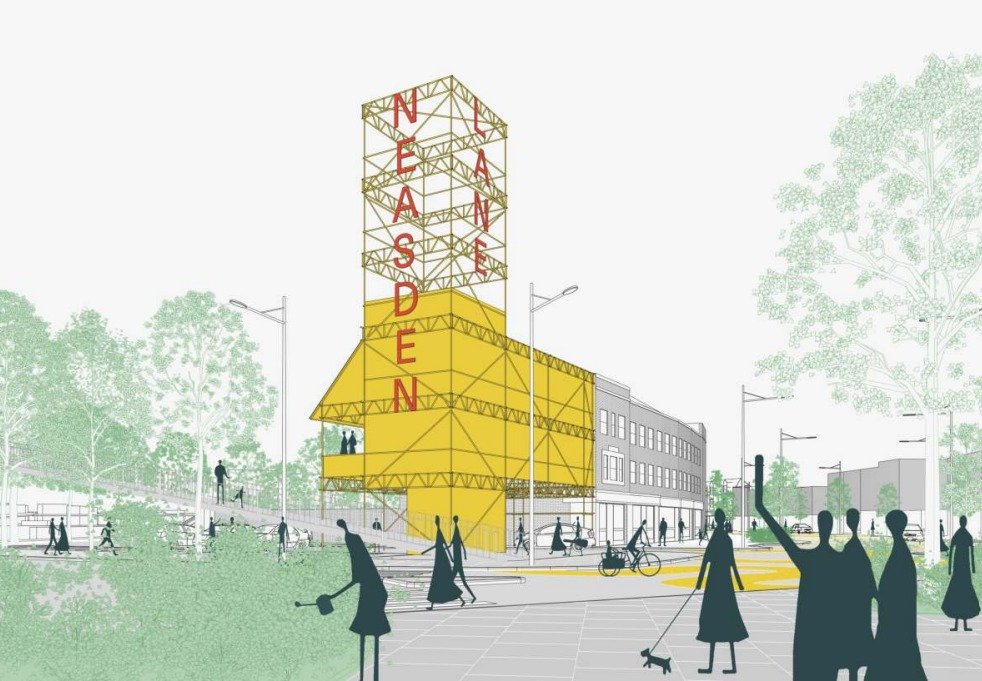 Neasden Town Centre plans, The Lighthouse. The demountable structure is designed to be a multi-functioned beacon to ‘celebrate community and culture’. Image Credit: Brent Council. Permission to use with all LDRS partners.
Brent Council Leader, Cllr Muhammed Butt said: “Neasden is changing, and it needs to change. It cannot be right that the area around a Jubilee line station just minutes from Central London has altered so little, while Wembley by contrast has been transformed.
“We have a real chance to fix the fundamentals in Neasden through the Civic Partnership, working with residents and businesses to create a better town centre, support state of the art new education facilities with the College of North West London, and better connect this part of Brent to the huge opportunities coming with Old Oak Common and HS2 through a future West London Orbital station at Neasden.
“My view is simple: we should set our sights high for Neasden. This corner of London has been overlooked for too long, and now we have the chance to put it on the map for good.”
📩

Get the latest breaking news, roadworks, crime updates and local events straight to your inbox – totally free, every day.
SIGN UP below