
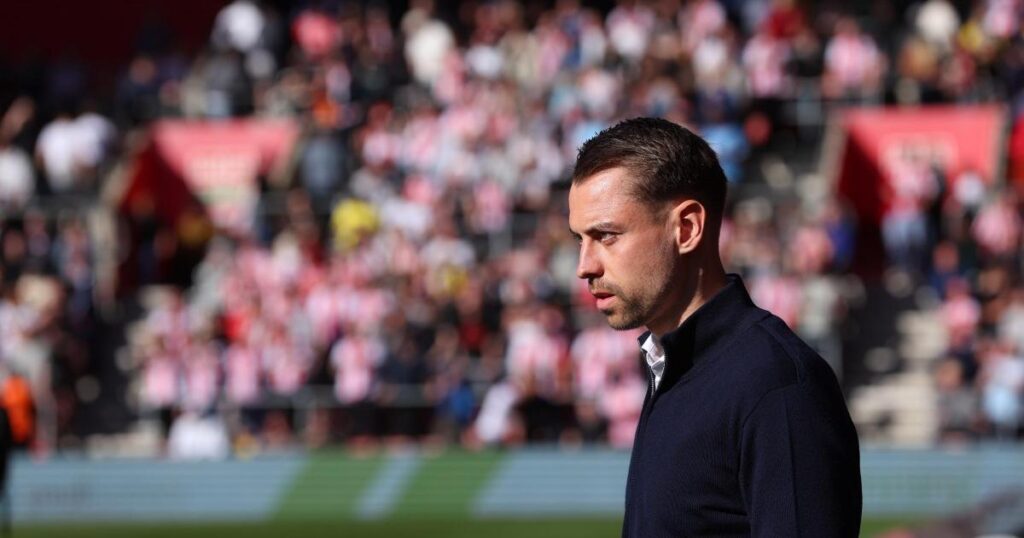
“Clarity,” insisted the Irishman, speaking to ITV from the pitchside.
It was only about an hour later when Saints were two goals up against Oxford United, and on course for a third clean sheet win in five matches.
Saints have actually only conceded one goal from open play in nine outings, since the chaotic 4-3 comeback win over Leicester City on February 10.
And if you take that Leicester game out of the equation, you have to go back to January 17 to find a concession from anything other than a set piece.
It is a remarkable run of results, when you consider that many externally felt Eckert was on the brink of the sack heading to Portsmouth.
It is why Eckert was manager of the month for February and will be again for March, though he seemed keen to ignore the award’s existence altogether.
Supporters noticed that the obligatory winners’ photograph spotlighted Eckert’s entire staff, including assistant Ben Garner, who arrived in January.
“It is a nice appreciation, but it doesn’t mean anything to us. We need to make sure that the end of the season is a good one for us,” he said.
Tonda Eckert pictured with his full Saints staff (Image: Southampton FC)
If we learned anything from the last four years at St Mary’s, it is that the need for clarity must not be underestimated. It has not always been there.
Sport Republic’s stewardship of the club since January 2022 can ultimately be summed up as lurching from one direction to another in desperation.
It is most easily visible as changes in the style of play and the supporting cast in the dugout, but they are often symptoms of technical-level changes above.
When Eckert took over in November, players began eulogising about the level of detail the interim boss would go into in his pre-match planning.
Eckert was eating three meals a day at Staplewood, and he still brings a pamphlet of tactical detail on the opposition to every press conference.
He held constant conversations with players, which was understandably a source of frustration when they were six games winless over Christmas.
But that is the kind of detail required to go into a three-game week in the Championship and play in three different formations, and win them all.
“Every game is different,” said Eckert. “There are some games that you need to win on the ball, and there are some that you need to win defending.
Tonda Eckert has worked with individual players like Finn Azaz (Image: Stuart Martin)
“I see that this league demands you be able to win games in different manners. I think sometimes teams struggle if they think it’s only one way.”
While the midweek win over Norwich was a slog, Eckert’s midfield nullified Matt Grimes at Coventry, and Tom Fellows unlocked Oxford immediately.
Eckert also demonstrated his tactical flexibility – and the buy-in he has with the players – in the 1-0 win at Premier League Fulham in the FA Cup.
Saints held 32 per cent possession and made the fewest passes in a game since Simon Rusk’s spell, but butchered Marco Silva’s side on the counter.
Conventional football wisdom warns managers against tinkering with a winning team, but unconventional does not necessarily mean not rational.
Eckert studied his UEFA Pro License in Italy, and he has made references to the infamous style of play. His first two wins at Genoa were both 1-0.
“They score a goal, and then it just becomes a fortress,” he said.
Tonda Eckert alongside coaches Jeremy Newton and Ryan Flood (Image: Joe Giddens)
So while he has assisted three bosses who won the World Cup as players, it is no surprise that a voice in Eckert’s head asks him to stifle the opposition.
He tells his players to manipulate the tempo of games, and placing advertising boards around the pitch to limit Oxford’s throws speaks for itself.
He’s hot on the ground staff to cultivate a near-perfect playing surface, and he praises them publicly for it. In fact, everything Eckert says is calculated.
On the fitness of his players, he will only say what he wants the opposition to know, and he has not criticised a single player by name during his tenure.
Despite not playing professionally himself, Eckert seems to have a grasp on how footballers tick. This is his sixth season in a senior dressing room.
From the start, he placed responsibility on everyone at Staplewood – especially security, the first people players see on arrival – to lift the mood.
He does not speak too much at half-time, letting the players lead, and he consults Ben Reeves, who did play professionally, on in-game substitutions.
Eckert has placed trust in the likes of Cam Bragg, energising and inspiring the group, while he pushed for Saints to sign real men with life experience.
Cam Bragg was Tonda Eckert’s captain in the under-21s (Image: Stuart Martin)
Eckert’s approach extends off-pitch, including bringing sporting neuroscience experts, Neuro11, into training, as we reported in December.
They strapped electrodes to Ryan Manning’s head and analysed his free-kick run-up to produce a science-backed best practice, amongst others.
And Eckert, working with the club’s sports performance expert Mark Bitcon, pushed for the help of sport & exercise psychologist Dr Andrea Furst.
“The manager’s done so well with everyone,” said Shea Charles. “I think the team’s just gelled so well now, and we’ve hit form at the perfect time.”
A lot of what Eckert has done is simple. Reintroduce James Bree, ditch five-at-the-back, play a big striker, and, of course, he has a better goalkeeper.
But the young coach’s all-encompassing approach shows maturity beyond his years. Remember, he is only 33, and this is his first management gig.
It is no surprise that some reporters in Germany are already touting Eckert for a Bundesliga job, but he has to continue to prove himself here first.
“You pay the bill at the end,” he usually says, probably imagining sliding his card to the waiter in one of the Winchester steakhouses he frequents.
The odds are still stacked against Saints, but clarity has turned to confidence, and Eckert has everyone believing that it can become celebration.