
FA Publish Written Reasons For Davis Ban
Monday, 23rd Mar 2026 11:59
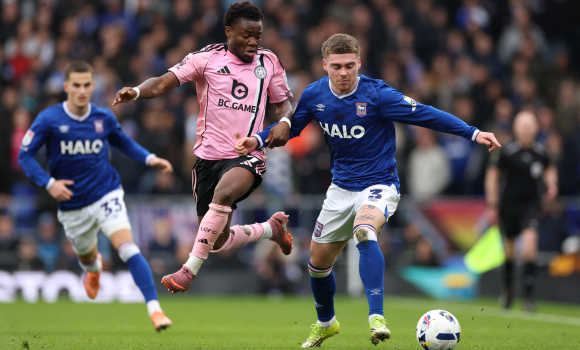
The FA has published the written reasons relating to Leif Davis’s three-match ban for violent conduct.
Davis was suspended for a hair pull on Leicester City defender Caleb Okoli having been charged after referee John Busby, who had been booed off at the end of the match having failed to award the Blues a blatant injury time penalty, had emailed the FA.
The left-back accepted the charge but both he and the club felt the three-game censure was excessive, however, the length of the ban was upheld by an independent FA regulatory commission made up of chairman Udo Onwere, a former player and now lawyer, ex-referee Stephen Bennett and ex-central defender Clarke Carlisle.
The written reasons read: “The referee emailed the FA on 10th March asking that the incident be reviewed, he wrote, inter alia, ‘Ipswich Town number three [Davis] and Leicester City number five [Okoli] at the far post compete in an aerial challenge. In challenging for the ball Ipswich Town number three can be seen to grab the hair of Leicester City number five… This was not witnessed on the day by any match official.’
“Having reviewed the available footage the FA proceeded to investigate the allegation that [Davis] had acted in a violent manner towards [Okoli] by pulling his hair when challenging from the incoming ball from a corner.
“The FA sought the retrospective opinions of three former referees as to how they would have dealt with the actions of [Davis] had they witnessed the incident.
“All three of the former referees [Eddie Wolstenholme, Michael Mullarkey and Alan Wiley] stated that they would have dismissed [Davis] for violent conduct had the referee witnessed the incident in question.”
Town responded through their general counsel, Laura McCallum, who said that “the charge was admitted” but that “the standard punishment of a three-match suspension was clearly excessive” and provided submissions regarding that point.
Davis himself replied on 11th March admitting the charge but outlining mitigating factors and reiterating Town’s position that the three-game ban was excessive.
The independent regulatory commission hearing took place on Thursday 12th March on Microsoft Teams.
“The commission viewed the footage of the incident on many occasions,” the written reasons continue. “It was very clear from the footage that in order to gain an advantage over his opponent, [Davis] pulled his opponent’s hair.
“The commission concluded that the pull on the opponent’s hair was made with considerable force. The commission also noted that there has been a growing prevalence of this type of hair-pulling offence in recent seasons and the applicable punishment has consistently been a three-match suspension for a red card offence of violent conduct.
“This incident fell squarely into that category and, if anything, it was at the more egregious end of the spectrum relating to this type of challenge.
“The commission were very careful in considering the context of this challenge and the actions of [Davis] at the time of the alleged incident and the surrounding points raised by ITFC.
“Indeed, the Commission carefully considered the surrounding points raised by ITFC and, in summary, considered ITFC’s position (where they stated that the circumstances of the challenge were truly exceptional and that the standard three-match suspension was clearly excessive) as follows:
“The level of force used’ – the level of force used was not considered to be negligible. In fact, the force used was aggressive enough to force [Okoli]’s head to jolt backward and was an invasive act upon [Okoli]’s personal space.
“The prevalence of the type of incident in question in football generally’ – as already outlined the commission recognised several recent incidents of this nature that have occurred. Examples include Michael Keane (Everton v Wolves), Alfie May (Huddersfield Town v Luton) and Jack Diamond (Stockport County v Huddersfield Town).
“The wider interests of football in applying consistent punishments for dismissal offences – the commission understood that each of the three examples given above resulted in the standard punishment of a three-match suspension.
“The commission agreed that [Davis]’s challenge was of a similar nature (if not slightly more forceful) to the aforementioned incidents and, as such, required a consistent approach to the level of punishment for the wider interests of football.
“ITFC also put forward submissions that suggested the truly exceptional nature of this incident was shown through the referee’s retrospective analysis of the match. ITFC stated that it was not appropriate to ‘re-referee’ a match after it had concluded (ie by watching the match footage afterwards) and that seeking to take retrospective action against [Davis] was unnecessary.
“The commission did not agree with this point and were inclined to follow the established approach adopted by the FA to retrospectively review ‘not seen’ incidents of violent conduct.
“This incident was characterised as violent conduct and so it was entirely necessary to review the incident retrospectively. The commission were also persuaded by the views of the three former top level officials who were unanimous in their decision.
“The commission also noted [Davis]’s good disciplinary record, however, it did not find that the submissions made by ITFC provided sufficient evidence that the standard three-match suspension should be disapplied.
“Turning to the personal statement provided by [Davis], the commission did not find his mitigatory explanation to be persuasive. [Davis] stated, ‘I remember raising my left arm to propel me upwards and to put myself in a good position to compete with Okoli in the aerial challenge as he is much taller than me.
“‘At no point did I intend to be reckless with my challenge or negligent in any way. However, I recall making contact with Okoli’s shoulder and the back of his head with my outstretched arm. I remember that I headed the ball clear and away from our box.
“‘Having reviewed the footage sent by the FA, I accept that I did pull Okoli’s hair, however, it was never my intention to pull his hair and I don’t know why I did that.
“‘I want to make it clear that the contact I made with the back of Okoli’s head was completely accidental and, as set out above, I wish to apologise for my actions. Given the speed, physicality, and close-quarters nature of defending the box during a corner, making some form of contact is common and often unavoidable.
“‘On this occasion, because of how quickly the moment unfolded, I unintentionally caught the back of his head. I want to stress again that it was never my intention to pull Okoli’s hair and I sincerely regret that this happened.’
“Whilst the commission were appreciative of [Davis]’s explanation, it did not find that this statement provided them with compelling evidence that the standard three-match suspension should be disapplied.
“Therefore, the commission, having regard to all the submissions and regulations, concluded that the standard punishment was applicable and there was nothing in this incident that could be regarded as being truly exceptional which would render a three-match suspension as clearly excessive.”
The Blues were not granted any provision to appeal against the ban, which saw Davis miss the games at Sheffield Wednesday and Millwall, as well as the Birmingham match after the international break.
Both manager Kieran McKenna and chairman and CEO Mark Ashton have made their frustrations and anger at the decision plain.
Photo: Action Images
Please report offensive, libellous or inappropriate posts by using the links provided.