
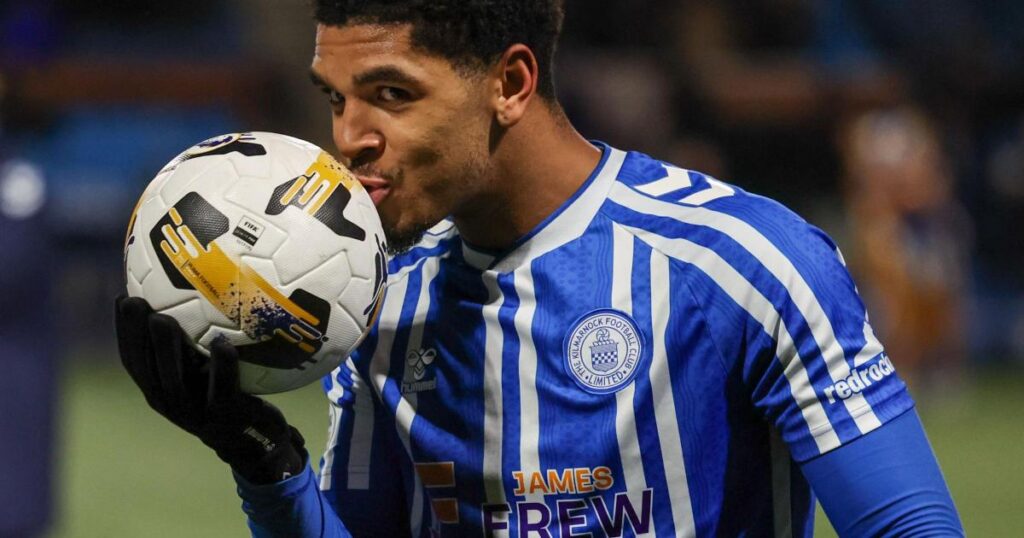
That is why Celtic recruited him in the first place. But at Rugby Park, another Arsenal alumnus was showing just why Kilmarnock plucked him from the footballing wilderness back in October and gave him a platform to get his once hugely promising career back on track, as a rejuvenated Tyreece John-Jules scored three times for his side in a potentially pivotal 4-3 win over St Mirren.
“It was a bit emotional actually,” said John-Jules.
“I’ve had a lot of injuries, so to get back doing what I love, scoring goals and feeling good, it was a lot for me. It was a great night for everyone involved.”
To understand how John-Jules, once deemed one of the brightest talents in the Arsenal youth set-up – he was tipped by then Blackpool manager Michael Appleton as ‘a future Arsenal number nine’ while out on loan at the club – came to be in Ayrshire at all, it is worth revisiting those early days of his footballing journey, which he strode in lockstep with the likes of Bukayo Saka, still a close friend to this day.
“I joined Arsenal at eight,” he said.
“When you’re that age, you just want to play and enjoy football. You don’t really take it in; you’re not thinking, ‘I’m playing for Arsenal.’ You’re just playing and running around and enjoying it.
“I’m from a footballing family, so everyone’s always been supportive of me. Growing up at Arsenal was always a great help.
“My mum and dad both pushed me from young. My dad played football, not at a high level, but he’s always played. My mum loves football as well. They pushed me, taking me to training and finishing work early so they could take me. You want to repay your family for all the sacrifice they had to make.
“Throughout my whole life, I wanted to become a footballer; I’ve always had that dream. Making a living out of it is very fortunate because so many people don’t become professional footballers.
“The fact that I’m able to do that and make my family proud is amazing to me.”
It is a mature outlook from the 24-year-old, who holds no resentment that he has yet to scale the heights that his pal Saka has managed, counting himself fortunate to still be drawing a wage from the professional game at all. At least part of the explanation for which will soon become apparent, given the ill fortune that has befallen him along the way.
“When you’re going through the ranks at Arsenal, you’re playing with the same guys every year and you create good bonds,” he said.
“But then you also see people go and people stay. When you see people get released, you start to think that, ‘this is getting cut-throat’, around the under 14s or under 15s. Especially under 16s, people get scholars [contracts], some get released, and some get pros. It’s really character-building. To know that you’re fortunate enough to get a scholar or pro is when you really start to believe that you can actually make a living out of it.
“It’s a very brutal industry. When you’re young, you don’t know what’s coming ahead. When lads get their first setback and get released, it can hit them hard.
“Football’s definitely a mental game as well, it can be so tough.”
Having managed to prove himself though throughout various stages of the Hale End Hunger Games, John-Jules was rewarded with priceless experiences as a young Arsenal hopeful, working under some of the most storied names in the history of the club, and indeed, the game.
Read more:
“Yeah, I had Thierry Henry for a few sessions when he was doing his coaching at Arsenal,” he said.
“You could see the knowledge and the quality. Even in training, he would do some things and you’re like ‘Wow.’ You can see the class straight away.
“You try to take as much advice from those top players who have done it in the game. It was a great experience. I think I would have been about 14 or 15 at the time.
“As soon as you see him you freeze because you’re thinking ‘Is that Thierry Henry right in front of me?’ Everyone was taking pictures. My dad took a picture with him too actually. It was a great experience for sure.
“You want to learn as much as you can from a player like that. I watched him when I was growing up; he’s one of my idols to this day. It was a crazy experience.
“Then Freddie Ljungberg was my under 23s coach when I was about 17 or 18. We had a good relationship and got on well.
“Again, with the career he had, you just want to listen to everything he says and try to take it on board. I’ll always be thankful for him; I learned a lot under him.”
Ljungberg was a major advocate for John-Jules in these early stages of his career, immediately promoting him into the under-23 set-up despite his tender years, and speaking warmly of him on many occasions.
“TJ has always been a very good football player and we’re trying to use him a little bit more in play,” Ljungberg said back in 2019.
“He comes a little bit deeper and he’s becoming more involved in the game. We’re using his strengths and he gets the goals as well, so it’s really good.”
Traits that Kilmarnock fans may well be recognising now in his game. Back then, though, it appeared that his path to the Arsenal first team was set fair.
“At Arsenal, you would train with the first team sometimes, playing against them for tactical stuff for example, but my first proper sniff with the first team was a mid-season camp to Dubai,” he said.
“I was chosen to go and played against a team there. I came on for the first time and got a goal. That’s when my career started to go to another level. I started getting a lot of recognition.
“From then, I went onto the pre-season tours, and I was on the bench a few times in the Europa League and the Premier League. It was always nice to be involved. You want to impress the manager you’re playing under and try to get to the top.
“When Unai Emery was the head gaffer, he was a very good coach and a good tactician. He likes to push the youngsters. Bukayo, Emile Smith Rowe, and Reiss Nelson all came through under Unai. He showed that he likes to trust the youth. It was a good experience for sure.”
The next step was to leave the comfort zone of academy football, and see if he could mix it with men in the English Football League. The first stop was Lincoln City.
“That was a definite eye-opener,” he said.
“Going from under 23s football to men’s football, there was definitely a gap.
“I was only 18, so I was a young boy going into men’s football. It was a different experience being in the men’s changing room, training at that intensity every day, and playing in front of that many fans. It’s built me for the challenges I have today.
“You’re going into duels and you’re thinking ‘can I handle myself?’ You’re not playing against 18 or 19-year-olds, you’re playing against men.
“You go into an environment not knowing what it actually means to some guys who are playing for their mortgages and new contracts. You’re just coming in at 18 and you’re learning. You’ve got to get used to that atmosphere quickly, so you don’t feel out of place.
“That was the COVID year though, so it got cut short, and that was tough.”
Still, the slow progression through the levels on his roadmap to the top looked to be plotted out.
“I had a couple of good seasons at Doncaster, Ipswich, Derby, and Blackpool,” he said.
“The more you go on loan, the more you start to realise what it takes to be a professional footballer in the men’s game.
“You get used to the gameplay, the intensity of training and matches, and playing in front of crowds and pressure. It’s good as a young player to get men’s minutes if you can.
“I’d been playing under 23s since I was 16. Two years later I was still playing under 23s, so I just wanted to test myself in that next step in the men’s game. It was definitely in my mind that I wanted to test myself.
“I was scared at first because I didn’t know what to expect, but the more loans and the longer you’re there, you start to get used to it.”
Along the way though, he hit a few bumps. And major ones at that. Enough in fact to ultimately knock him a little off the course he had been following since the age of eight.
“Every season after the first loan, I had quite a few big injuries,” he explained.
“Ipswich was my first major injury where I had to have surgery [for a hamstring issue]. Then the season after, I had to have another surgery on my other hamstring. There’s a point where you start to think ‘What’s going on?’ but I just kept faith and kept praying.
“For sure though, the mental side of being injured is really tough. People who have had long injuries will tell you that it does feel lonely sometimes. People are out training while you’re in the gym on your own trying to get back to fitness. It was especially hard when I didn’t have a club and I was alone trying to work hard on myself, it was quite tough.
“You’ve got to remember why you do it and what you’re doing it for. Set yourself some goals for when you get back. That’s what kept me going and motivated, along with my family.”
Ultimately, though, his dream of becoming the Arsenal number nine he had been tipped to be had to be put on hold, admitting that his release from the club in the summer of 2024 after more than 15 years was hard to swallow.
Luckily, he had a strong support network, including the players he had come through the ranks alongside, most of whom – barring Saka, of course – have had to plough a path away from the Emirates.
“Of course it was tough,” he said.
“Arsenal was a home to me; I’d been there since 2008 until I was 23. It’s all I ever knew, it was comfort.
“To finally leave the nest was tough, but I knew what I wanted to do and that I had to leave to take a step back so then I can possibly take a few steps forward in the future and keep playing to get back to that level.
“I am still friends with a lot of the guys I came through with like Trae Coyle, James Olayinka, Zech Medley, Matt Smith, and Bukayo. All these guys I’ve grown up with from eight years old and we’ve made it all the way to 22 or 23.
“It’s nice to have lifetime friends growing up and playing together for so many years. To see them kick on as well is nice to see.
“I’m quite close with a lot of them still. They’re some of my closest friends from eight until now. It’s always nice to see them do well.
“We always speak to each other, congratulate each other when we’re doing well and pick each other up when we’re not doing so well.”
He leaned on that support again after his release from Crawley Town last May, and finding himself working alone to stay fit as he waited for the phone to ring. Eventually, it would be Killie that would come calling in late October, and the move is seemingly working out as being highly beneficial to all parties.
A short term deal was struck, which was quickly extended to the summer, and he is hoping he may be able to earn a longer contract before too long.
“It all happened very quickly,” he said.
“I was at home and I got a message from my agent telling me that Kilmarnock had a friendly against Newcastle and they wanted me to come down for a little trial. The next day, I took a train to Newcastle and played 45 minutes. We ended up winning and I got an assist. It turned out to be a good decision.
“Because of those bad injuries and missed a lot of games throughout my career so far. But I’m starting to feel like my old self and I’m praying that the injuries are left in the past.
“I’ve been doing a lot of work over the last two years focusing on my body. I’m praying that my body holds up so I can keep doing what I can to stay fit. I’ve always had belief in my ability, and I know what I can do on the pitch.
“As long as I can keep showing people what I can do while staying fit, I think I’ll stand a good chance.
“I’m forever grateful to be given the opportunity to play for such a big club in Scotland. I was a free agent in the summer doing a lot of training on my own and camps. For Kilmarnock to take the risk on me, I’ll forever be grateful and I’m just trying to pay them back.”
He has certainly started to do just that. He admits that playing under three different managers in as many months in the form of Stuart Kettlewell, interim boss Kris Doolan and new manager Neil McCann has been a challenge, but he feels as though the former Hearts, Rangers and Scotland winger is bringing the best out of him.
McCann had warm words for John-Jules’s contribution to his side’s midweek win, not only for the goals he plundered, but for the work he put in for the cause, something he said the striker had to up when he first came into the club.
“There’s no hiding place at all these days!” he laughed.
“They’ve got all the numbers on a spreadsheet and he showed me them. It’s all good; that’s what you’ve got to do to help the team and yourself.
“When the gaffer came in, he pulled me into a meeting and told me exactly that. He knew that if I did work a little harder, the next part would come. It’s happening now. I’m doing well with my numbers and fitness-wise, and the goals are starting to come too.
“Coming back from injury, sometimes you’re a bit wary of your body. I’m starting to feel better and more confident in my body, so I’m able to push that extra step further.
“As soon as he came in, he changed the feel about the place. There was an energy shift for sure. He came in with such positive energy and told us that he believes we’ll get out of it. He’s going to help us and give us everything we need.
“Everyone just bought in straight away.”
It isn’t just about hard graft though, with John-Jules appreciative of the fact his new manager places a greater emphasis on getting the ball on the deck and playing than some of his predecessors may have done.
“You could see in training that he wanted to play a different style which is appealing to everyone to play more football,” he said.
“For me personally, I like to get the ball on the floor and try to make something happen, bring people into play, and score some goals.
“Playing good passing football gives you an advantage if you believe in each other. Growing up at Arsenal, that’s all I’ve ever knew. For Neil to come in and implement that definitely suits my game.
“Since he’s come in, everyone’s bought in and we’ve been getting better results and performances.
“We’ve just got to keep going and trust in what the gaffer says.”
Which brings us to the here and now, and a full circle moment for John-Jules as he prepares to line up against a man he once idolised, and who he will be looking to upstage as he plots a new, circuitous route back to where it was once said he was destined to be.
“Funnily enough, when I was about 12, I had the same barber as Oxlade-Chamberlain,” John-Jules remembered.
“I was a kid at Arsenal, and he was in the first team. My barber took me to a game to watch Arsenal and Oxlade-Chamberlain had a box, and he surprised me by letting me go into his box to watch the game.
“I met him after the game and got a little picture and stuff. I don’t know if he remembers that! But it was a great experience and a great memory for me.”
Maybe tomorrow, John-Jules will produce something that Oxlade-Chamberlain, and Celtic, are unlikely to soon forget.