
It was the news that many expected — Sean Dyche had been dismissed from his duties at Nottingham Forest in the early hours of Thursday morning.
Just 18 league games into Dyche’s tenure, owner Evangelos Marinakis has brought the sword down on his third manager of the campaign before winter turns to spring. Forest are in talks with the former Wolverhampton Wanderers boss Vitor Pereira, leaving the club in an unprecedented situation of having four managers in the dugout within a single Premier League season.
The closest comparison to such chaos in recent memory is Leeds United’s last relegation season in 2022-23. Starting the campaign with Jesse Marsch until February, Michael Skubala had a brief stint in the technical area to steady the ship as interim head coach. Javi Gracia was then brought in and dismissed within a matter of weeks before Sam Allardyce’s failed firefighting exercise saw Leeds return to the Championship.
Those in the East Midlands will be keen to ensure they do not suffer a similar fate. Ironically, Dyche’s dismissal came after a contest that Forest could — and should — have won convincingly at home on Wednesday evening, based on the chances they created.
With 35 shots and an expected goals (xG) tally of 2.6, Forest did enough to earn three points but somehow left the pitch with a goalless draw against Wolves. Those figures were the highest they have registered without scoring a goal since returning to the Premier League. Run the same game again 100 times, and the likelihood of another stalemate would be remarkably slim.
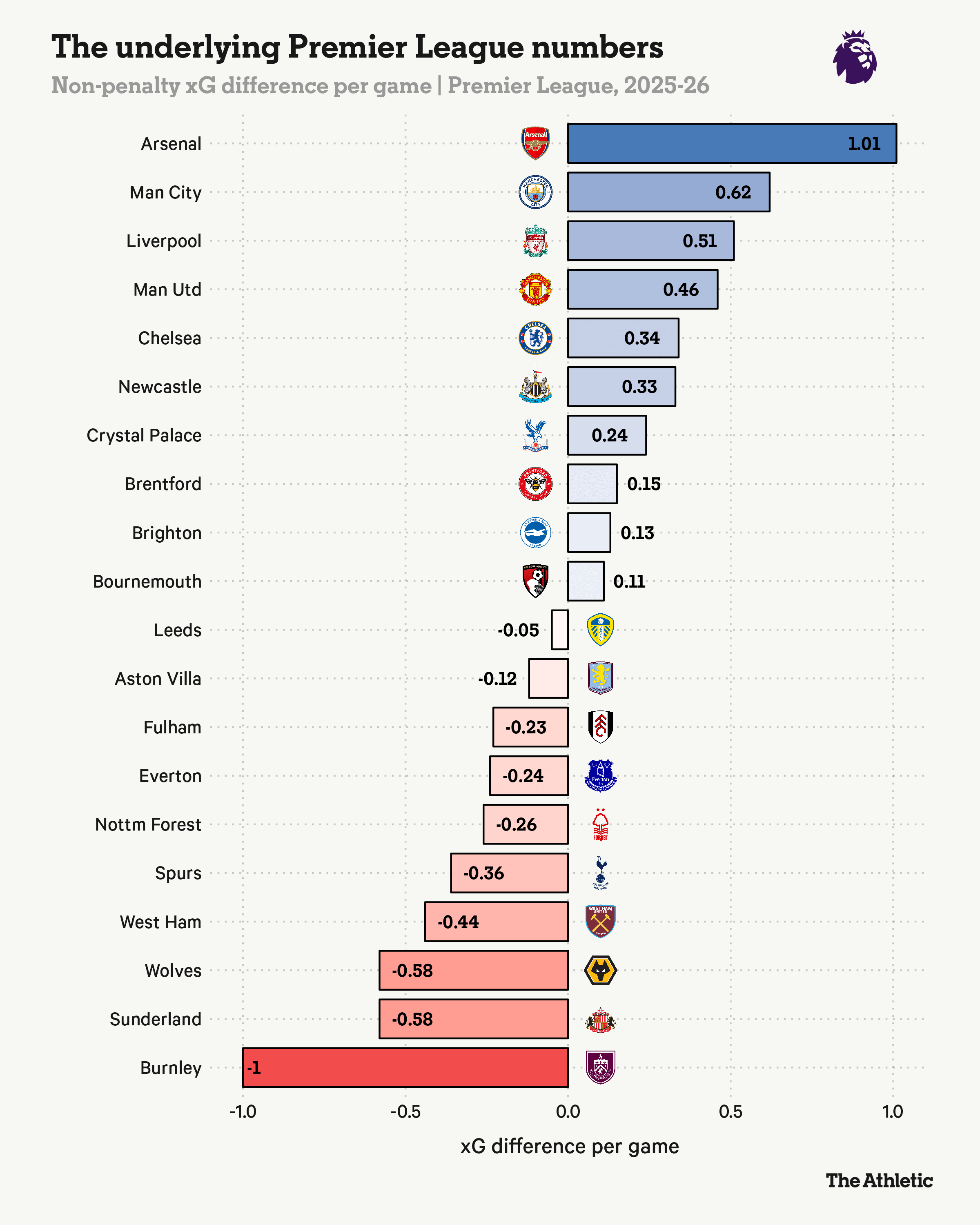
That will be of little consolation to Dyche, whose tenure was shrouded in confusion and an overall lack of attacking potency. Their underlying numbers in both boxes — aggregating their xG for and against — would suggest their performances should put them clear of the relegation zone, but the reality of the league table is far more confronting.
With just three points separating them from West Ham United in 18th, relegation looms if things do not change quickly.
It is remarkable to think that Nuno Espirito Santo was the man in the dugout at the start of the 2025-26 season. The outlook was significantly more positive as Forest prepared themselves for a first European campaign in 30 years.
A stylistic shift from Nuno to Ange Postecoglou and back to Dyche is as muddled as it sounds. Therefore, comparing across the three managers since the start of 2024-25 is a largely nonsensical exercise — but then again, so is the situation that Forest find themselves in.
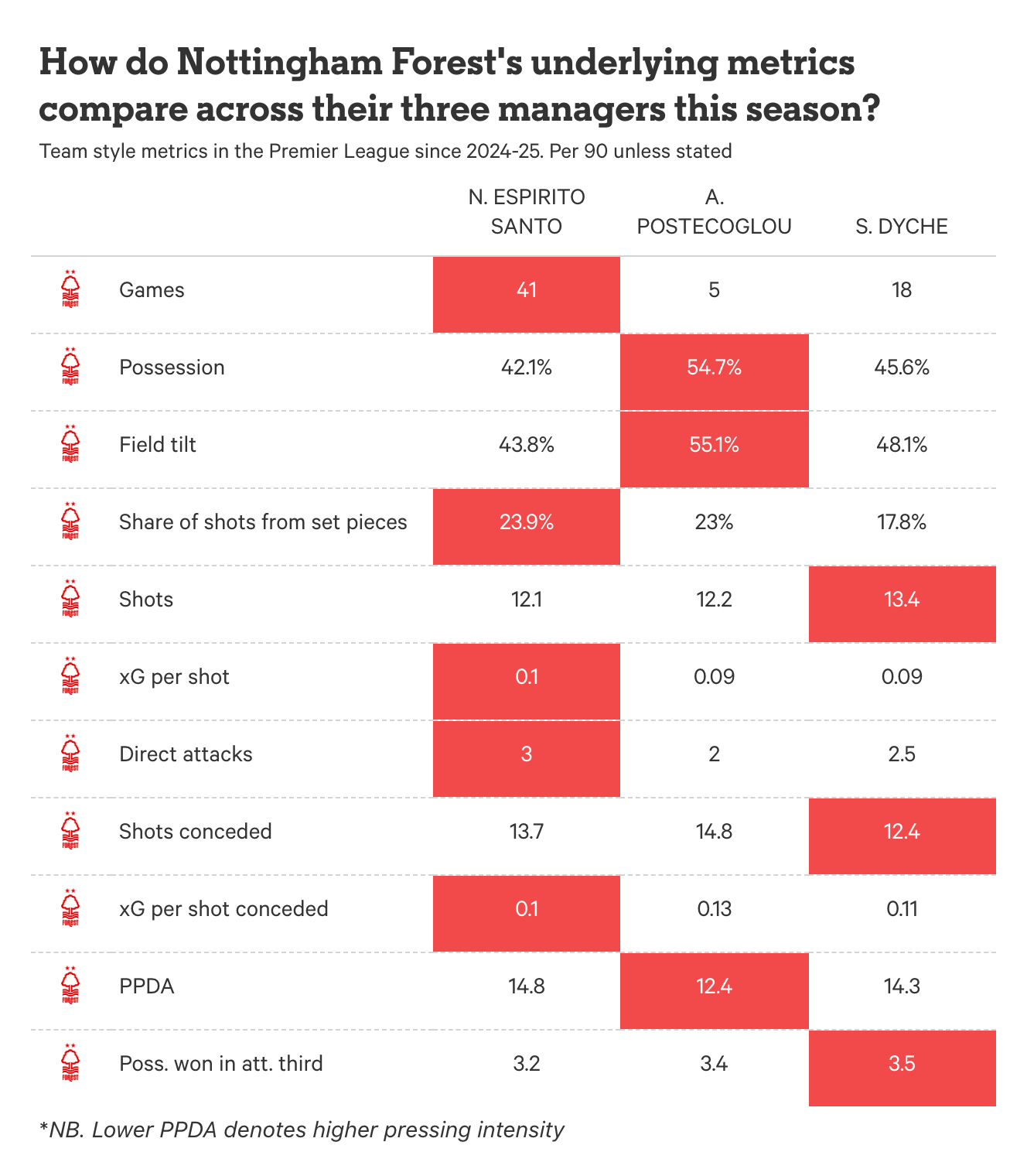
In the interest of doubling down, let’s contrast key metrics from each coach’s time at the club. They largely track the fundamental principles of the respective coach, with Nuno showing strength from set pieces with a counter-attacking style (direct attacks) that create high-quality chances (xG per shot, 0.1).
Postecoglou upped the ball possession, territorial dominance (field tilt), and physical intensity (passes per defensive action, PPDA), but Forest became too open out of possession. Dyche’s style was more Nuno than Postecoglou, but the numbers are fairly middling, and Forest lacked the same attacking punch that brought them success last season.
Even accounting for Chris Wood’s injury, a return of 1.1 goals per game — compared with Nuno’s 1.5 per game — was a regression.
Marinakis wanted to introduce a more possession-dominant style of play at the City Ground at the start of the season. Despite their seventh-placed finish under Nuno, Forest completed the fewest passes of any team in the Premier League in the 2024-25 campaign, going long with almost 80 per cent of their goal kicks and generating over 30 per cent of their xG via set pieces, the highest shares in the division.
They were happy to cede possession, defend patiently and compactly, before springing forward and making the most of their opportunities to attack with direct, uncompromising football.
Appointing Postecoglou signalled a complete U-turn. He is a manager known for his adventurous approach in possession, not afraid to commit players forward and encourage them to take risks with the ball.
Four losses out of five make for difficult reading, with Postecoglou barely granted enough time to hang a picture on the wall before he was dismissed. With just 39 days in his position, it marked the second-shortest stint as a Premier League manager since Allardyce at Leeds (30 days). Sacking Postecoglou so soon after his appointment was an admission of error from Marinakis, with the contrast in style simply too much for all involved to handle.
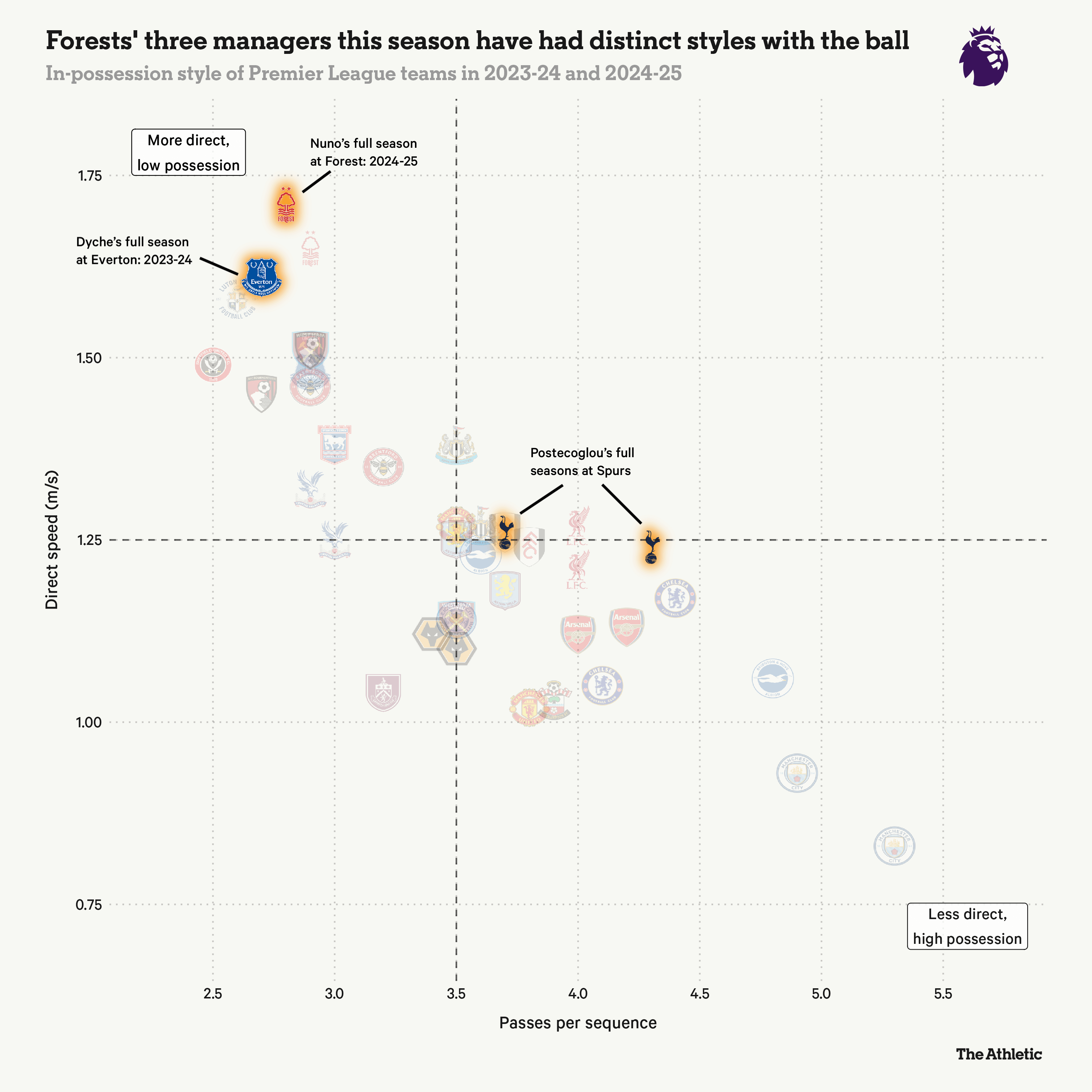
The visualisation below details the average number of passes per possession sequence and the speed at which teams move the ball towards the opposition goal.
As we can see, Postecoglou’s teams are much more patient in possession, closer to Pep Guardiola’s Manchester City than Nuno’s Forest for intricate possession play. It is a distinct philosophy that, perhaps unsurprisingly, didn’t immediately click with a group of players accustomed to approaching games with much more caution.
Choosing Dyche — back up towards that top-left corner where Nuno, Thomas Frank and Andoni Iraola reside — as Postecoglou’s successor represented another dramatic and dizzying change of plan.
Even then, those anticipating a return to simpler times under the traditionally no-nonsense Dyche would be in for a shock.
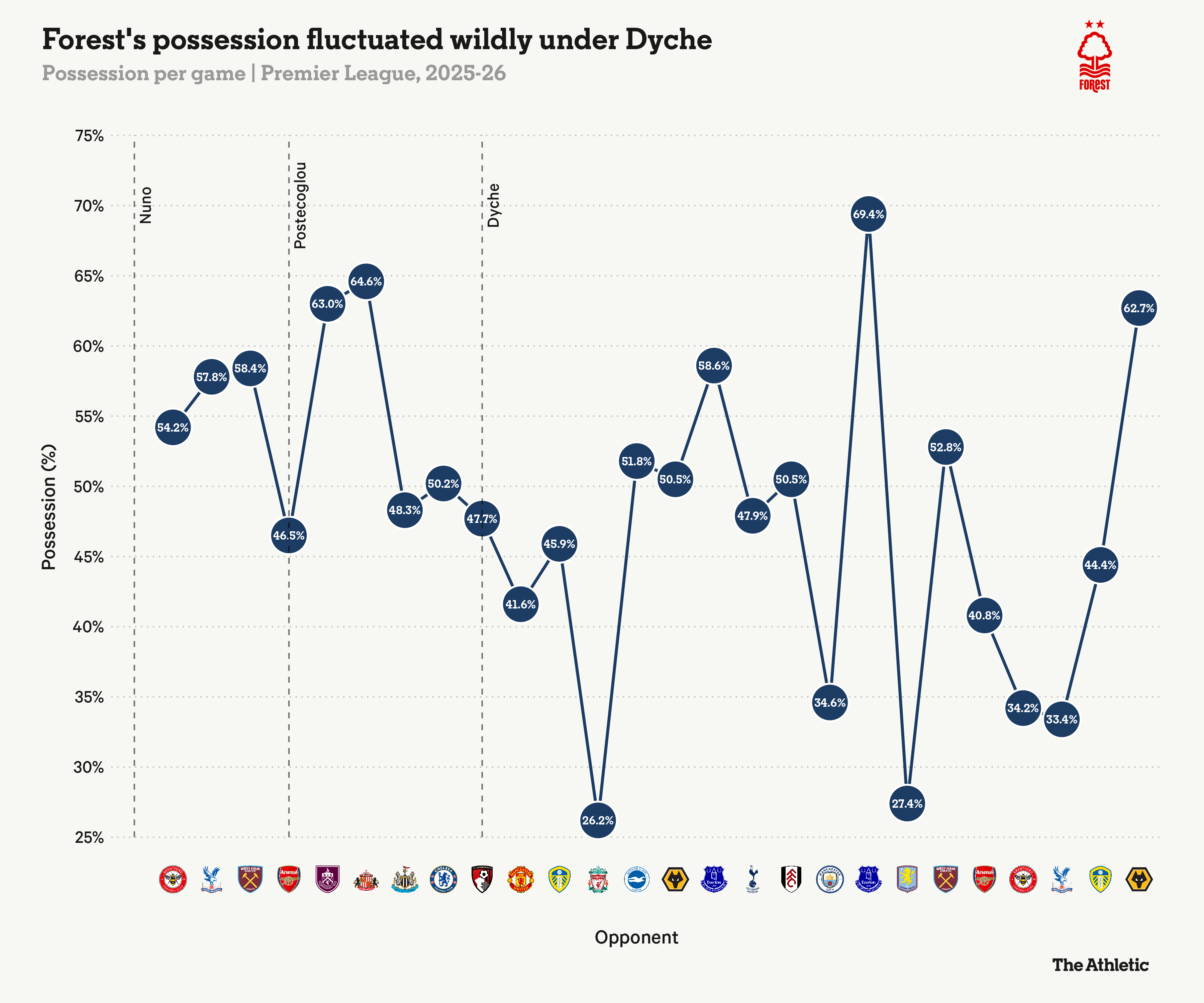
While you could argue that his team looked most comfortable with less of the ball — notably beating Liverpool at Anfield with 26.2 per cent of possession, and running Manchester City close at the City Ground a month later — it looked as if Dyche was tasked with instilling a more proactive approach, as his team often sought to control the flow of games.
As we can see below, possession swung dramatically throughout his tenure. They completed over three and a half times the number of passes against Everton than they did away at Villa just four days later.
In other circumstances, such game-to-game adaptation may be looked at positively. But Dyche’s teams tend to thrive on tactical consistency and familiarity with a gritty, defensively spirited system. Expecting him to coach expressive, possession-dominant teams to break down low blocks — as we saw with that nail-in-the-coffin draw with Wolves — was not a sustainable approach.
Forest’s summer recruitment suggested they would have more of the ball this season. The arrivals of Omari Hutchinson, James McAtee, and Dan Ndoye should have raised the technical level of the squad, but none can play their best football when their profiles are at odds with the manager’s style.
Forest are at their best when they absorb pressure and hit teams on the break through the heart of the pitch. Marinakis has desperately tried to evolve that playing style by turning over players and managers, but the output — as shown above — paints a muddy picture.
With Pereira set to be Forest’s fourth ‘permanent’ manager of the season, the short-term remit is to steer clear of the relegation zone. What his style brings in the medium-to-long term is uncertain, but his appointment would at least maintain the theme of confusion that has swirled around the City Ground over the past 12 months.