
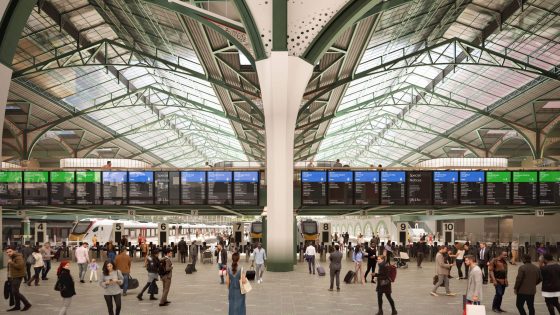
The City of London’s Planning Committee has approved Network Rail’s plans to transform Liverpool Street station in a scheme intended to boost capacity, accessibility and commercial space at one of Britain’s busiest transport hubs.
Network Rail, which is leading the project, says the station has not seen a major redevelopment since 1991, despite passenger numbers having roughly trebled over the past 35 years. Liverpool Street currently serves about 118M passengers a year from London, East Anglia and the east of England. Network Rail forecasts passenger numbers could rise by 35% to about 158M by 2041, and says the new works will prepare the station to accommodate more than 200M passengers in future decades.
The proposals aim to tackle chronic congestion and improve accessibility. Key elements are:
A 76% increase in overall concourse capacity, including a 23% expansion of the lower concourse
Step‑free access from street level to all platforms, including London Underground lines for the first time
Eight new lifts (up from a single four‑person lift) and an increase in escalators from four to 10
New entrances and improved access to buses, bike storage and taxis, with enhanced wayfinding
Additional public amenities such as toilets on every level, family facilities and Changing Places toilets
Network Rail says the designs – led by architect Acme and engineered by Aecom – will preserve the station’s Victorian trainshed, leaving the historic structure “completely untouched”, while opening up new views of the heritage fabric for passengers. The redevelopment also includes a new office building above the concourse with a publicly accessible roof garden; Network Rail describes the office space as “the best‑connected and most sustainably located in the capital”.
Network Rail has presented an economic case for the scheme, estimating the transformation could add up to £4.6bn a year to the City of London economy by increasing visitor numbers. The company says this uplift is comparable in scale to a 1p change in the basic rate of income tax. The figure is intended to capture wider benefits from improved transport connectivity, although Network Rail has not provided a detailed breakdown.
A multidisciplinary team has been assembled for the project, including architectural, engineering, heritage, accessibility and environmental specialists. The full list of firms on the team is below.
The City of London Planning Committee’s resolution grants planning permission but does not in itself start construction. Network Rail will need to satisfy any remaining planning conditions and secure funding and construction contracts before work can begin. No construction timetable was set out in the announcement.
Liverpool Street is a key node for commuter and regional services and forms part of a complex transport interchange with multiple Underground lines and surface connections. The proposed increase in capacity and step‑free access would address long‑standing complaints from passengers about congestion and accessibility limitations, particularly for people with mobility impairments and those travelling with luggage or children.
Critics of large station redevelopments often point to potential disruption during works, the treatment of historic elements and the commercialisation of public transport spaces. While the plans promise to retain the trainshed, local interest groups and heritage bodies will be likely to scrutinise detailed designs and construction methods as the project progresses.
The accepted design is Network Rail’s second attempt at a revamp following an earlier scheme by Swiss practice Herzog & de Meuron, which was binned after receiving vociferous negative feedback.
Ellie Burrows, managing director for Network Rail’s Eastern region, said: “This decision represents a key step towards the transformation of Britain’s busiest station and marks the beginning of an exciting new chapter for Liverpool Street.
“Our plans focus on improving the everyday experience for passengers whilst respecting the station’s unique heritage. With annual passenger numbers forecast to grow to 158 million, this approval ensures the station will be future proofed for decades to come.”
Jo Streeten, managing director at Aecom (Building + Places) said: “Aecom welcomes the City of London Planning and Transport Committee’s decision to approve the transformation of Liverpool Street Station, which represents a pivotal moment in upgrading Britian’s busiest train station to meet future passenger demands, while honouring its rich history. As lead engineer for the proposals, we have worked with our partners from the earliest stages to develop a design that has been shaped by detailed heritage, multi-disciplinary engineering and underpinned by robust environmental impact assessments.
“By combining significant improvements to accessibility, capacity and passenger experience with sensitively integrated commercial space, the scheme helps secure the long-term investment needed to support a nationally important transport hub.
“We are proud to have helped the project reach this significant milestone and look forward to continuing to work with Network Rail, Platform4 and Acme to ensure Liverpool Street Station is fit for the future while remaining true to its past.”
Network Rail’s design and professional advisory team for the new scheme includes:
Acme – Architecture
Aecom – Multi-disciplinary Engineering & Environment
Certo MS- Project management
Newmark – Planning & Development
Gleeds – Cost Management
Donald Insall Associates – Heritage & Townscape
GIA – Daylight and Sunlight
JLL – Valuation
AVR London – Visualisations
SLA – Landscape Architecture
Shared Voice – Communications & Engagement
Intelligent Data Collection – Pedestrian modelling
Mima Group – Accessibility & Inclusive design and wayfinding consultants
Seam – Lighting Design
RWDI – Wind Engineering
The Boundary – CGI Views
Plowman Craven – Surveys
Sweco – Building Control Advice
Addleshaw Goddard – Legal
Publica – Cultural Strategy
Like what you’ve read? To receive New Civil Engineer’s daily and weekly newsletters click here.