
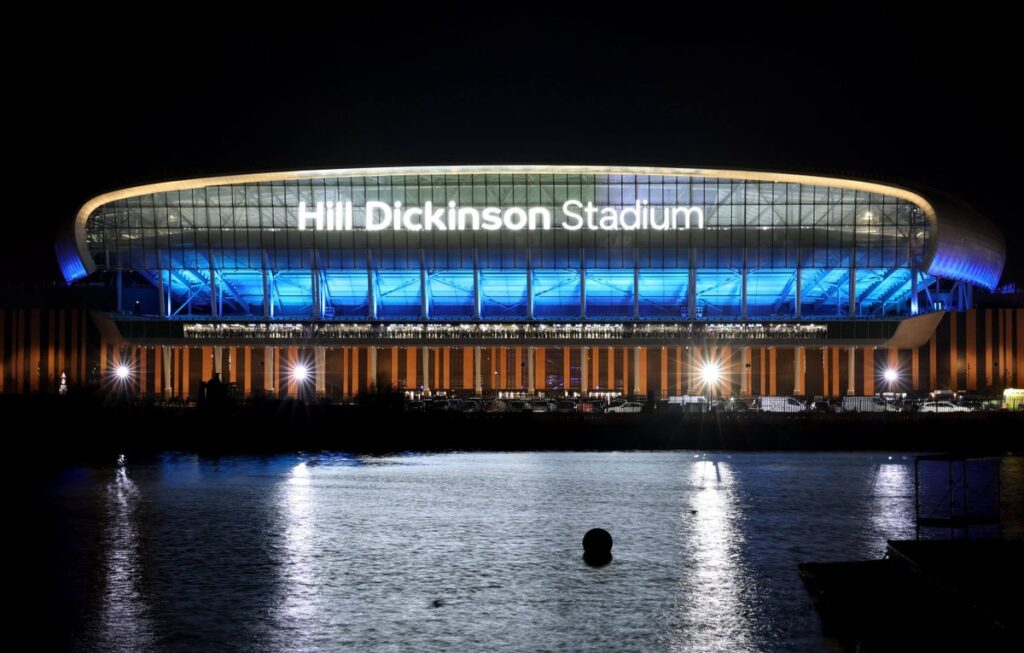
The honeymoon is over for Everton at Hill Dickinson Stadium.
David Moyes’ side were unbeaten in their first five matches at their near 53,000-capacity new home after it opened last summer but have now won just one of the past five league matches there (and none of the last four), while also exiting the FA Cup at the third-round first hurdle on penalties against visitors Sunderland.
This is not just an irritating statistical quirk for the club. A fanbase’s mood is often dictated by home form, given how few of them — proportionally — are able to attend away matches. And while Everton have been strong on the road, beating Manchester United, Nottingham Forest and Aston Villa in recent months, the 3-0 defeat of Forest on December 6 was the last time many of their supporters were there in person to see them win.
Early-season positivity about the £800million dockside arena has started to wane, with grumbles over the atmosphere and accessibility becoming more common. On social media, old footage of the club’s previous stadium for 132 years, Goodison Park, has started to circulate again. Particularly in times like these, when results are poor, there are those who yearn for the warm embrace of the past.
Moments like these were inevitable. Generations of fans made the pilgrimage to Goodison every other Saturday during the season and came to see it as a second home. Cutting the cord is not easy, and there are some common gripes — legitimate or otherwise — about all new grounds.
Fans are sitting in new seats, next to new people, and still forging new routines. It takes a while to fully feel at home. Ten years on from leaving Upton Park for the London Stadium, West Ham fans still don’t — although that probably says more about watching football in a venue built for athletics than anything else.
Historical evidence suggests results tend to suffer as everyone, from team to fanbase, acclimatises. Among other things, Everton are playing on a different pitch, with larger dimensions (it is five yards longer, but the same width) than the one at Goodison.
The cost of going to the games has gone up — ticket prices were raised more or less across the board with the move — and, compared to previous campaigns, Everton have had a disproportionate number of Monday evening games already this season, exacerbating transport issues in getting to and away from their new home.
Then there are the smaller things, though they still make a difference. The club have not quite perfected the timing of when to sound the pre-match siren and play Z Cars, their traditional walk-out anthem, which has also not helped the atmosphere.
And, more fundamentally, we are still waiting for a truly iconic moment, a match where the ground hummed and throbbed for the full 90 minutes or a moment fans spilled onto the pitch in delight, like they did after James Tarkowski’s dramatic 98th-minute equaliser in the final Goodison derby last February.
So, has the move — as some have suggested — made it easier for visiting sides to pick up results at Everton?
It is, of course, hard to quantify how uncomfortable teams find playing at Hill Dickinson compared to Goodison, but Everton’s results there are undoubtedly poor. They are averaging 1.55 points per away game (ppg) this season compared with 1.33ppg at home. Moyes has spoken repeatedly about the need to improve that record.
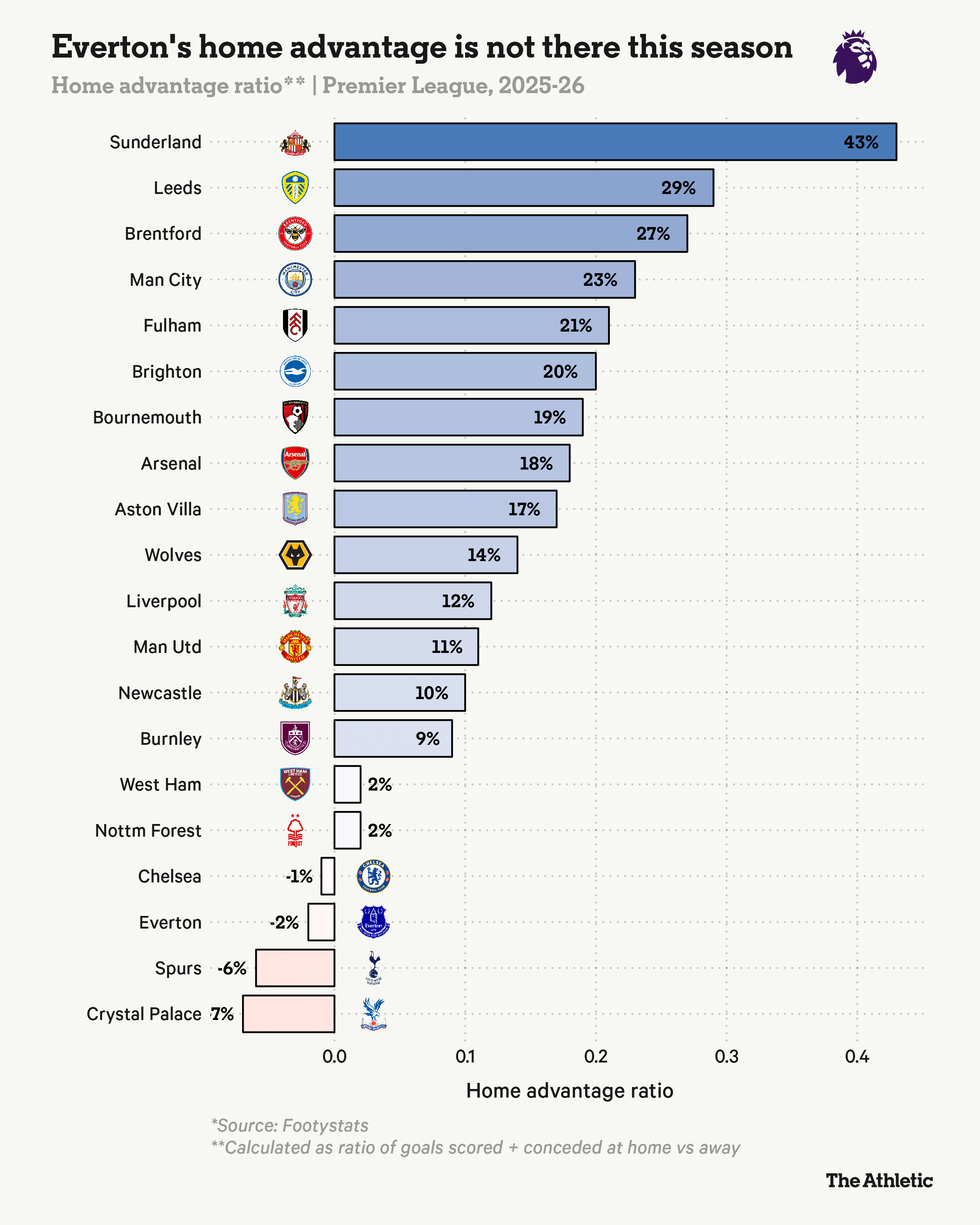
As the below graphic shows, Everton are among a small group of Premier League clubs who have a better record on their travels this season. They are one of four teams among the 20 not to have a positive home advantage ratio, which is calculated by looking at the goals scored and conceded at a side’s own stadium versus their away fixtures.
Despite the recent nostalgia over ‘Fortress Goodison’, this is nothing new.
In fact, Everton are currently averaging more points per game at home than they did in their old stadium’s final season (1.26) and also in 2022-23 (1.11). And in 2023-24, they took 28 points from 19 league games at Goodison, an average of 1.47 per match — an increase on the current rate but within touching distance. Rather than a deviation, home struggles have been the norm in recent years.
On its day, the Goodison atmosphere would be as loud and as hostile as any stadium in the country. But it could also go quiet at times. The mood would often ebb and flow, spurred on by the team’s performance, a supposed injustice or a crunching challenge. Fan groups like The 1878s regularly sought ways to improve the vibe.
Life at Hill Dickinson Stadium is much the same.
While Everton toiled in the first half against Leeds on Monday, the place was subdued. In the second half, when their side had the momentum, the crowd buzzed. Just ask Leeds manager Daniel Farke.
“Overall, the stadium is very impressive,” Farke said in his post-match press conference. “When they were on top of the game and equalised, it was a great, great atmosphere.”
If anything, much of the available evidence suggests that tactics and personnel have had more impact on Everton’s home form than the move away from Goodison.
It has been a while since their personnel suited being the aggressors in games. Before the Friedkin Group’s takeover just over a year ago, resources were scarce. Key creative players such as James Rodriguez, Lucas Digne or, more recently, Alex Iwobi, were either sold or simply let go in an attempt to comply with profitability and sustainability rules (PSR).
Under Moyes’ predecessor Sean Dyche, Everton won just one league game in which they had more than 50 per cent possession in a tenure stretching two years. Dyche was better at drilling the defensive basics than forging a coherent attacking blueprint, but he was also dealing with a hollowed-out squad short on quality.
Everton attempted to rectify that last summer, bringing in attacking midfielders Jack Grealish and Kiernan Dewsbury-Hall.
There have been improvements in some areas, but many of the same issues remain. Chance creation is still a problem, with Everton having the fifth-lowest expected goals figure in the league after 23 matches (24.8). They lack creative quality from full-back and struggle chasing games, winning just once and losing on eight of the 10 occasions this season where they have conceded the first goal.
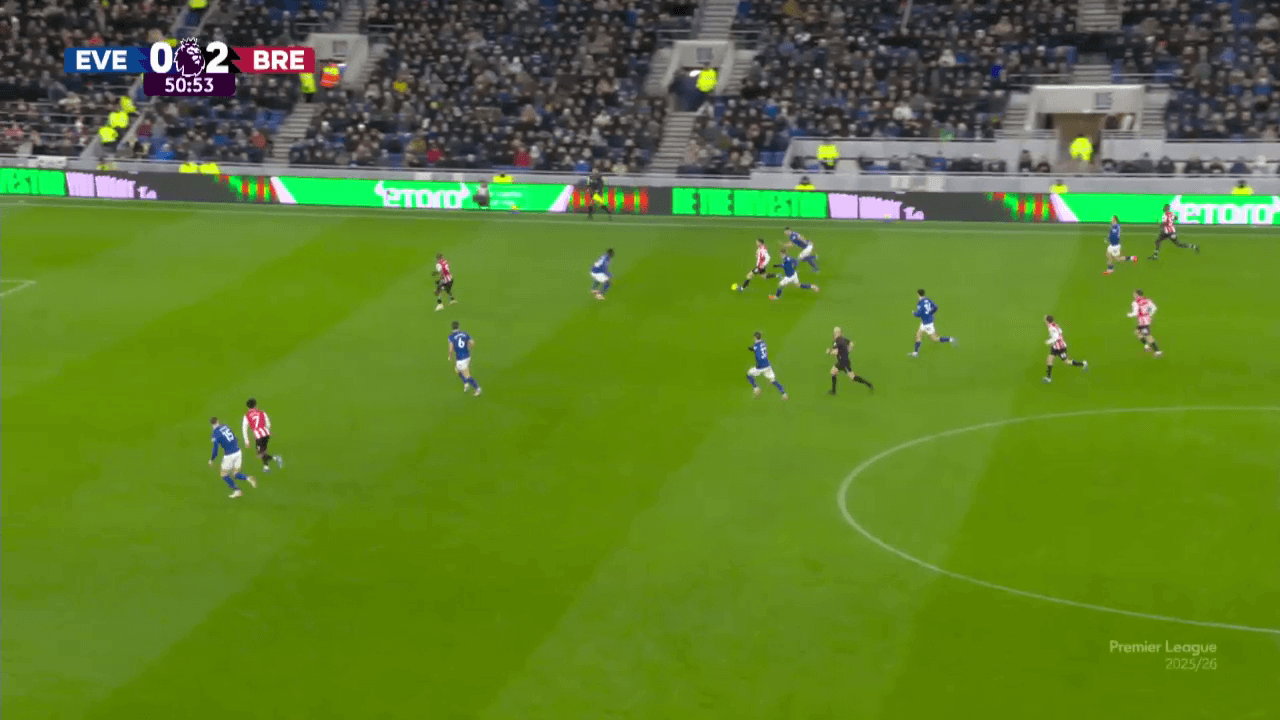
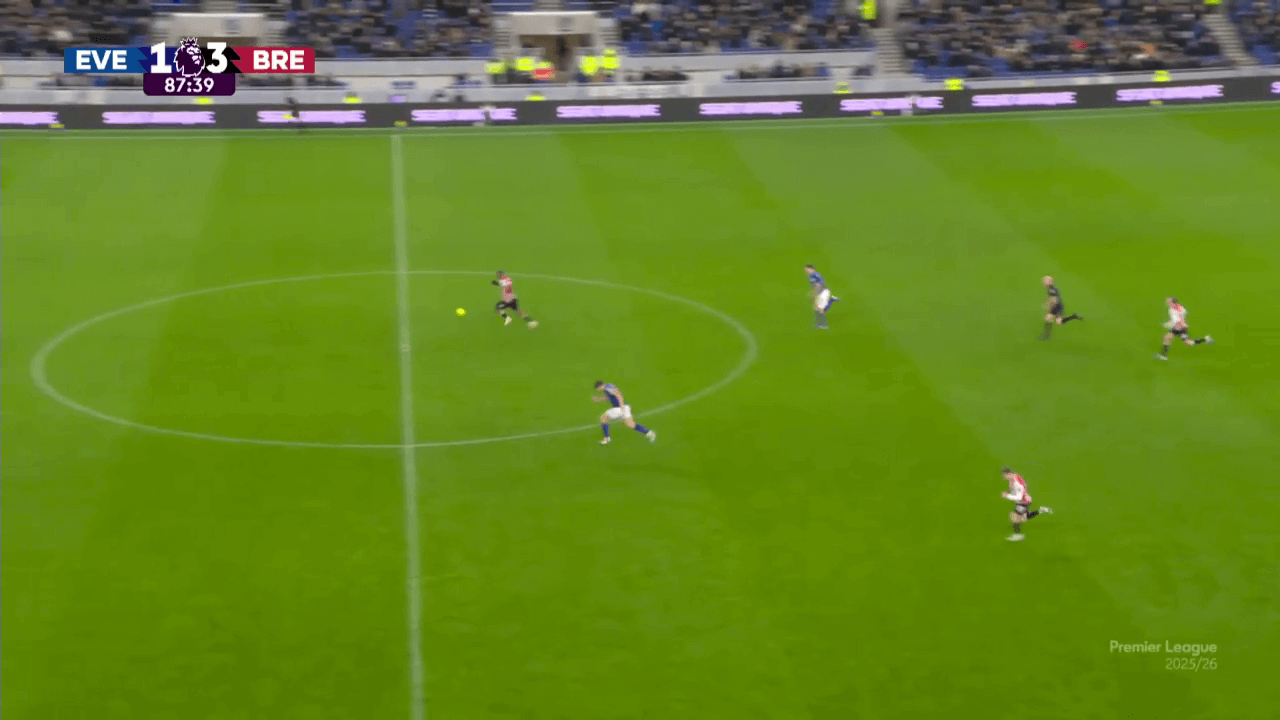
There have been matches where Everton have been dominated physically at home, like the defeats against Tottenham, Newcastle and Brentford. But there have also been many other occasions where they have been caught playing a high line.
We can use the position of offside decisions for opponents against Everton as a way of measuring their defensive line height. This is a relatively small sample size, so caution is advised, but Everton’s average defensive line at home is 29 metres from goal, compared with just 20m in away matches.
Moyes has attempted to play a more expansive game at home, pushing the side up and attempting to win possession closer to the opposition goal. But this has exacerbated some of the side’s flaws. Without the pacy Jarrad Branthwaite, who came off the bench against Leeds to feature for the first time all season following a hamstring injury, the defence has been exposed.
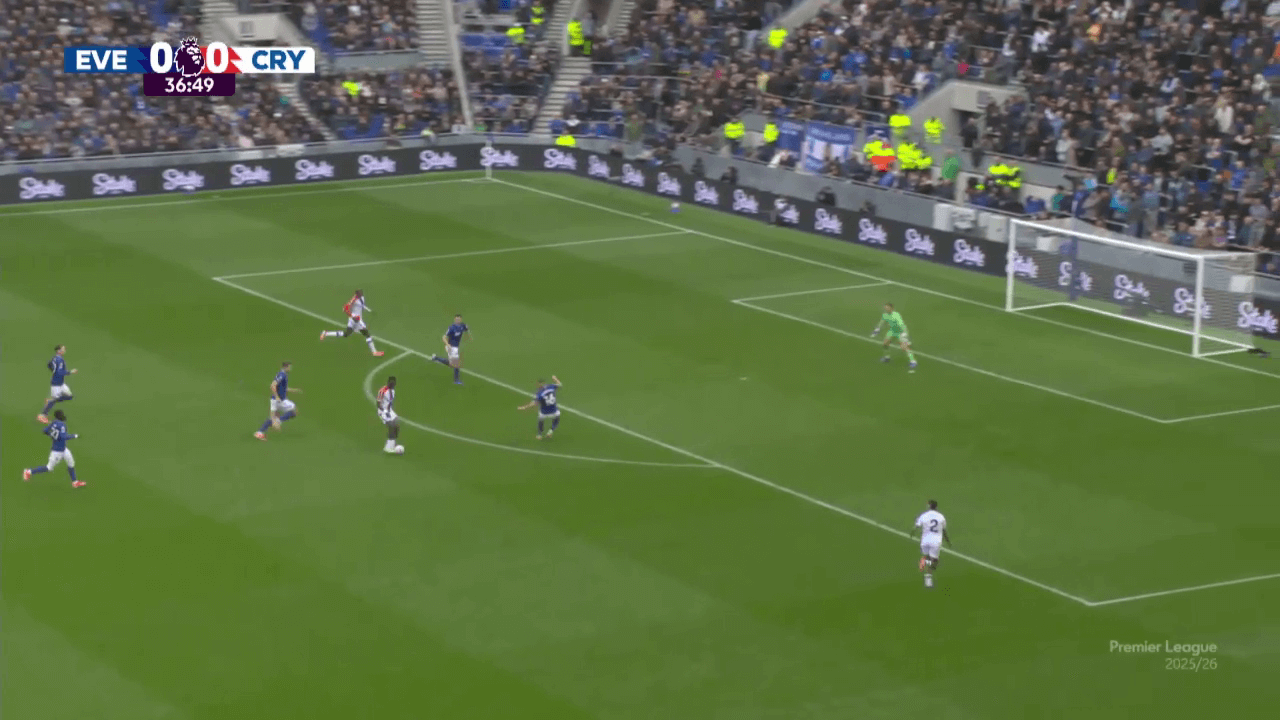
Here are some examples.
This is Daniel Munoz’s opener for Crystal Palace in October, which came after the visitors created a three-against-two situation.
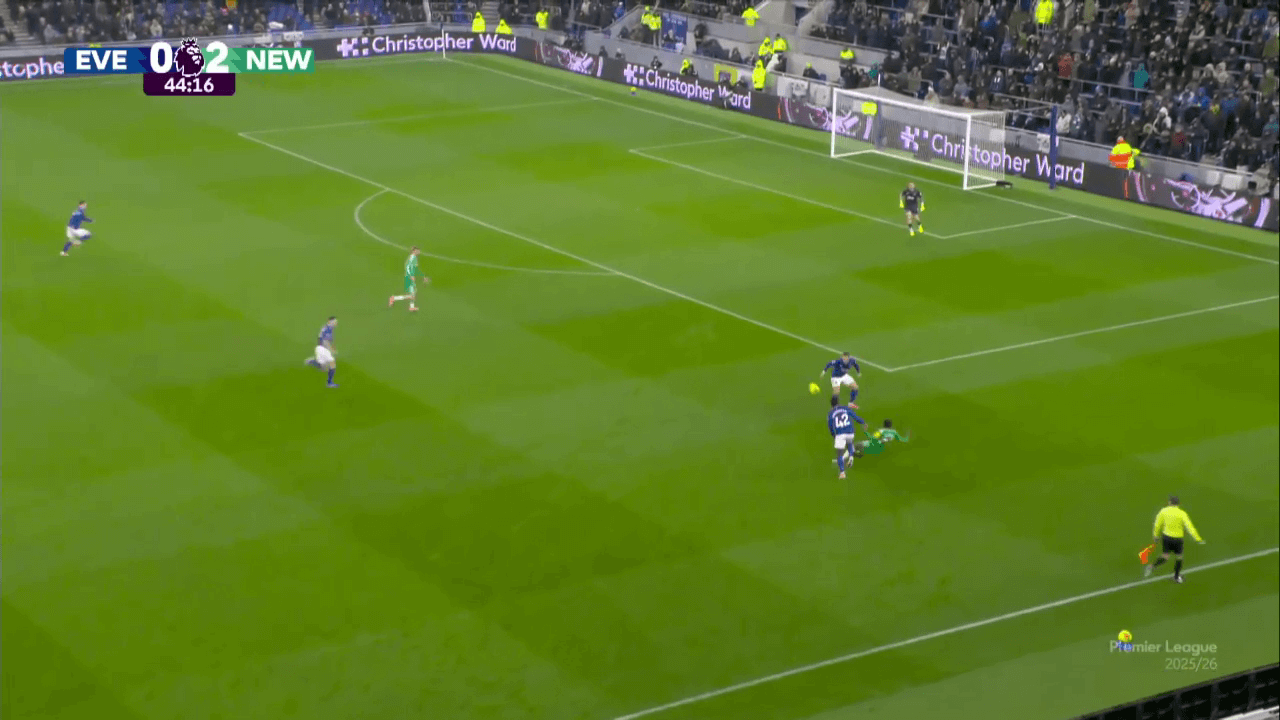
Newcastle ruthlessly exploited the high line for Nick Woltemade to score their third goal in a 4-1 win at the Hill Dickinson Stadium the following month.
And the below stills show Everton’s high line exposed for two Brentford goals in the 4-2 defeat this month.
Everton have been more dominant at home than away this season.
They have considerably more possession, take more shots and concede fewer attempts than they do on the road. But the quality of chances they create at Hill Dickinson is lower than when they are on their travels, and they are also allowing opponents into more dangerous shooting positions (see their higher xG per shot conceded below).
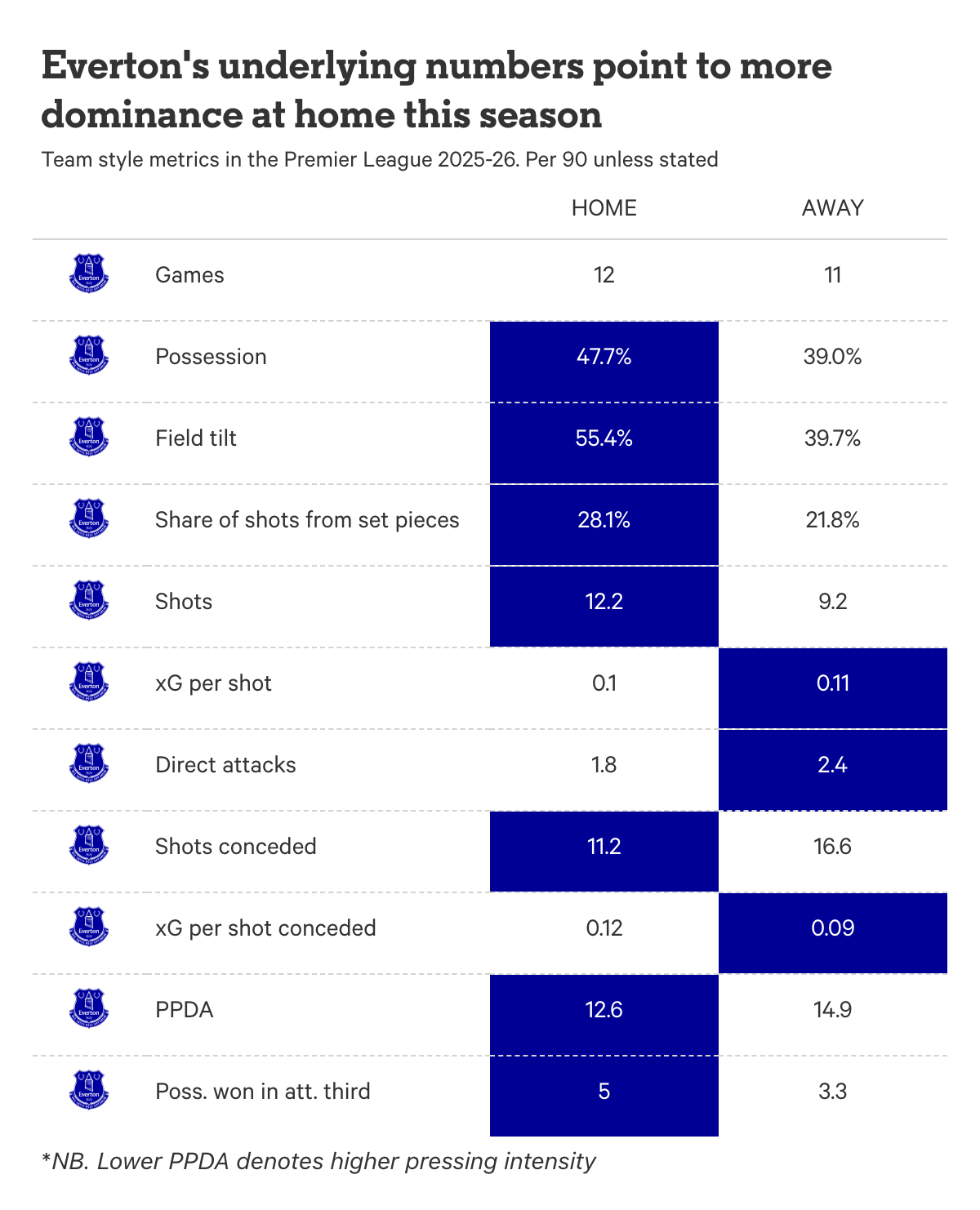
Away from home, Moyes’ side have been more compact and direct, which suits the likes of defenders Tarkowski and Michael Keane. In the 10 games where they have had their lowest possession share this season, they have won five times. In the 10 highest, they have three wins. Only once — that October day against Palace — have they had more of the ball than their opponents and claimed three points.
Their best performances of late have come in wins at Forest and Villa.
“Sometimes in those games, it will play into our hands when you’re away because you are not the team that needs to push and needs to play forward,” midfielder Merlin Rohl said after the latter.
Recent poor home form may have sparked debates over the Hill Dickinson atmosphere, and left some fans pining for Goodison, but tactical tweaks not nostalgia will be key to any turnaround.