
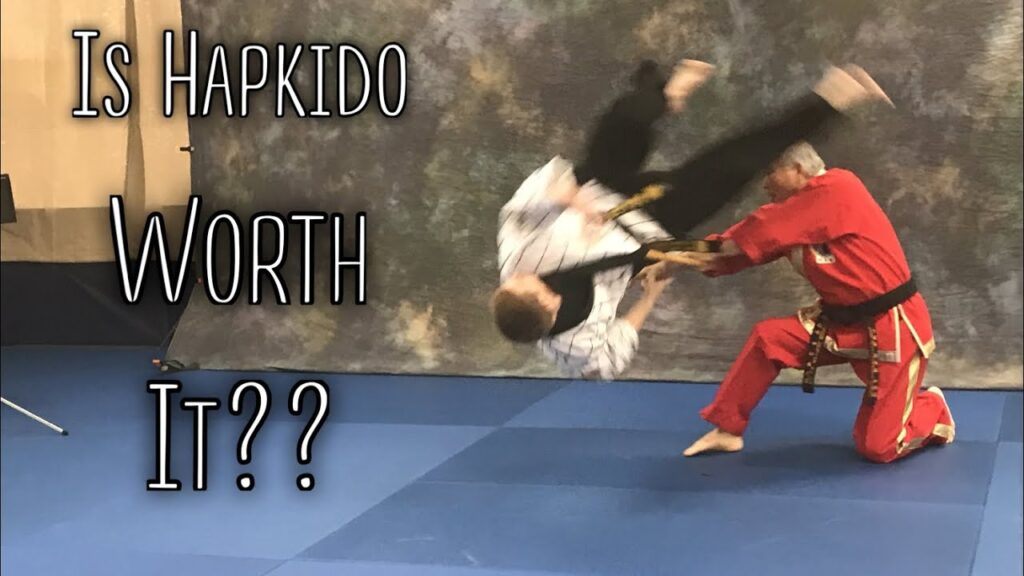
In this video we explore the common criticisms that Hapkido practitioners face today, and why some people still feel valid in practicing this art and even making it a lifestyle.
I have been practicing Hapkido since 2001 and have seen the ups and downs that it faces. This is why I still do it. By Matt Hinkamp
***Music obtained from bensound.com – “Slow Motion”***
Some gear I use:
Makiwara: https://www.amazon.com/gp/product/B08FBQXTSC/ref=as_li_tl?ie=UTF8&tag=mhinkamp05-20&camp=1789&creative=9325&linkCode=as2&creativeASIN=B08FBQXTSC&linkId=c10a40b59eabb8ee60451e80ae4dfc40
Rebreakable Boards: https://www.amazon.com/gp/product/B00U360W7W/ref=as_li_tl?ie=UTF8&tag=mhinkamp05-20&camp=1789&creative=9325&linkCode=as2&creativeASIN=B00U360W7W&linkId=7f2bc592b840701011738e7cf6076512
Kicking Targets: https://www.amazon.com/gp/product/B076CB6F13/ref=as_li_tl?ie=UTF8&tag=mhinkamp05-20&camp=1789&creative=9325&linkCode=as2&creativeASIN=B076CB6F13&linkId=ec2f89e6dd7f0600e7a8250edc0075f8
Macho Sparring Gear: https://www.amazon.com/gp/product/B00JFZ5UJC/ref=as_li_tl?ie=UTF8&tag=mhinkamp05-20&camp=1789&creative=9325&linkCode=as2&creativeASIN=B00JFZ5UJC&linkId=42b92e1dba5ea8e07c2a4b501847564d
Nunchakus: https://www.amazon.com/gp/product/B07PJDBYN5/ref=as_li_tl?ie=UTF8&tag=mhinkamp05-20&camp=1789&creative=9325&linkCode=as2&creativeASIN=B07PJDBYN5&linkId=866de6d6471255c353b8a98da3ccca72
Practice Swords: https://www.amazon.com/gp/product/B00K8EUTBS/ref=as_li_tl?ie=UTF8&tag=mhinkamp05-20&camp=1789&creative=9325&linkCode=as2&creativeASIN=B00K8EUTBS&linkId=1029cc08ea494d7d81f0add36659dc51
46 Comments
I do make an error here explaining the history of Hapkido, stating that its creator, Choi Yong Sool, was influenced by Aikido, when in fact he and the creator of Aikido, Ueshiba Morihei, were both individually influenced in Daitō-ryū Aiki-jūjutsu by Takeda Sōkaku.
I gained historical understanding from my Korean grandmaster, which it appears I slightly misunderstood due to the language barrier, and used it here rather than researching further to confirm. I figured personal testimony from a second generation master trumped anything I could get online. It does, as he definitely understands the history completely, but I just misunderstood it, hence the mistake here.
Thanks to all who pointed it out
I have only recently started studying Hapkido. I've trained in other arts, principally Jiu Jitsu, Shorei Ryu Karate, and Muay Thai. But I've also dabbled with a handful of others including Shotokan, Wing Chun, Krav Maga, and Systema.
I've worked in both law enforcement and tactical security. When thinking about getting back into martial arts, I started to think critically about each of the times that I've had to go hands on with someone in real life. I came to the realization that in every physical encounter I've been in, not once did I kick or strike anyone. Every time it was about gaining control and compliance of the other person.
When I came to that realization, I asked my self if that's the case, then I why am I studying strike based martial arts? What I need is something more grappling based. Likewise, I have never used any of the jiu jitsu I've learned in a real confrontation. It was always grab an arm/hand and get control. It is for these reasons that I have decided to look more closely at Hapkido.
Absolutely!
I have trained in hap ki do andnit helped me prevent someone from pick pocketing me in Rio Dijanrio Brasil. The wrist grab allowed me to control the situation without harming the person while I was able to get away ..
It works just fine for me.
I have studied Tae Kwon do, mua Thai and kick boxing and hap ki do I find is practical and my favorite
Dojunim Ji, Han Jae student and black belt, I'm in the military police and CPO agent. I can tell you it works from experience.
This video is bullshit! Who ever made this has no understanding of this martial arts form
So it is good for many things.
That is good to know.
I say training in any art is better then none at all regardless of style. However, in this case I can see the LE application that Hapkido can provide.
This isnt true hapkido
In you havent' trained under Hwang In Sik, your hapkido sucks.
I. amen a former akido practitioner, and like you said it's about self defense and not fighting, it's about stopping It before it starts, hapkido like akido should be for self confidence…
I worked as a corrections officer for TDCJ and armed security as well as a bouncer on the side.. Hap Ki Do and Jesus kept me alive and kicking, through a lot of fights not for a belt or a trophy but just to live.
From a standpoint of someone who does BJJ and Muay Thai this shit looks stupid🤣, if you want ground game do bjj or wrestling, if you want stand up game do Kickboxing or Muay Thai. There's a reason why professional MMA fighters do these certain sports and not this "hapikido" nonsense. If you really want to protect yourself and learn how to throw someone or get them off you, learn Judo. Trust me, wrist locking someone with both hands and leaving his other hand open to smash your skull aint a good idea.
Most martial arts are better than nothing. I do hapkido and taekwondo as well as japanese jujitsu cause it's fun and inexpensive. Bjj is way too expensive in my area. Critics need to understand that. If I wanted to be a cage fighter I'd pay the high price tag and train in mma and bjj. Since I wanna have fun, get fit and meet people I'm happy doing my thing.
if it is a fighting art the practitioners should know how to fight. Straight and simple.
Wrist techniques not practical? Clearly this guy hasn't fought a wrestler, they constantly attack the wrist to move them away to shoot for the hips
So in other words……..junk
I'm no longer surprised by ignorance of negative or shock jock junkies who say this art or that art isn't effective. They often speak without historical reference or research that has any depth. One of the things that made Bruce Lee a force to reckon with is that he understood that there are ranges of combat. To be a more rounded fighter Bruce Lee believed you're going to have to get comfortable with multiple ranges. Looking over martial arts landscape you see many of styles out there focus on one to two ranges of combat. So its not "this" particular art is the end all and be all art. Its i need to spend time on my stand up game…i need to work on my ground game…what are my hand skills?…how are my kicking skills?…do i understand why the weakest parts of the human body are best for bringing a street confrontation to a close?
" KUNG paanong inibig Ako Ng Ama ,gayundin Naman ,iniibig ko kayo;
Manatili kayo sa aking pag- ibig. -GOD JESUS CHIRT,APOCALYPSE 22:13 JESUS IS GOD.
Very well stated. Thank you!
Hoi yong sool fighting style korean p
Why are you going to waste your time doing this garbage when there’s more effective REAL training out there to learn.
I am with quite a few of the people commenting. I’m former military, former law-enforcement and a former bouncer. I have my fifth-degree black belt in the art. It saved my butt on many occasions. What do you see a demonstration like this, it’s just demo stuff. Real HKD is messy and aggressive. Unfortunately with a lot of people know as HKD is what they see in taekwondo schools. Often that’s water down and incomplete.
As far as striking and/or ground art, that’s just gonna depend on the particular school you go to. My teacher was a five time golden gloves boxer and had his black belt in judo. Striking is an Intercal part of what we do. And as he put it, Graham work as a natural part of Hapkido, The problem is a lot of the old school masters didn’t like going to the ground so they neglected that area. But Those techniques are still there. And as far as those ground techniques go, Agron work is about getting off the ground as quickly as possible. Not rolling around trying to submit you like in competition.
I trained in Hapkido for 5 years. I agree with everything in you video.
Il like your explanation. Sorry I had to continue i french.
Je suis 4e dan de hapkido et 6e dan de taekwondo, professeur de MMA. J'ai été videur pendant 5 ans. Je me suis donc battu dans le cadre de la boite de nuit quelques dizaines de fois.
En 2005 j'ai commencé le MMA et le JJB en plus du taekwondo. Depuis, j'ai arrêté la pratique et l'enseignement du hapkido.
Je ne suis jamais revenu au hapkido par manque de temps car je n'avais pas le temps pour faire du traditionnel.
NE PAS s'entrainer au hapkido pour la self defense: c'est vendu comme self defense MAIS ce n'est pas fait pour cela : le corpus technique de l’aïkido n'est pas fait pour. Morihei Ueshiba a conçu son art martial sur l'énergie et la santé et non pour la confrontation. Choi Yong Sul n'a pas pu s'extraire de ce postulat. Nor ji han jae. L 'hapkido est donc un art de bien être et non de confrontation.
Ses chutes par contre sont géniales.
NE PAS essayer de faire du sparring avec le corpus technique du hapkido: pour ça il y a le MMA.
Ses coups de pieds sont des variations des coups de pied du taekwondo, souvent en lignes basses. Souvent faite de manière un peu médiocre quand on est pas bon en taekwondo.
NE PAS tenter des coup de pieds à terre : soso tchagui, hanja tchagui selon comment vous les appelez. Technique jolie mais dangereuse pour les genoux et futile.
NE PAS parler à ses élèves de la rue et du hapkido.
NE PAS dire que les militaires coréens font du hapkido, hapkimoodo, uéjon moosool, teukkong moosool, kuksoolwon, taekwonkido, hapkimoosool, bulshimoosool: ils font du MMA, du grappling et du self defense avec matériel, couteau, baton telescopique, taser: pas du jang bong, dan bong, jipanghi, kum…
EN FACE D'UN COUTEAU: ne tentez pas un technique de hapkido! C'est trop compliqué à appliquer.
Si vous voulez être bon en hapkido, pratiquez le pour ce qu'il est: de l’aïkido et un art martial traditionnel comme le kumdo.
Fuyez les maître qui vous parlent d'efficacité et d'hapkido, c'est comme l'eau et l'huile.
J'ai mis 10 ans à le comprendre.
Quant à l'efficacité du MMA dans la rue, c'est un autre débat.
Sorry for this answer in french but i don't have a good level in english. Use google traduction: i keep my text simple.
Thanks for your video.
I had a lot fun with hapkido 2 dan black belt also taekowndo black belt jujitsu black belt Korean American taekowndo black belt
The main thing I have learned thus far in my almost one full year of Hapkido is that it has one main purpose–to survive and hopefully win a fight after trying unsuccessfully to avoid it. There is no competition type attacks taught, no kata, no illegal moves. Hapkido is about doing as much damage as necessary to incapacitate, disarm, or escape an attacker. Some of it I would NEVER deploy in a street fight! Mainly the complicated wrist locks etc. Those are for a subdued opponent who is no longer attacking. They look cool and impressive in a controlled environment with a docile training partner but my feeling is they would get you destroyed on the street because there is such a small margin for error. Hapkido teaches old school stuff like taking out the knees, eye gouges, throat punches, kicks to the groin, fist to the solar plexus etc. Most people can do those things–Hapkido teaches you to do them even better!
The frank introspection and circumspection are profound. How many practitioners of their respective styles mention the weaknesses in their chosen art? I haven't heard a single one until now. In stark contrast, they argue how their art is effective in all situations, against all opponents, against all styles.
I believe there is an ethos and a pedagogy in many Hapkido schools that is unique from Japanese and Chinese styles. The focus is not about the perfect spacing of feet in a stance or the angle and placement of a strike. There is no exhaustive taxonomy of techniques and their many variations. For those interested in these things, karate would be the art that would embody these characteristics.
While the instruction seems less exact and more free flowing, the Hapkido practitioner's body eventually learns. Since there is no single accepted technique, no sacred canon of appropriate execution, Hapkido practitioners are able to make the adjustments to make the technique work for him or her. It rewards the thinker, the motivated. The techniques become yours, even if you need to train them up like dogs you picked up as puppies. You do not serve the technique and those who deemed it to be executed in a specific manner. It may take the time it takes to become a brown belt to learn a front kick correctly in Hapkido, while the karateka can snap a beautiful high front kick with mechanical perfection after the first year. When it is learned, though, it is yours, and not something that is borrowed from its composer to be performed following an instruction book.
An excellent video.
I been doing hapkido for a while I will say a lot of it is fake first demonstration but the majority of that is real it depends on who's teaching and we all know it's a lot of fakes
Almost didn't recognize Ji Han Jae without the white and gold dobok.
I got my BB through the IHF. The 1st Dan was basically for self-defense, while the 2nd Dan was more a combat style where you were trained to start and win a fight, and the 3rd Dan was for weapons training with the primary weapon being a sword much like the Japanese katana. From my experience, I agree that the training varies from dojang to dojang. The master in our school, Master Jin-O Kang, said that HPKD was a foundation on which you built. Many graduates of the school went on to Muay Thai, Judo, BJJ, or MMA training. I was very happy with the training I got and the good people I met along with the excellent instructors. On average, the 1st Dan would take 4.5 to 10 years to complete; the 2nd, 2+ years; and the 3rd, 5+ years of training.
I think you’re supposed to learn both Hopkido and Taekwondo together… not isolated…
I spent time in Korea, the way they teach there is more dynamic, as far as almost everyone had military training. Many people in my dojang were police, military or pro fighters and bodyguards. A few injuries, but training was serious. The attitude was very traditional. Respect was number 1. Belts were not so important, but your age and knowledge were used to improve every class. I think the main point wasn't money. Sometimes the head teacher would drill you do hard a couple of days. Then call you to the front the third day and call everyone to attention, then award you a belt. Usually to claps and tears of joy. The higher students really helped the lower students, like a big extended family. Even me, a Migook Saddam (Foreigner) Thank you all my Hung Nim (Big Brothers) in Korea. You are great people.
Hapkido has served. Me well as a bouncer and several street attacks. It is VERY practical
Self defense hapkido techniques wrist between aikido techniques wrist techniques
Based on your video, if the goal is being active for health while doing a fun activity, Hapkido could be your thing. In terms of fighting, maybe Hapkido can help during clinching which can lead to a takedown. It's not a recommended base discipline for MMA, but it would be nice to see which moves can be used for MMA.
Does Hapkido train full contact?
Плохо работает против мма и борцов, немного уверенности на улице дает, тогда уж и кравмагу изучайте. Это для неспортсменов
😂😂😂 "the MMA" 😆 🤣 😂 😹 😆 in all seriousness i like hapkido. More people should give it a try, you never know if you'll like it.
What a massive waste of time.
A good excuse to practice BS 🧔
Those who criticize Hapkido nd Aikido should learn and understand these Arts. These 2 arts have much to offer just have patience nd keep an open mind
I have ADHD and in class that’s the only time that I can stop and focus without meds.
This is true, joint manipulation don't work in initial entry of hapkido nor aikijutsu and you will end up using a judo skill or bjj skill unless you press the pressure point or nerve endings to make the resisting attackers wrist or arm forcefully obey the flow.
Movies.
I started in combat hapkido 26yrs ago, we transitioned and evolved into practical hapkido. I absolutely love the practicality of our hapkido n how its evolved, recieving my masters a couple yrs ago n i still continue my journey,