
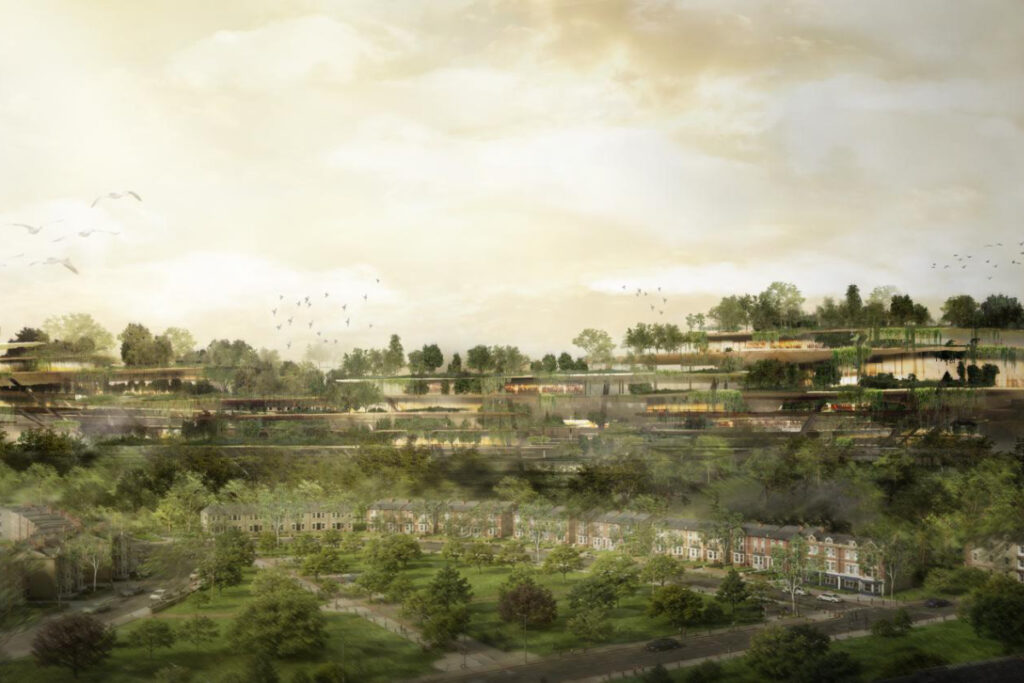
HAS Design and Research is one of nine winners of an international design competition to rethink the Crystal Palace.
A collaboration between the Museum of Architecture and the Great Exhibition Road Festival, the design contest invited participants to reimagine the Crystal Palace, which was burned down in 1936, on the occasion of the 175th anniversary of the Great Exhibition. It was held to explore how a new form of architecture should function and who it should serve in 2026.
Nine winning entries were chosen for display at the Great Exhibition Road Festival on June 6 and June 7.
Made of iron and glass, the Crystal Palace was erected incredibly fast to host the Great Exhibition of 1851 and received over six million visitors. After the world fair, it was relocated to Sydenham, but later ravaged by fire in 1936. The Great Exhibition exemplified industrial optimism of Victorian Britain at the height of its empire.
HAS Design and Research’s project, The UK Grand Crystal Palace, unfolds in the context of homogenised architecture and the legacy of the Great Exhibition. In fact, Victorian Britain promoted co-existence between nature and the city. In response to industrial pollution and overcrowding, it initiated the modern public park movement.
The UK Grand Crystal Palace is a new model for urban ecological architecture. A structure of an over 3km-ring enclosing a park is designed to accommodate plants, animals and human visitors. It is home to local flora, including endangered species.
“Functioning as a vast ecological lung for London, the project presents Britain’s indigenous natural heritage to the world while reinforcing the relationship between urban life and environmental restoration,” according to the concept note.
Made of locally sourced timbre, the structure integrates climate-responsive technologies and cantilevered sections to cool the temperature. Inside, the building can host a wide range of activities from exhibitions and summits to commercial spaces.
“It symbolises a new vision for the future: an architecture no longer centred solely on humanity, but one that embraces plants, animals and ecology as equal participants in a new non-human-centred world,” it added.