

Editor’s note: This is an updated version of an article which first appeared on The Athletic in February 2025.
At the aptly-named Vitality stadium, 48 hours before Bournemouth’s game against Wolves in the Premier League, Andoni Iraola was smiling, laughing and talking about the importance of creativity and animation, chemistry and happiness, in football and beyond.
“I don’t have complaints,” he said. “I think we have a very good changing room, a healthy one. It’s something that will give you a lot of points at the end of the season. When problems come, you know the people you want next to you. I’ve no complaints. Happiness brings points.”
It is an unexpected twist in the conversation, because Iraola then nods to the book on the desk in front of him and said: “This is very unhappy — a dangerous route.
“But I liked the book.”
The book in question is Frankenstein by Mary Shelley. Iraola mentioned it to TNT Sports’ deaf language programme Sign Up before this interview. Not only has Iraola read the novel — a long time ago, he says — but, after becoming manager of Bournemouth, he visited Shelley’s grave.
Something known locally, if not so much nationally, is that Shelley is buried in the middle of Bournemouth.
“I read it when I was, like, 19, 20 years old,” Iraola said. “I remember the process, because I started by reading Dracula by Bram Stoker and I really enjoyed that one. It was a different book, written differently — in (the form of) letters — one envelope, then another. I really enjoyed it, and from there I thought: ‘OK, now I go to Frankenstein, it could be something similar.’
“But now, when I remember, Frankenstein by Mary Shelley is completely different. It’s nothing to do with Dracula. But I also enjoyed it.
“The connection with Bournemouth, I didn’t know until I came here. One day, just out walking with my wife, I think she told me: ‘I’ve read Mary Shelley’s grave is around here’. And it is in the middle of town. You can go there and see it. It’s nice to see, it doesn’t look like something special, but I think it is part of the history here. I liked the experience.”

Mary Shelley’s grave at St Peter’s church in Bournemouth (Michael Walker/The Athletic)
Iraola confirmed the outside impression of an uncommonly cerebral football man with a hinterland. He was studying Law when moving into the professional game as an Athletic Club player over two decades ago. He says reading has always been part of his life, including his football career.
“I started reading quite early and I remember all my football life — I was a professional from 20 — I used my travels by bus, plane, always with a book,” Iraola said. “It was not part of my preparation, but it helped me forget what was happening around me for one hour, two hours.
“What I get (from literature) is some distraction from football. When you start reading a book you are thinking about other things, you don’t think of football. It’s like going for a walk or riding a bike.
“Normally when I read, I read one book that is about detectives, quite easy, noir; and then I try to read one book that is more difficult intellectually, that requires more attention from yourself. It’s the way I’ve done it.”
Shelley was 20 when writing Frankenstein in the early 19th century, which Iraola agreed is mind-blowing when one considers the anguished and futuristic subject matter. It was published in 1818 and has never been out of print. She is buried in Bournemouth due to her son Percy — who lived in nearby Boscombe — moving her remains, and those of her distinguished parents Mary Wollstonecraft and William Godwin, from London. This paragraph hardly does her extraordinary life justice.
“The generations before ours, I think they were much more mature at the same age,” Iraola said. “We sometimes want to be eternal kids, continuing our studies until we are almost 30. Life was different when she lived. You had to wake up earlier. I think it’s amazing she can write this book at 20.”
Iraola was not painting himself as football’s intellectual — he was responding to questions — and is quick to get back to football. But occasionally he returned to the novel in front of him and said he still sees “two, three players with books” on Bournemouth away trips, even though “nowadays we’re all on the phone, still reading but in a different way”.
He sat with the initials ‘AI’ on his tracksuit top, and if ever there was an early entry into the world of artificial intelligence, it is the unnamed ‘monster’ summoned by Shelley’s Victor Frankenstein. “In a fit of enthusiastic madness, I created a rational creature,” Frankenstein declares at one point.
Iraola smiled again — he will come back to pithy two-word phrases such as “enthusiastic madness” — and talked about the creative process in the novel, and in football coaching. “There can be a similarity here,” he said.
“They create something in the book and they don’t know the repercussions, the consequences of what you are creating. Sometimes you will make mistakes creating. In this process you learn from mistakes and become better. I probably haven’t thought about it like this (gestures towards book), but it’s true that when you give some freedom, go to places that are new, you don’t know the end product.
“But sometimes you have to risk. Luckily for me — and not for the book — we are talking about football. The consequences are not as bad as what happens in the book. You can lose games, in the worst case (scenario) you can be sacked. But even if the worst happens, it’s only a game.”
He pauses, then adds: “But if you fail, I always say, you have to fail with your ideas.”
Iraola said his coaching ideas are not much changed from his first days as a manager at AEK Larnaca in Cyprus, which was eight years ago. He moved from there to Mirandes in La Liga’s Segunda Division, then to Rayo Vallecano and, in June 2023, to Bournemouth. Iraola left Bournemouth at the end of the season, but not before securing Europa League football.
“The things that have given me the chance to be here, to coach in the Premier League, are ideas I trust in from the start,” he said. “You have to adapt, but if you saw the first games I coached in Cyprus, what the team was trying to do is very similar to what we are trying to do here. You learn in the process, but the main idea doesn’t change a lot.
“I was clear in what I wanted to do. I had to learn a lot of small things — some not so small, influential — but the main approach I haven’t changed because it’s the way I love football to be played and it’s the way I feel comfortable coaching. I could play a different way, and I have the tools to do it, but I think I would be a worse coach practising a way of playing I don’t feel inside.”

Iraola, playing for Athletic Club, challenges Villarreal’s Robert Pires during his playing days (Jose Jordan/AFP via Getty Images)
Iraola’s style could be described as collective structure combined with dynamic individualism. After Bournemouth’s 4-1 dismantling of Newcastle at St James’ Park in January 2025, midfielder Tyler Adams encapsulated the approach as “controlled chaos”.
It was a two-word compliment, but it is terminology Iraola does not want to encourage. Organised spontaneity might be more appropriate. Nor is he eager to punt any Marcelo Bielsa comparison — Iraola was coached by Bielsa in Bilbao. “Marcelo is… you learn a lot from him. I’m quite conventional,” Iraola said.
“I’m not sure if I like, when they talk about my teams, the use of this word (chaos),” he said. “People have used this term, especially here in England, and I understand what they mean, but I think there’s much more organisation behind it than it looks.
“There has to be good organisation and from that good organisation there can appear very good ideas — what the players do when they are on the ball — but you have to put in starting points. It’s dangerous to associate creativity with everything being a mess. You have to put in the structure and get in a position from where players have to make their own decisions.
“The game is for the players. Coaches are just the assistants. Coaches cannot pretend to control the game — luckily for the game. But I try to encourage this creativity, try not to limit touches in training for example, try to encourage them to carry the ball, go one against one, take risks. Because I think it’s the easiest way to make a difference.
“You can organise patterns but, collectively, a lot of things have to go in synchronicity; players going by their own can make a difference.”
Iraola is not chastising Adams. He is clarifying a coaching attitude.
“It’s something that you have to develop in training every day,” Iraola says. “Sometimes I love drills in training where players have to make a lot of decisions. It’s not just a closed exercise where you tell them to pass from there to there. Normally we try to train with opposed drills, otherwise I see it as a little bit artificial — unopposed training. If you have someone challenging, it becomes something completely different.
“In these drills sometimes they even have to cheat, or find ways to win the exercise. I think they are good for developing collectively and individually. From academy level, it’s something I encourage in the coaches, to find exercises that are demanding mentally for the player.”

Iraola overseeing training (Robin Jones – AFC Bournemouth/AFC Bournemouth via Getty Images)
When The Athletic visited Bournemouth, it was hard to miss Iraola’s warmth, and how the players responded to the environment. However, Iraola said managerial distance is a quality he has had to acquire since his Larnaca days.
From this, however, flows his vital human ingredient, chemistry, and that leads to all-important workplace happiness.
“When I have to make decisions, I have to be very cold,” he said. “Sometimes you want a player you really like personally to do well, but if he’s going to be worse than another player you don’t like so much you have to think of the group. That’s hard.
“You have to think of the kind of people you want around your club and who will make the group of players and the atmosphere around the club better. Sometimes there are players you don’t think deserve to play but you know will give you more chance to win. You have to choose and you have to be honest.
“Chemistry is key. It is mandatory. I have not seen many teams get good results without chemistry, but it is something you have to build. You need good leaders to set a culture inside the club, clear values, because on the pitch, these values will appear.
“Happiness is very important. That’s the reason why managers value players who don’t play a lot but train very well. They are difficult to find and these are the players no manager wants to lose. For me these players are really valuable, even if the players don’t feel it the same way.
“This is one of the main parts of chemistry. If you’re playing, it’s very easy to be happy, but the ones who continue to push even when not playing keep the level high.”
Iraola is earnest, serious in this moment. In Frankenstein, Shelley wrote: “When falsehood can look so like the truth, who can assure themselves of certain happiness?”
Back in February 2025, Iraola knew what he was creating at Bournemouth. It was a big smile.

GO DEEPER
Guipuzcoa: The tiny Spanish province that is big in the Premier League and beyond
Before that weekend’s game, on Saturday at lunchtime, across from St Peter’s church is a pub where fans of Bournemouth were beginning to gather for pre-match pints. It is called the Mary Shelley. There is a Hammer Horror version of Frankenstein’s monster’s head on the sign.
Inside, Andrew and Brian, long-time Bournemouth supporters, were chatting. Andre was beaming. He was at Anfield in August 2022 when Liverpool hammered Bournemouth 9-0, so he relished last season — never mind the one just passed. “Eleven hours on a coach; now we’re beating Man City,” he said.
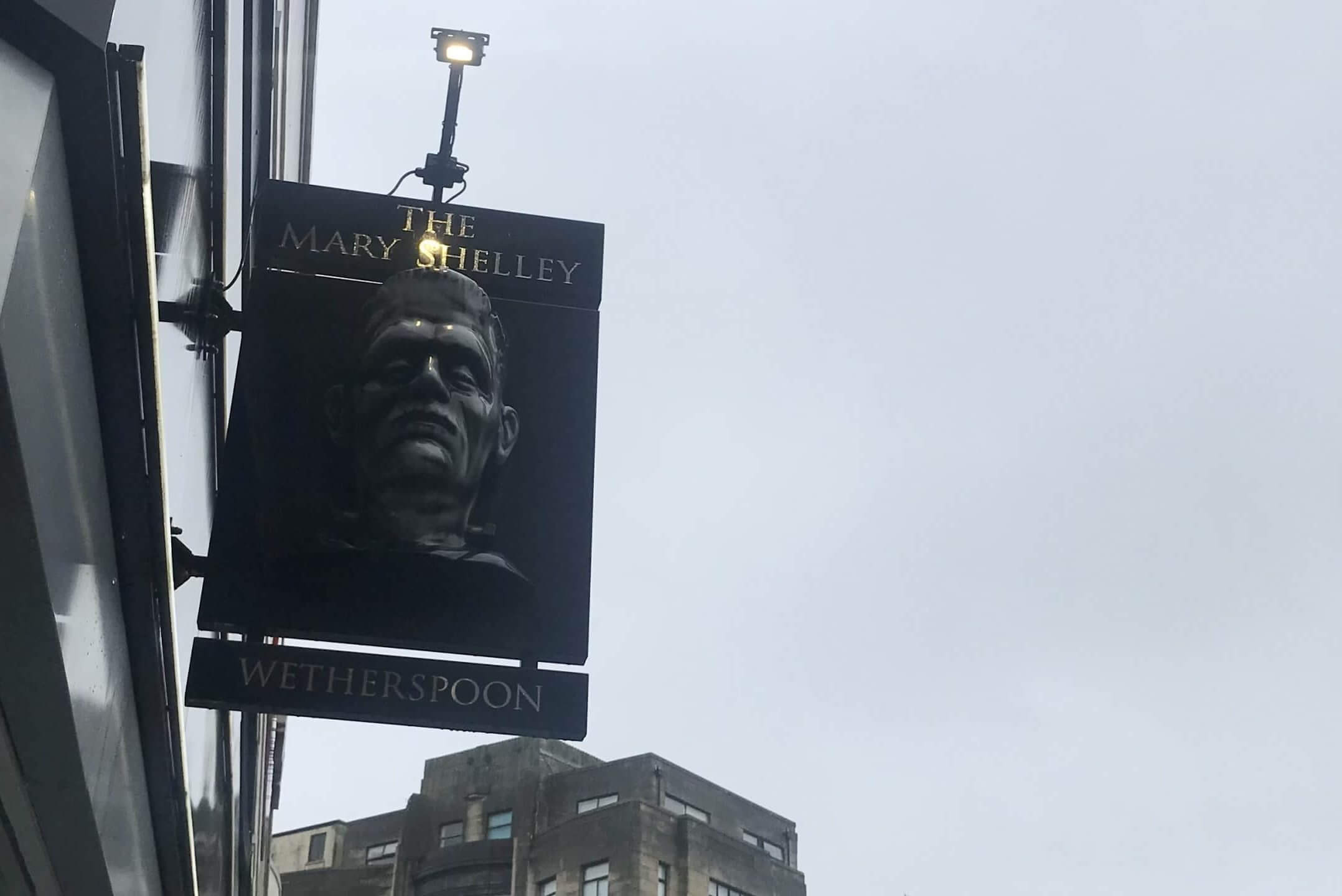
The Mary Shelley pub in Bournemouth (Michael Walker/The Athletic)
When he hears Iraola had been across the road to the churchyard to visit Shelley’s grave, he is impressed. But he was already.
“Eddie Howe should have a statue outside the ground and Iraola is absolutely incredible,” he said. “Iraola has developed these players, Justin Kluivert, Ryan Christie and a lot of the others. He’s lifted them up to such a high standard. And they give it their all, you see that. It makes you feel proud as a supporter.”
Bournemouth lost that weekend, and did not qualify for Europe. But this season they did, finishing sixth in the Premier League.
Now Iraola has left Bournemouth and joined the team that finished one place higher than them in the Premier League — Liverpool.