

The free-to-enter competition invited participants to explore a new, modern form for the 19th-century iron and glass landmark, which burned down in the 1930s.
The nine winning entries will be displayed during the Great Exhibition Road Festival to be held at London’s Exhibition Road, South Kensington, this weekend (6 and 7 June).
The winning designs range from a large textile canopy suspended by slender scaffold poles, created by Kupeki to respond to the textile tradem which thrived during the age of British imperialism, to a 1.8-mile ecological ring built to accommodate plants and animals as well as visitors, drawn up by Jenchieh Hung + Kulthida Songkittipakdee/HAS design and research.
The Museum of Architecture said: ‘What unites the selected winners is a shared reckoning with the original building’s legacy.
‘The Crystal Palace of 1851 was a triumph of prefabrication and scale, but it was also an instrument of imperial display, gathering the spoils of extraction and colonial trade under a single glass roof.
‘Each of the nine selected projects engages with that inheritance, whether through material accountability, ecological restoration, post-colonial critique or the celebration of the communities and knowledge the original exhibition left out.’
The Crystal Palace was erected in just 17 weeks to host the Great Exhibition of 1851, and received more than six million visitors. After the exhibition, it was relocated to Sydenham, south London, but was destroyed by fire in 1936.
Plans to reimagine Joseph Paxton’s landmark building were abandoned by Bromley Council more than 10 years ago.
One of the winners of the latest competition, Edward Norman’s The Unfixed Palace, rather than suggesting a new building, proposed generating a field of mist between 3 and 8m above the site.
This would create ‘atmosphere, partial visibility and collective presence’ where the 1951 palace ‘made the world measurable and ordered’, said the Museum of Architecture.
Coinciding with the 175th anniversary of the original palace’s construction, the competition invited designers, architects, students and creative thinkers from anywhere in the world to submit entries.
Submissions comprised a single A2-sized digital page along with a 500-word project description and a series of individual images for publicity.
Entries were judged by architectural historian Neal Shasore, communication consultant Rob Fiehn, Museum of Architecture founder and director Melissa Woolford, and Imperial College London professor of materials engineering Ambrose Taylor.
The Museum of Architecture is a UK-based charity and cultural institution dedicated to finding new ways for the public to engage with architecture, and probably best known for its annual Gingerbread City exhibition.
The winners
The Palace of Returns by Beste Aykut
The Palace of Returns by Beste Aykut
Sited on Exhibition Road, this open arcade is formed from 175 reclaimed structural ribs, one for each year since 1851. Each component carries a visible material passport recording its origin, labour and carbon history. At the exhibition’s end, the ribs are dismantled and distributed to schools, community gardens and repair workshops across the city, making redistribution the central architectural act.
The Unfixed Palace by Edward Norman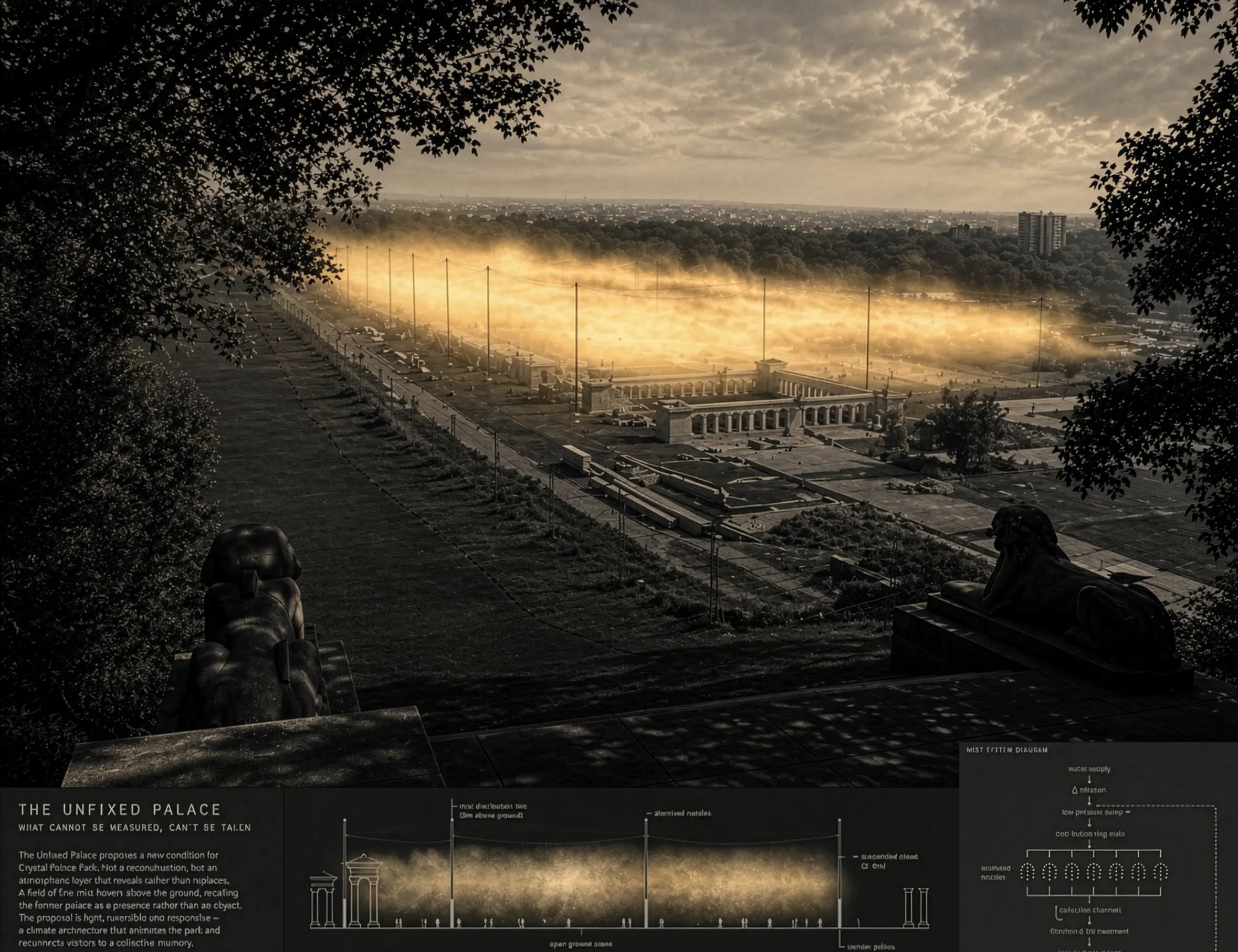
The Unfixed Palace by Edward Norman
Rather than constructing a building, this proposal suspends a field of mist above the original Crystal Palace footprint in Crystal Palace Park. Hovering between 3 and 8m, the responsive cloud thickens in humidity, disperses in wind, and glows at night. Where the 1851 palace made the world measurable and ordered, this offers atmosphere, partial visibility and collective presence.
UK Grand Crystal Palace by Jenchieh Hung + Kulthida Songkittipakdee / HAS design and research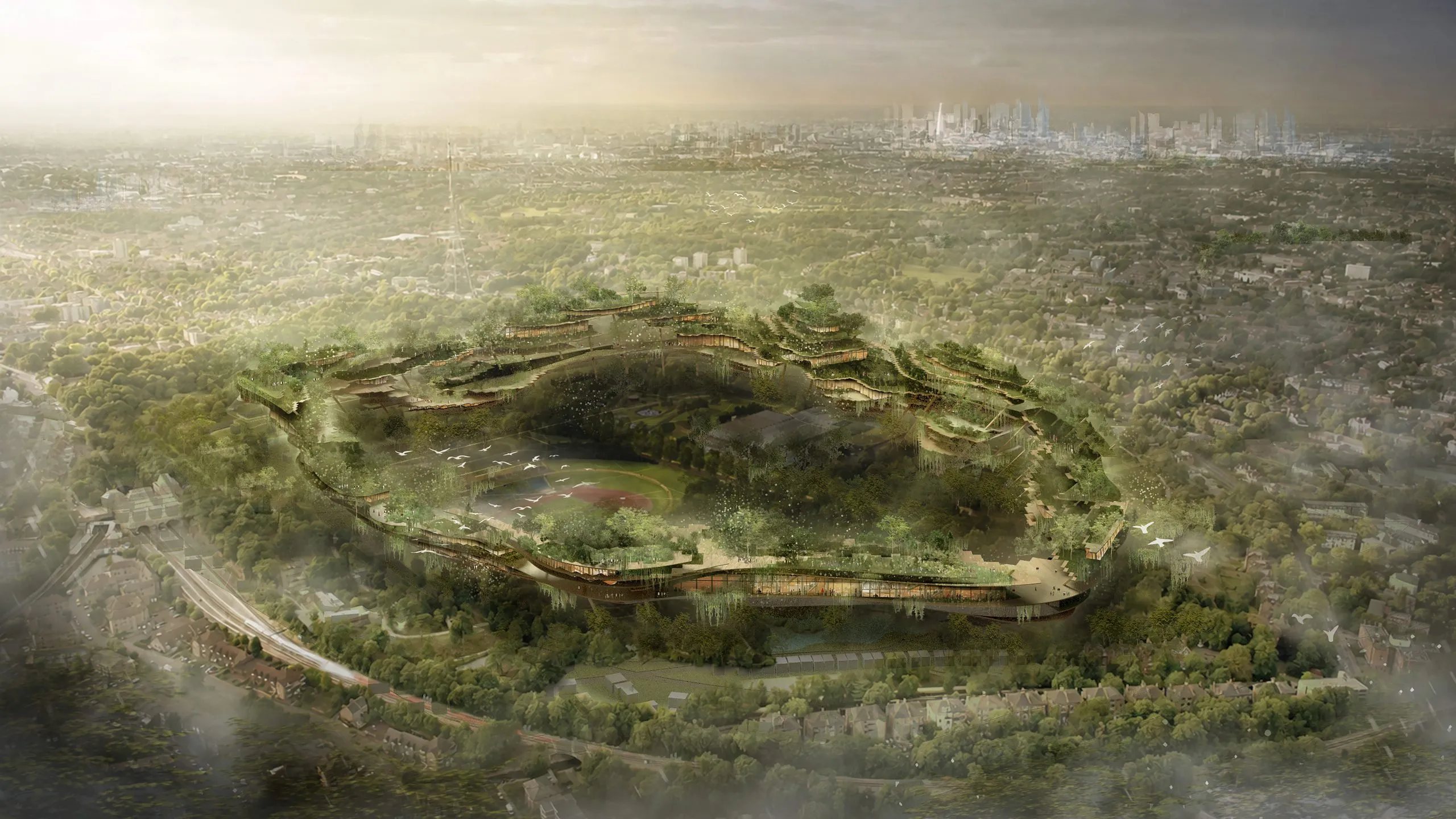
UK Grand Crystal Palace by Jenchieh Hung + Kulthida Songkittipakdee / HAS design and research
A continuous ecological ring extending more than 1.8 miles around Crystal Palace Park, enclosing 85ha of restored native British habitat, including heather, oak, rare orchids, as well as the insects and birds that depend on them. Constructed in mass timber, the structure redefines architecture not as a monument to human progress but as a living ecosystem in which plants and animals are equal participants.
A Field of Return and Exchange by In Saison
A Field of Return and Exchange by In Saison
Returning to the original Hyde Park site, this proposal replaces the singular Crystal Palace with a fragmented landscape of lightweight modular structures distributed across the historic footprint. Workshops, gardens, forums and repair spaces prioritise participation over display. The original building’s grid remains faintly legible beneath the new interventions, holding past and present in deliberate tension.
Woven Commons by kupeki
Woven Commons by kupeki
Located on the abandoned North Lower Terrace in Crystal Palace Park, this project responds to the textile trades that powered British imperialism with a woven canopy suspended on slender scaffold poles. It creates a shaded civic space for fashion repair, community kitchens, cooling gardens and open public events. Built from recycled fabrics and designed for circularity, it transforms a site of imperial absence into shared infrastructure.
A Simulated Future Civic Framework by Daniel van der Poll
A Simulated Future Civic Framework by Daniel van der Poll
Conceived as a contemporary successor to the Great Exhibition, this proposal establishes a repeating structural grid radiating from the original Crystal Palace footprint, supporting interchangeable canopies, platforms, exhibition halls and pavilions. Permanent infrastructure carries fluid programmes, ranging from world fairs to local markets, and the modular system is designed to be reproduced in cities around the world, forming a distributed global network.
Monarch by Dominiq Oti
Monarch by Dominiq Oti
Positioned in Hyde Park, Monarch takes migration as both its subject matter and its structural logic. Large-scale industrial gantries – referencing the frameworks used to build great ships – support shifting curatorial installations exploring the successive waves of migration that have shaped British identity. Named for the monarch butterfly, the project is provisional, adaptable and polysemous, designed to leave traces rather than fix meanings.
After the Palace: A Necropolis of Return by Dr Harriet Harriss, Naomi House and Heidi Lu
After the Palace: A Necropolis of Return by Dr Harriet Harriss, Naomi House, Heidi Lu
A counter-monument in Hyde Park built from post-colonial waste streams, it features salvaged rubble, contaminated soils, mycelium binders, composted textiles and mineral debris. Conceived as a sarcophagus designed to decompose, the structure slowly transforms into fertile ground over the exhibition period, redistributing material to rewilding and remediation sites on former extraction territories. Where the Crystal Palace sought to immortalise industrial progress, this insists on mortality, decay and return.
Unbuilding the Crystal Palace by Samuel Young and Oliver Hartley
Unbuilding the Crystal Palace by Samuel Young and Oliver Hartley
This project inverts the original building’s logic of extraction and spectacle. Demolition material quarried from across London is gathered, encoded and assembled by displaced workers whose accumulated knowledge and technique become the architecture itself. Gabions of carefully sorted debris give way to vaulting, cut stone, faience and carving. Construction becomes collective craft, collective education and a new form of city-making.