
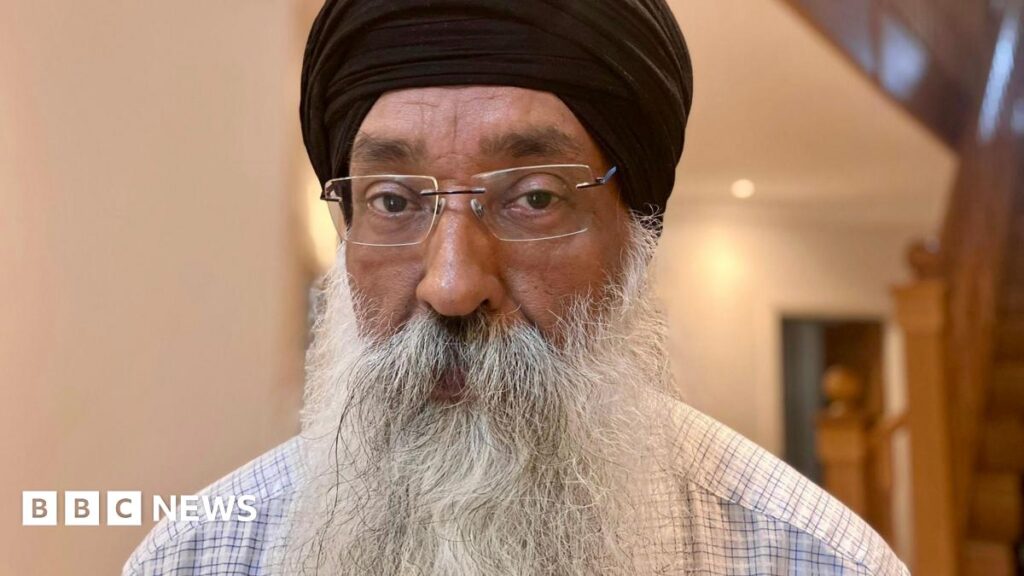
Singh said the Sikh community had found the case and the attention surrounding it “quite difficult”, as it had “called into question our faith and what we believe”.
“This is not about the Sikh community and its religion, this is about one individual, and trying to get that across in the current political environment has proved really difficult,” he said.
In particular, the law surrounding the Sikh ceremonial knife, which is sacred to many, has been called into question by some politicians and commentators.
Under current legislation, a practising Sikh may wear a small, curved blade, known as a Kirpan, close to the body but drawing it in an act of aggression is illegal.
Section 139 of the Criminal Justice Act 1988, external states that it shall be a defence for a person charged with having an article with blade or point in public place to prove that they had the article with them for religious reasons.
This legislation also applies to anyone wearing it as part of national dress, such as a sgian dubh blade worn as part of Scottish Highland dress.
If the item is used in an act of violence then it is deemed an offensive weapon.
Following Thursday’s verdict, the UK Sikh Federation said in a statement: “Fully practising Sikhs who wear a Kirpan should continue to recognise the serious responsibility that accompanies it, together with the limited legal protection that exists for wearing it for genuine religious purposes.”
The federation said it believed the large blade used by Digwa “was not the normal Kirpan worn by fully practising Sikhs”.
“That’s what we wanted to clarify – that actually the perpetrator used an item which can only be called an offensive weapon,” it added.
Singh said: “There just hasn’t been any incident like this but, nonetheless, there is something for the community to do, to make sure every fully-practising Sikh that wears a Kirpan understands the law and understands that if you use your Kirpan offensively, it ceases to be a Kirpan.
“It becomes an offensive weapon, it’s simple as that.”