

Before heading to the airport, I get in touch with an old Dutch footballer to ask what has gone wrong with Raheem Sterling.
Jan Everse, a former Netherlands international, started his career at Feyenoord. He played with Johan Cruyff at Ajax and went on to manage PEC Zwolle, with a young Arne Slot in his team. But his focus, as a Rotterdam man, is always Feyenoord. And he is amused that a sports writer is flying in from the UK to watch a player who, in different circumstances, might have been playing at this summer’s World Cup.
“You’re coming to see Raheem Sterling?” he asks. “Does your boss not like you very much?”
Sterling, he explains, is having a bad time. How bad?
“It’s over,” he states, very matter-of-factly. “I hope I’ve made a mistake and misjudged him, but I don’t think so. Look at the comments on the internet — the fans are killing him. ‘The biggest failure in our history’, they are saying.
“He’s not fit. If he makes three or four sprints, you don’t see him for 20 minutes. He’s not explosive any longer. He falls over his own legs. He’s hesitating. He’s anxious not to make mistakes. One against one, he never passes a defender. So now, without his old speed, he plays the ball without risk. He has no confidence, and that’s because he knows he cannot do what he wants to do.
“I feel pity for him. I don’t feel pity for a lot of footballers, because I know how much they earn. But I feel pity for him because he was such a fantastic footballer and I can see the old Raheem Sterling in my memory. It’s not a happy marriage. And if you feel pity for a player with his qualities, and his background, you know it’s over.”

Raheem Sterling did not get a kickstart by moving to Feyenoord (Bas Czerwinski/AFP via Getty Images)
It’s over? At the age of 31? I came off the phone thinking it must be worse than I had imagined but, equally, I want to see it with my own eyes. I’ve been writing about Sterling since he made his breakthrough as a 17-year-old at Liverpool, throughout his years at Manchester City and a long, often brilliant England career. I know what a tough character he is. I’ve seen, close up, his elite mentality.
Arriving in Rotterdam, however, I’m not detecting much sympathy from the supporters who have gathered at Oude Haven (Old Harbour) or, opposite De Kuip stadium, the strip of bars and eateries in Puck van Heelstraat where fans congregate for pre-match drinks and patat broodjes.
“Did you see what Willem van Hanegem had to say?” asks one supporter, Dennis, wearing Feyenoord’s red and white shirt among a beery, boisterous crowd outside the Hollywood pub. “Because that’s how everyone feels. At this point, everyone will be happy when it’s over.”
Van Hanegem is one of the greats of Dutch football and such a legendary figure at Feyenoord there is a stand named in his honour. He has said of Sterling: “If I were them (Feyenoord), I would ask for my money back and say, ‘Just go home’.”
I’ve already been told that Sterling’s absence of form has led to some tense moments between Feyenoord’s head coach, Robin van Persie, and some of the journalists who follow the club.
Van Persie has had some harsh write-ups of his own this season. In February, he handed a bouquet of flowers, pointedly, to two of his press box critics to mark his first anniversary in the job. The criticism of Sterling has been another sore point. “Typically Dutch,” Van Persie complained, arguing that it was unfair to judge the player until he had been there six to eight weeks. But then we reached that point and Sterling was out of the team. So then what?

Robin van Persie has defended Sterling since his arrival in January (Peter Lous/Eye4Images/NurPhoto via Getty Images)
Their game on Sunday felt very much like Sterling’s goodbye to Rotterdam. Feyenoord drew 1-1 with AZ to guarantee a second-place finish and Champions League qualification. It was their final home match of the season and Jordan Bos, an Australia international, played in the wide-left attacking position that Sterling was supposed to fill. Bos, to put it in context, is usually a left-back.
It was the third game in four that Sterling, on a short-term contract, was an unused substitute. And, crazy as it might sound, I wonder whether Van Persie may have kept him off the pitch to spare him, potentially, from any more of the ridicule that has attached itself to his previous performances.
The game, for example, at NAC Breda in March, when Sterling made his first start for his new club. He was substituted just after the hour. “Sterling didn’t start well,” Van Hanegem wrote in a column for Algemeen Dagblad newspaper. “Then he was laughed at by the crowd. I don’t really like that. That boy has won everything in his career; show him some respect.”
Or the home game against Groningen last month when Sterling entered the play as a 74th-minute substitute. A Dutch journalist sent me an update, via Whatsapp, late in the second half. “It’s getting a bit sad now,” it read. “Sterling just got on the pitch, gets a ball played to him and falls over while trying to run past a defender. Everyone’s just laughing at him in the stadium.”
In happier times, there were questions at England press conferences about whether Sterling was a future Ballon d’Or winner.
Maybe, on reflection, it was a bit over the top bearing in mind he would have had to get past two half-decent footballers by the name of Lionel Messi and Cristiano Ronaldo. But Sterling was seven years younger than Messi, whereas the gap to Ronaldo was almost a decade. What about when those two had moved on? Could that be Sterling’s time? And Gareth Southgate, then England’s manager, nodded in agreement, absolutely not ruling it out.
“In terms of, ‘Can he fulfil it?’, he’ll give himself every chance,” Southgate told reporters after a 5-3 win over Kosovo in 2019. ”There are some outstanding players around — (Eden) Hazard, (Kevin) De Bruyne, Messi, Ronaldo. But he (Sterling) has got the drive, he’s got the professionalism, he’s got the ability. He’s physically and mentally strong for such a small-statured lad.”
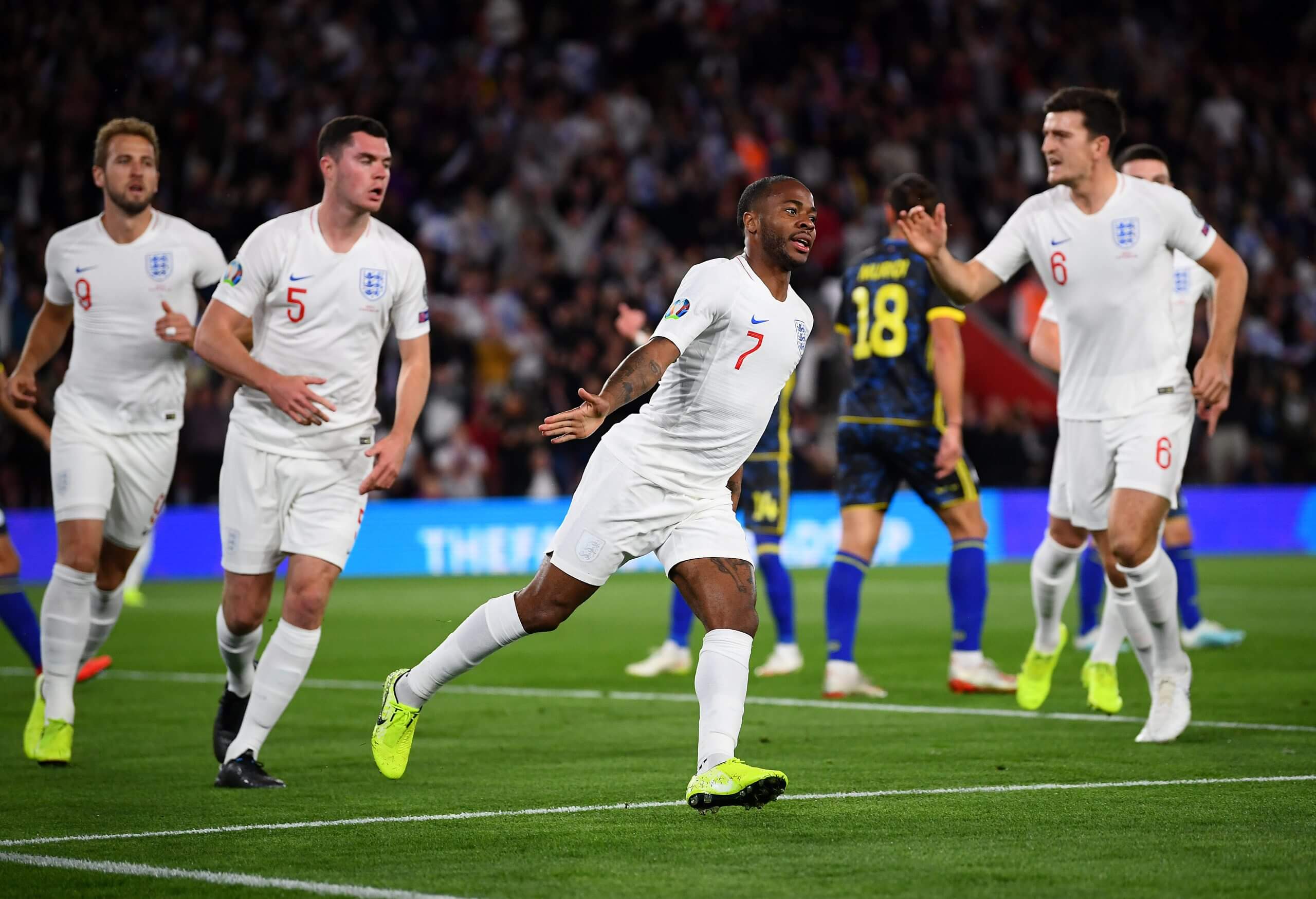
Raheem Sterling at the peak of his powers against Kosovo in 2019 (Clive Mason/Getty Images)
Well, he got close (ish). Sterling was 12th in the Ballon d’Or voting that year, then 15th when the award returned in 2021 after a year’s absence for Covid-19. For England, his 82 caps took in three World Cups. At the European Championship in 2021, he was named in UEFA’s team of the tournament.
There were four Premier League titles with Manchester City. At Liverpool, he won the Golden Boy award as the world’s best young player. And let’s not forget his MBE, in the queen’s 2021 birthday honours list, for his services to racial equality as a serious, socially engaged footballer. Ignoring, for one moment, how it ended for him at Chelsea and Arsenal, it is the kind of career that commands respect among anyone who has ever kicked a ball for a living.
So I wait for Van Persie after Sunday’s game to find out more. What has gone wrong? And what happens next?
He chooses his words carefully. “The question with Raheem was never about his qualities,” he explains. “He has scored over 200 goals in England (it’s a slight exaggeration, but OK). In my opinion, he was, and still is, a winner. And, from day one, he has worked really hard. We were building him up, fitness-wise, and he was slowly getting better… but, at the same time, we had to win every single game to achieve our goal of Champions League football.”
That last line — the inevitable ‘but’ — feels particularly relevant. What it doesn’t quite explain is why, three months in, Sterling seems further away than ever from the team. Yet Van Persie does also make the point that there were mitigating circumstances, out of the player’s control, to explain why “we knew (from the start) his match fitness was not at our level”.
Before the move to Feyenoord, Sterling had seven months without football because of Chelsea’s decision to ‘bomb-squad’ a player who had cost them £47.5million from Manchester City. There were 17 league appearances during a season on loan at Arsenal, but only seven of them starts, and three 90-minute performances in all competitions.

Sterling has only featured sporadically for Feyenoord (Sonny Lensen/ANP via Getty Images)
Ostracised by the club that was paying him £325,000 a week, Sterling took on a personal trainer while he was at Chelsea. His name is Ben Rosenblatt and, before leaving Rotterdam, I call him to ask about the accusation, in football language, that Sterling’s legs have gone.
Rosenblatt has coached more than 1,000 athletes, including world and Olympic medallists. “I’ve been in football and professional sport long enough to know that everyone has an opinion,” he says. “But I also know it’s a very fickle world and opinions can change very quickly. My experience — and I’ve talked about this to Raheem — is that it takes only one moment to change everyone’s opinion and give yourself positive momentum.”
The player, in Rosenblatt’s words, is “a freak, an incredible specimen”. As part of a specially tailored fitness regimen, Sterling was put through his paces at an alpine test track near Surrey, a two-mile stretch of steep, snaking slopes used by the British army to test tanks and armoured vehicles. But it is also clear how all that time without football has left Sterling playing a long game of catch-up.
“It was gobsmacking,” says Rosenblatt. ”When we started working with him, I was definitely thinking, ‘I don’t know how this guy can play again’. Then, within a few sessions, it was, ‘Oh, wow, that’s impressive’. We were able to get him to the point where he got back into training (at Feyenoord) and didn’t look out of place. Fundamentally, though, if you think about it in the context of pre-season, he was playing again after a week or two weeks, with all that pressure and expectation. That is something Raheem can handle, by the way. But there is a reality to it.”
It all makes sense even if, unfortunately for Sterling, he may have to understand that these questions will persist unless he rediscovers his touch next season, presumably for a new club. Major League Soccer, perhaps? Or the Middle East? Or is there a club in the Premier League who would take a gamble? All that can really be said for certain is that Sterling may have to re-invent himself during the summer.
He was, after all, a machine earlier in his career, playing more than 50 games in eight successive seasons (or 40-plus in 11). By the time he was 29, he had well over 600 games under his belt, all at the highest level. That, in turn, makes it inevitable there will be fears of burnout. Has everything caught up with him? Is he now at the point when age becomes his toughest opponent.
“I’ve enjoyed working with him,” says Van Persie. “There’s one more game to play next weekend (at Zwolle) and then we’re going to sit down together and ask him how he liked his time with Feyenoord and how he sees the future. We will do the same, from our point of view. Then we will decide if he stays or takes on another challenge.”
The stories last week that Sterling had already been told were incorrect. It feels like it is coming, though. And if nothing else, at least it seems to be heading towards a dignified parting. Everyone at Feyenoord says the same: that his attitude has been impeccable, that there have been no issues behind the scenes and that, despite it not working out, it has been good for the other players to have him around.
Ultimately, though, it is tempting to think Van Persie might regret ushering in Sterling as “one of the biggest transfers in the club’s history”. The player was billed as ‘Raheem the Dream’ and Feyenoord were so keen to give him the red-carpet treatment they moved training across the Belgium border to Tubize, 85 miles away, so he could be involved while he was waiting for his work permit.
Since then, Sterling had made only seven appearances, and just four in the starting XI. He has not scored a single goal and, though Van Persie generously pointed out there was an assist in a 2-1 win against Excelsior in March, Sterling’s place has often gone to a 19-year-old, Tobias van den Elshout, since he was removed from the team.

Sterling and his Feyenoord team-mates acknowledge the fans on Sunday (Bas Czerwinski/ANP via Getty Images)
Van den Elshout is usually a central midfielder and that, according to Everse, is damning in itself. “So you have Feyenoord playing some very important games (to qualify for the Champions League) and a guy from the youth team is playing instead of Sterling,” he says. “This boy (Van den Elshout) is a midfielder, playing as a left-winger. How can it be that a young player, who has never started games in the first team, is in the line-up, in a different position to usual, ahead of Sterling? That, for me, was end of story. You kill Sterling. Kill him! He looked very, very miserable.”
On Sunday, Sterling sat alone in the dugout — two empty seats on one side, three on the other. He has kept his distance from the Dutch media and it was made clear before the match that he would not be doing any interviews.
Later that evening, Marcus Rashford could be seen scoring a goal for Barcelona against Real Madrid in a Clasico win that helped his team claim the Spanish league. Rashford, three years younger, used to be one of the players Sterling was always measured against. Now, though, their careers are heading in opposite directions.
Yet it would be wrong to depict Sterling as looking miserable. At the end of the match, he gave his shirt to a young supporter in the stand. He went round each player with hugs and hand-shakes and he took his place, on the edge of the penalty area, as the team, the coaches and other members of staff lined up to acknowledge the crowd’s support.
Then something happened — a goodbye, a show of respect, whatever you want to call it — that felt out of keeping with the rest of the day. The crowd started singing Raheem Sterling’s name. And, for a few moments, it was just like the old times.