

“The president radiated charm and charisma and power. He stepped over to where Tyler was standing and said, ‘I’m Jacob Ramsey’.
“Then Ramsey made the introductions. He pointed and said, ‘John McGinn, my national security advisor. Matthew Cash, the NSA director’.”
That excerpt, taken from a 2025 short story titled Eleven Numbers, is a diversion from Lee Child’s Jack Reacher books, which regularly top The New York Times’ bestseller list, but carries on a key ingredient of them, which is sometimes subtle and sometimes obvious. That being Aston Villa Football Club.
It is approaching three decades since Child’s first Reacher novel and his first citation in them of Villa, his boyhood team.
The surname of Shaun Teale, a defender who played for the club from 1991 to 1995, was used in that book, Killing Floor, for character Mayor Teale. In the follow-up Die Trying, it was Paul McGrath, Dwight Yorke and, maybe most joyously, the polarising but memorable former club-record signing Savo Milosevic.
“It’s a layer of amusement for me and, in a way, that keeps it fresh,” Child tells The Athletic. “Weirdly, the hardest thing for me about writing is making up names. Villa players feel like a free supply of names.
“I can’t have a bad guy named after a Villa player, although I did have Milosevic. Most people thought I was talking about the Serbian dictator. I was talking about (a striker at the club from 1995 to 1998) Savo Milosevic, who couldn’t hit a barn door.”
Since then, other examples from the squad include Peter Withe, Gary Shaw, Juan Pablo Angel, Darius Vassell and Ashley Westwood and former managers John Gregory and Graham Taylor, whom Child recalls ringing up back in the days he worked for Manchester-based Granada Television, hoping on the off-chance he would pick up. As it happened, the club secretary put Child through to Taylor and they spent the next hour chewing the fat over all things Villa.
Leaning on Villa players for name inspiration can feel like a set-up to a joke or a question in a pub quiz — for instance, what do Tom Cruise and former Villa midfielder Morgan Sanson have in common?
Answer: Both are in Jack Reacher.
“When you’re writing a series with one recurring character, inevitably, it’s always a little bit autobiographical,” Child explains. “So I extended that, just as a bunch of in-jokes. Reacher has the same birthday as I do. He would not be a Villa fan, because how could he be? But he happened to be serving in the (U.S.) military and happened to be in Europe at the time and happened to go to Villa’s European Cup final in Rotterdam (in 1982) — a pure in-joke.”

Savo Milosevic in his Villa days (Mike Egerton/EMPICS via Getty Images)
So what makes a good character name?
“No S on the end, because the possessive then becomes ugly on the page,” says Child, 71, who has sold more than 100 million books. “I can’t have Ollie Watkins. After the first television Reacher series in 2022, the ratings were so incredible that Amazon offered me an insane amount of money to do Eleven Numbers.
“I had Ramsey, Cash and McGinn, but I desperately wanted Leon Bailey and Watkins in there somewhere, but I couldn’t have Watkins and I did not want Leon because it sounds not quite stuffy enough for Washington D.C., where the book was set. So I had Oliver Bailey, which, if you’re a Villa fan, you’ll see it seeded, but the rest of the world doesn’t notice.
“Suppose I was a Manchester City fan, and I suddenly had a character, Erling Haaland — that’s b****y in your face. You need to keep it subtle. You don’t want it to get in the way, but I do somehow translate their on-field personality to what I need for the story. So like McGinn, who, as a player, is a busy, controlling midfielder; I thought he would do for the national security advisor.”
The Reacher series spans 30 novels, initially written solely by Child himself, though he now collaborates with his brother, and fellow Villa supporter, Andrew. Through them, he became friends with Black Sabbath guitarist Geezer Butler, who has read his books and previously encouraged Ozzy and Sharon Osbourne to do the same.
Reacher was first adapted in 2012 as a movie, with a sequel four years later. Tom Cruise played Reacher in both, leading casts featuring Rosamund Pike and Robert Duvall. A successful, Cruise-less Amazon television series has followed, and is into its fourth season.
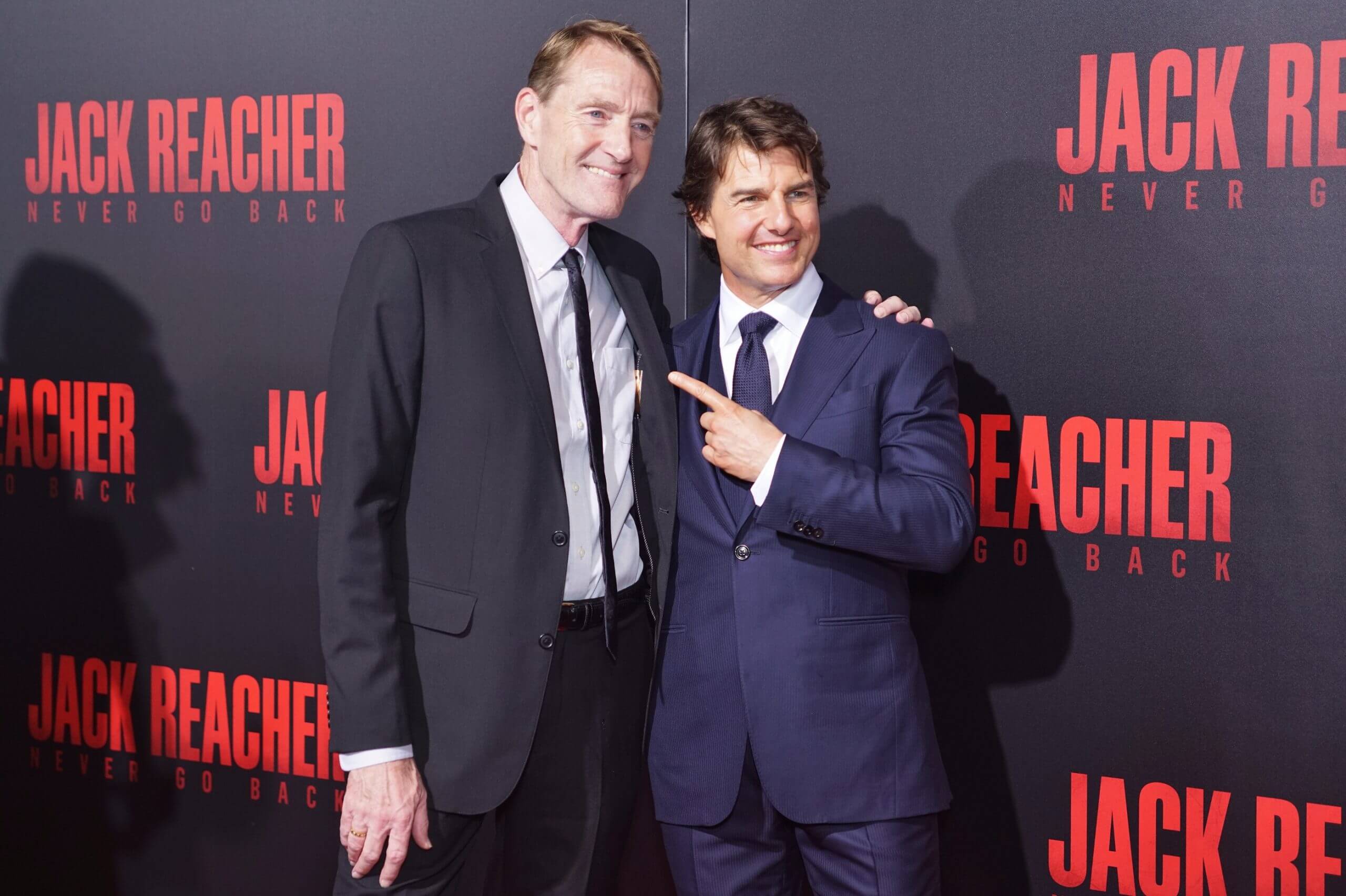
Child with Tom Cruise promoting a Jack Reacher film in 2016 (Ryan Theriot/WireImage)
Child meets The Athletic in a hotel restaurant in central Birmingham, having travelled down to the Midlands from his home in the Lake District in the north of England. As he puffs on a cigarette outside, he says how the city’s skyline has changed during the time he has been away.
His descriptions of Birmingham, similar to his memories of watching Villa growing up, are lucid and typically evocative. He even recounts a game away at Stoke City in the 1980s, where Villa won 3-0 and how it felt being in the away end.
Born in nearby Coventry, Child spent his early years watching West Bromwich Albion, another local side, with a friend and the boy’s father, before falling for Villa at the age of seven.
“April 21 was the 64th anniversary of my first Villa game,” Child says. “Back then, Birmingham was very different — most industry worked on Saturday morning. This kid up the street and his dad worked in a little tiny metal workshop in West Bromwich, and they were season-ticket holders. If it was a reserve game, he would give me the ticket, because his dad didn’t want to go. (And) If it was first-team and he had to work overtime, I would go.
“One time, a couple of weeks before Easter in 1962, we went to a reserve game, and it was Villa versus Albion at the Hawthorns. I hadn’t seen the Villa before, and these were only the reserves, but they were such a bunch of swaggering pirates, I instantly fell in love.
“Villa had first-team striker Derek Dougan, but he must have been rehabbing from injury because he’d had a bad car crash a little while before. He was unbelievable… superhuman. He scored a header I thought must have been from at least 80 yards. Villa, on a completely emotional level, chimed in with me, so I then abandoned the Albion.”
The following week, Child walked to Villa Park by himself. He was now living closer to the Aston district of Birmingham, though still several miles away.
“I was equidistant from the Hawthorns and Villa Park, so I just walked the other way,” Child says. “I had a sixpence in my pocket, which I had no idea whether it would be enough to get me in. I didn’t need money at all because there were always a bunch of old geezers who smuggled you in under the turnstile.
“That was Easter Saturday, and we were playing Leicester City. We won 8-3. There was another home game two days later on Easter Monday and I went to that as well, again being smuggled in by the old geezers under the turnstile.
“We beat Nottingham Forest 5-1. That became a poisoned chalice, because the Villa were pretty good for another few seasons, before the long decline into the third division. But once you’re committed, you’re committed. You can’t get out of it.”
Villa players and nods to the club’s history are sprinkled throughout Child’s books, yet he draws the line at certain names. Gordon Cowans, the legendary England international midfielder who helped them win the league and European Cup, was Child’s idol.
He speaks with reverence about Cowans. The last letter of his name is a no-no for the books, but for Child, it is difficult to envisage his hero in them anyway.
“He was, for a long time, the only superstar we had,” says Child. “He was as good as anybody in the world. He was slight and slender, but as a passer of the ball, he was unparalleled. I wouldn’t use him (in the novels) because he is too special to me.”
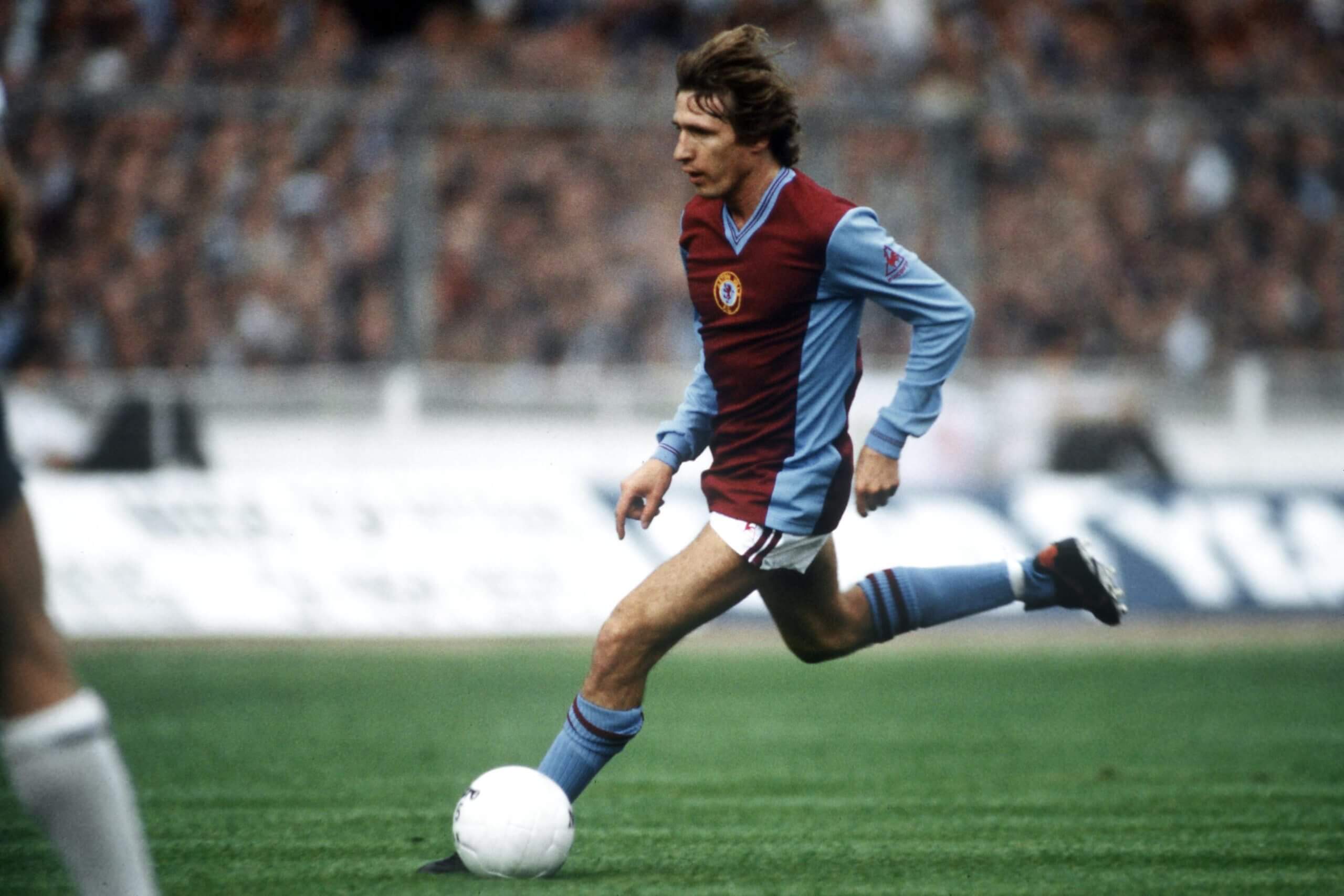
Gordon Cowans, one of the Villa greats (Peter Robinson/EMPICS via Getty Images)
“The publishers are never aware,” Child says of using Villa players’ names. “They don’t know at all. I even named towns after players. Perry Barr was my local station, so one character was called James Barr. There was a place in Montana I called Yorke, after Dwight Yorke and so on.”
The Athletic asks what the subtlest, or most random, Villa link has been.
“Well,” Child says, “I make the assumption nobody’s going to notice, because there are a lot of Villa fans but what is the Venn diagram overlap between them and Reacher fans?
“The one I like most is not a player at all. Villa’s old programme editor first contacted me 15 years ago and we have since developed this long relationship. His name is Rob Bishop. He shows up in the book Night School, as the head of a CIA station in Hamburg, Germany. No one was going to get that reference!”
The next instalment of the Reacher series is due out in October and current Villa midfielder Ross Barkley’s name appears in its pages. Or at least it did during the writing process.
“I had been contacted six months ago by Birmingham Town Hall,” Child says. “They wanted to have an auction for a character name to raise money, so I said, ‘I’ll do it, but you’ve got to get it to us before the book goes into print’.
“As a space filler, Andrew and I put in Barkley as a character, intending to do search and replace when we got the winner. The auction never happened, so we were stuck with Barkley, which did not work, because one of the other main characters was called Bisley and Barkley was too similar.”
For the next hour, Child discusses Villa manager Unai Emery, Tottenham Hotspur’s toils against relegation and the career trajectory of former Villa fan favourite Jack Grealish.
He questions football’s existential purpose and why fans become so infatuated. The conversation then circles back to Villa’s ongoing quest to win this season’s Europa League, which, naturally, leads to reminiscing about that 1982 European Cup triumph.
“I had dinner with that team. It was very cool,” says Child. “Captain Dennis Mortimer gave me a replica of his winner’s medal. They told me how Gary Shaw was at some back gate (in the stadium), handing out tickets to friends 15 minutes before kick-off.
“Tony Morley had a particular physical tell I had learned over the years. He would extend his arms to balance himself while dribbling. I learned that when his arms were exactly horizontal, he was going to beat his man. Sure enough, he goes and beats the full-back, actually twice, and then crosses for the goal.”
Child returned to England in 2024, having lived in the United States for 30 years, and has since revived his love of attending matches. After befriending a local electrician, he discovered the man and his son were also big Villa fans, so Child arranged for all three to travel down for the Champions League quarter-final second leg against Paris Saint-Germain last season.
“Talk about full circle,” he chuckles. “I’m back to being seven years old again, smuggled in under the turnstile. I get invited to the chairman’s suite at Villa Park, which is fabulous. It’s one of the absurdities of life — when you get rich and prominent, you don’t have to pay for anything anymore. I can email them and say, ‘Can I get four tickets in the chairman’s suite?’
“Coming back to England means I can watch Villa again. In every way, watching Villa is coming home for me.”