
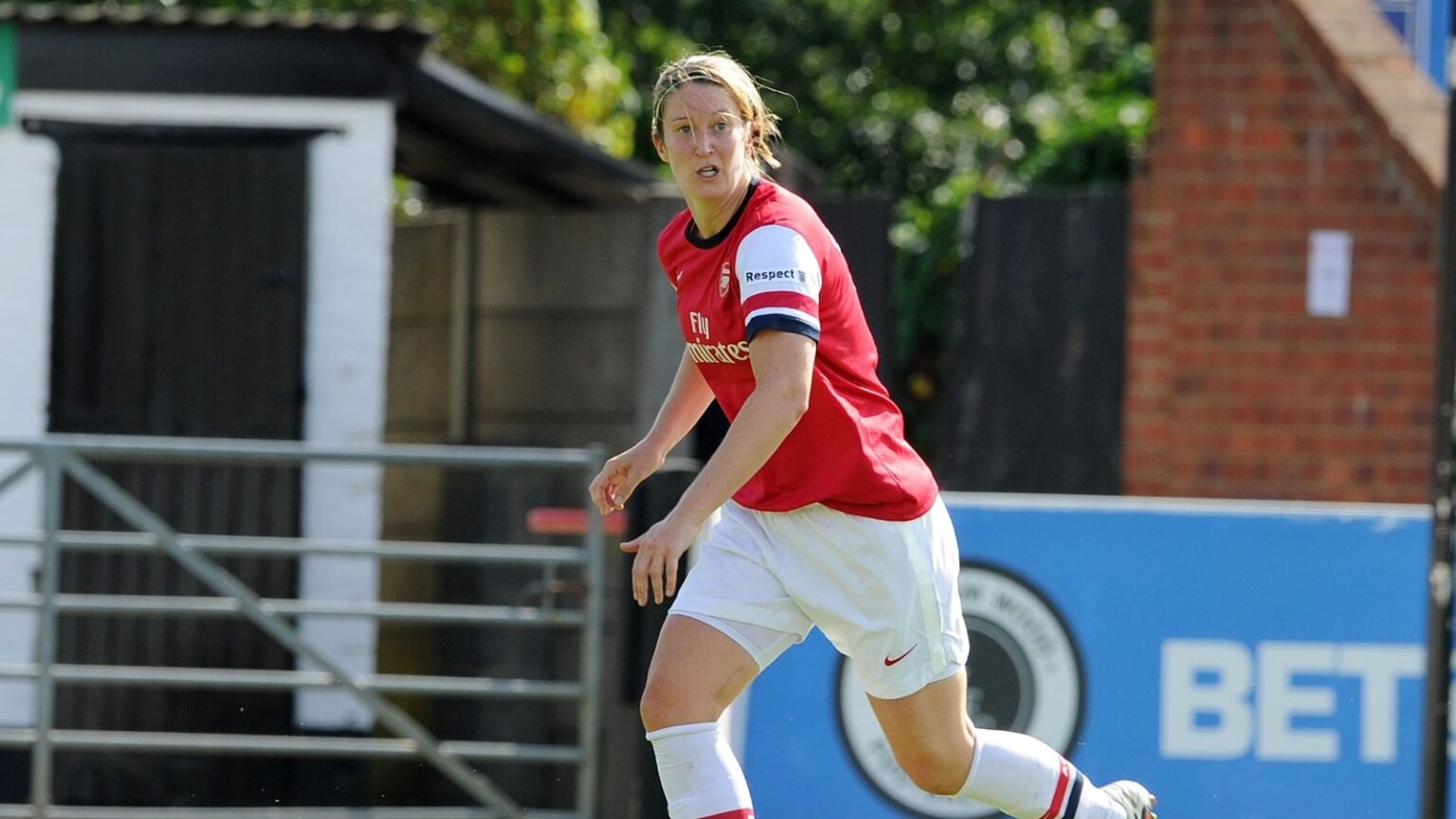
Ciara Grant is one of the most successful footballers of all time, having won 11 league titles, nine FA Cups, nine League Cups and a UEFA Champions League during 15 years in red and white.
Her Arsenal tenure split neatly in two: in the first half, she was a tough-tackling central midfielder with a penchant for a headed goal. In the second half, she was a central defensive colossus.
It all started in the 1980s in her home town of Waterford, a harbour town in south east Ireland. “I started playing football on the street with my friends and two brothers. I loved football and was a bit of a tomboy, and there weren’t any girls’ teams I could play for at the time.”
Like many players of her generation, Grant went straight into senior football. “I joined my local women’s team Benfica in Waterford at the age of about 13. I didn’t really think anything of this back then, whereas nowadays this wouldn’t be allowed due to league regulations. But I gave as good as I got on the pitch and I loved a good battle with the senior players.”
In 1998, aged 20, she caught the attention of Arsenal manager Vic Akers. “I played against Arsenal in a five-a-side tournament in Westport, Ireland, and my team got to the final against Arsenal.
“I remember Rachel Yankey, Kelley Few, Kirsty Pealling and Clare Wheatley were all on that team. After the game I had a chat with Vic, and he asked if I’d be interested in coming over to London to play.”
Grant had an offer to go and play in the United States on a scholarship. Ciara consulted with her parents and they advised her to go to Arsenal, although she admits they may have had an ulterior motive: “It was much closer to home!
“I’m glad I listened and made that decision as I had the most amazing experience and met so many people and friends that I will always remember and cherish.” Grant, still only just out of her teenage years, had to adapt to life away from home, but Arsenal made things easy for her at a time when most women’s football clubs didn’t have the infrastructure to do so.
“I travelled over by boat with another Irish player, Carol Conlon. We were met at King’s Cross station by Clare Wheatley. I lived with a lady called Jean who used to be the men’s team laundry lady. She was so, so lovely and she looked after us so well.
“I had the most amazing experience and met so many people and friends that I will always remember and cherish”
“After living with Jean for a few months we moved into a house around the corner from Highbury. Any players who came over from abroad lived in this house, so I met some lovely team-mates and friends for life.”
Grant held several administrative positions at the club during an era when the game was semi-professional. In fact, it wasn’t too long ago that if you wanted to renew your Arsenal Women season ticket, it was Ciara you had to write to. “We weren’t a professional team. We only trained twice a week so we had to work as well as play to earn a living. I worked with Clare Wheatley for 16 years and we had a great working relationship.”
Grant also dabbled in putting together the matchday programme for Arsenal Ladies, although she admits it was an altogether humbler affair than it is now, “When I look back now, it’s funny. I think it started off just black and white pages stapled together! Then we got help from the men’s programme editor, Andy Exley.
“He was fab and I used to just send him all the news we had on players and the club and he would do his thing and make it all flashy and shiny and in colour!”
On the pitch, Grant quickly established herself as a powerhouse in the Arsenal midfield: “I always hid at the back when the skills drills came out, but loved the battle in midfield. I was good at the basics and could play with tempo. I was a simple player, really.”
Simple is a modest description. Grant was incredibly effective, winning our Player of the Year award in her second season. She was a box-to-box midfielder who often placed emphasis on being in the opponent’s penalty area.
“I probably enjoyed more of the attacking and scoring side of midfield than the defending side. I would crop up every now and then and score a goal.” Grant attributes a lot of her goalscoring prowess to her aerial ability: “I was pretty decent in the air so a lot of my goals came from corners or crosses.”
She struck up a formidable central midfield partnership with Jayne Ludlow, to whom she is now married and has two children: “A true leader and legend of the game and still bosses me around now in the house!”
Together they racked up league titles in 2001, 2002, 2004 and 2005, as well as three FA Cups and four League Cups. However, competition became fierce in the Gunners midfield and in 2004/05, Grant had often found herself on the bench. That was until a suggestion from assistant manager Emma Hayes.
“Emma had spoken to Vic and said about trying me at centre back and I must have done OK as I played another eight seasons as a centre back for the club.” Grant found that moving positions was quite an adjustment.
“I was a bit insecure at first as it was completely new to me but I loved it as I became more experienced and confident there. I was a calm player on the ball, so I think centre back suited me as it gave me time to pick out passes.” She took on a leadership role, as in later years she was often surrounded by younger (and occasionally faster) defenders.
“I remember I used to always say to Gilly Flaherty, ‘Gilly, you’re my legs and I’ll be your eyes.’ So, in other words, you do the running and I’ll do the passing. Again, I played with so many top-quality defenders like Alex Scott, Anita Asante, Faye White, Gilly Flaherty, with of course the legendary Emma Byrne leading us from behind.”
When White ruptured her ACL in 2006, Grant’s senior role became even more pronounced. She played alongside a young Anita Asante at centre back during the most historic season in the club’s history when we won the quadruple, including our first Champions League title. Grant led a defence that shut out a top-class Umea side across two legs to win the final.
Read more Asante on finding her people and winning the UWCL
“Anita and I were converted midfielders. She was such a good player, very quiet and you wouldn’t hear her on the pitch – if she did shout you knew something was wrong! Anita was so calm on the ball; nothing fazed her. I had so many great players around me – Alex, Anita and Mary Phillip – so they all helped me have a good season.”
That legendary 2006/07 campaign presented its challenges, not least in the group stage, which was hosted in Russia across one week. “In the first game with about four minutes to go I got headbutted in the face and broke my nose. I had to be rushed to a hospital in Moscow and underwent plastic surgery – I came home with a new Russian nose!”
Despite that unwelcome injury, this was the most memorable season of her career. “It was amazing the group of players who were a joy to play with,” she says. “We felt that season that no team could touch us. We really were invincible.”
Invincibility was a feeling that Grant needed when she was charged with marking Umea’s Brazilian forward Marta in the final. “No one expected us to win it. We got close to getting to the final so many times and that year we did it. We had some luck along the way, but it was so good. We played at Meadow Park and the stadium was full to the brim – all my family came over from Ireland and the atmosphere was epic.
“Marta was like lightning, but between me and Anita we kept her under wraps.” Looking back, Ciara thinks the move into defence prolonged her storied career. “Kim Little signed so there was going to be even greater competition for places in midfield. I got a regular start playing at centre back.”
Grant eventually retired from playing in 2015. “I was never given a professional football contract. I was still playing and working full time up until the day I finished with Arsenal. But to see how far the game has gone now is super.
“If I were born 10 years later, who knows how I would have progressed. But I had a fantastic career and enjoyed every moment of it.”
“It was amazing the group of players who were a joy to play with. We felt that season that no team could touch us. We really were invincible”
With 105 caps, Grant is seventh on Ireland’s all-time appearance list, having recently been overtaken by Katie McCabe. Former Gunners Niamh Fahey, Louise Quinn and Emma Byrne have also achieved a century of caps for Ireland. “I loved playing for my country,” she says, “but we didn’t have the finances back then compared to now.
“We shared kits with the youth teams, stayed on the floor of delegates’ houses before training camps and travelled the longest way we could to get to away games. It changed towards the end of my career, and it started to feel that we were important players who represented our country.
Now they are well looked after and have the best of everything so I’m glad it has progressed to support them.”
Grant is immortalised on the side of Emirates Stadium alongside her team-mates in the “Invincible” wrap. “For players now to be able to play in such a fantastic stadium every game is out of this world. The girls are very lucky. We played on some very dodgy pitches over the years and we always loved when it got to the end of the season and we got one game at Highbury or the Emirates.
“We’ve brought our kids up to a few games and it has been amazing to be back at the club and enjoying the growth of the club and the game.”
She watched last year’s Champions League final with Jayne and their two children. “We were trying to explain to them that a long time ago we played in the competition for many years and won that cup. It’s funny to see their reaction as they try and process it as they are still young.
“Our daughter isn’t so keen on football – more of a netballer and actress – but our son is starting to like football and ask us lots of questions about our careers, trophies and top players.”
While their children are trying to place their footballing legacies, Ciara’s parents are on hand to help: “My mam has a cabinet in the living room with all my trophies, medals and caps. My brothers call it Ciara’s shrine! My dad still tells people I used to play for Arsenal. They loved to come over and watch, and both my parents are still Arsenal through and through.”
Copyright 2026 The Arsenal Football Club Limited. Permission to use quotations from this article is granted subject to appropriate credit being given to www.arsenal.com as the source.