

Written on 26/04/2026
The closer we get to the end of the season, the more rumours circulate about potential deals that may take place in the summer transfer window. With the World Cup stretching into almost the third week of July, there might be a temptation among clubs to complete a deal or two before the event in the United States begins, so that when players return from their holidays after the summer tournament, they know their next club.
Liverpool are one of the smooth operators in the market, and provided that Crystal Palace do not dig their heels in as they did with the Marc Guehi deal last summer, we could see the Reds move early for Adam Wharton as soon as the window opens. The rumours are too strong regarding the Englishman’s future potentially being at Anfield for it not to be considered likely that Liverpool will at least try to bring the player in.
By the end of this season, Wharton will have played more than two seasons for Palace, with a decent chance of adding another piece of silverware to the cabinet (Europa Conference League), on top of the FA Cup success last season. So, while the 22-year-old does not play for a ‘big-name club’ per se (with respect to Palace), he has reasonable experience of playing key roles for his team in big games, both in the league and in cup competitions.
Under Oliver Glasner, Wharton’s staple position in the Palace side is in the central midfield pivot, in front of a back three, with the wing-backs pushing forward to support a narrow front three. Below is the percentile rank bar chart showing how the England international has performed relative to other Premier League central midfielders this season.
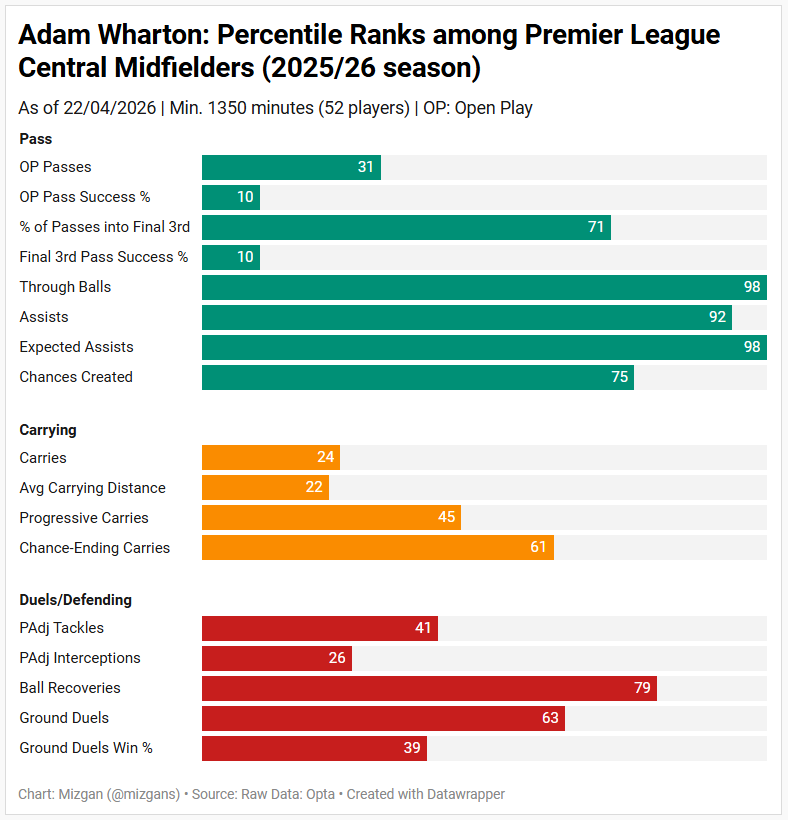
With less than an 80% overall pass success rate from open play (in raw numbers), it is no surprise that Wharton ranks among the lowest midfielders in that metric. However, the caveat is his higher ranking in through-ball attempts, chances created, expected assists, and the proportion of passes into the final third.
So, he operates as the team’s playmaker while playing as a central midfielder. The protection he has with an extra centre-back perhaps allows him to be a bit more adventurous with his passing, and the outcome of that is not bad either. He has five assists in the league this season (0.2 per 90) and has created 35 chances.
In terms of carries, the numbers do not lie in relative terms. The 22-year-old is not a major carrier of the ball from midfield to the final third. However, when he does carry the ball forward, he tends to end those actions with a threatening pass closer to the opposition goal, hence his higher ranking in chance-ending carries.
When it comes to defending and duels, in raw terms, even when removing the possession-adjusted (PAdj) metrics, the Englishman averages around 2.36 tackles per 90 and just below one interception per 90, which is not a particularly high volume. Furthermore, since he plays for a side that averages around 46% possession, the PAdj defensive numbers take an even bigger hit. He is decent in ball recoveries and ground duel involvement, but below average in ground duel success rate as well.
These numbers suggest that, even allowing for the added protection of three centre-backs behind him, he is not particularly strong in ground coverage or someone who is especially sharp in tackles in midfield areas.
So, why are Liverpool looking to potentially sign him in the summer? The answer could revolve around improved ball movement and chance creation from midfield. The Reds are second only to Manchester City in average possession this season (59.6%), but ball progression from deeper areas (midfield or defence) has been a cause for concern. Wharton’s numbers in percentile form (shown above) offer a case study of what he can bring on the ball.
Let us compare his raw numbers with three Liverpool midfielders who are fairly regular starters: Ryan Gravenberch, Alexis Mac Allister and Dominik Szoboszlai.
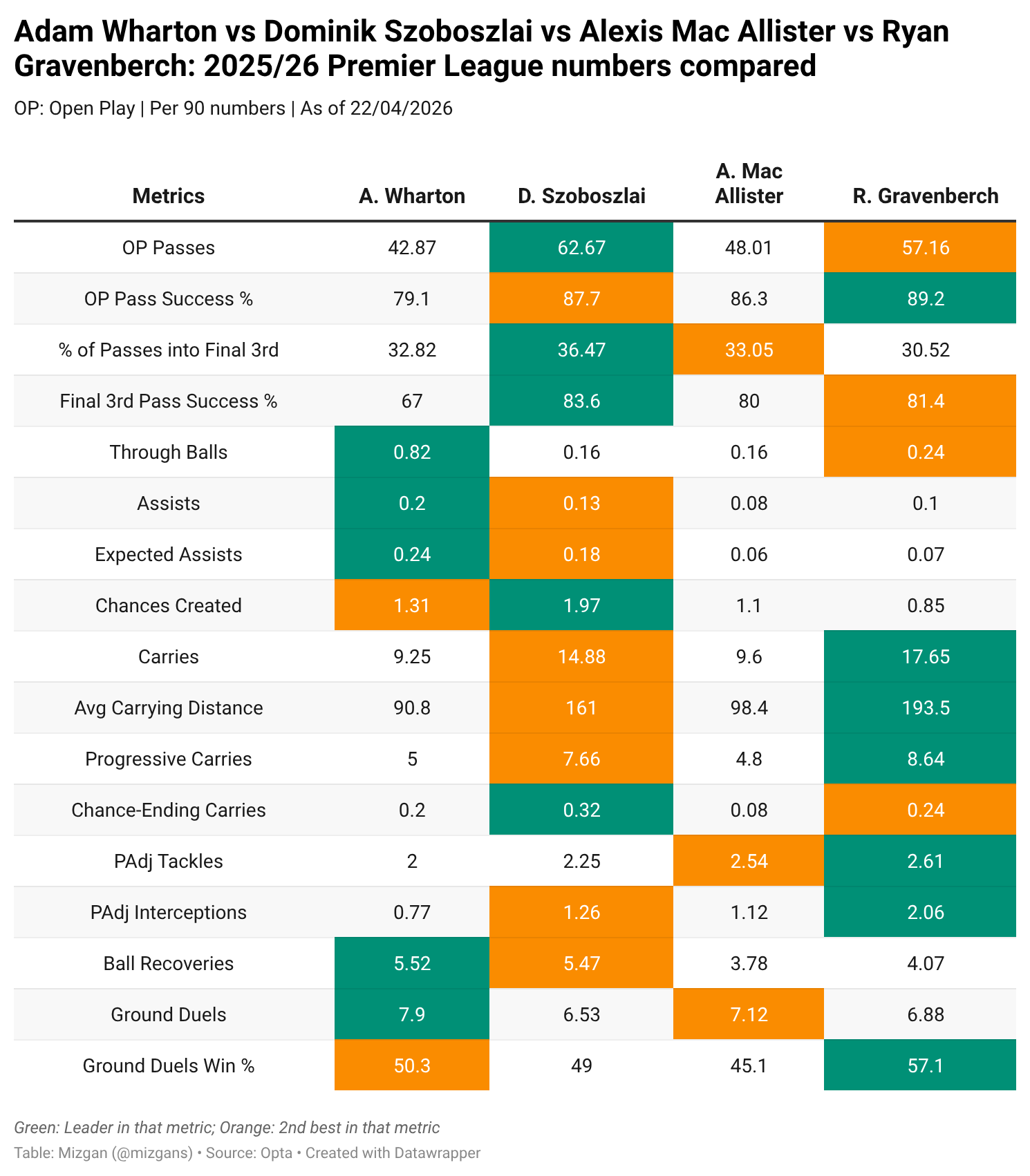
The proportion of passes into the final third would likely increase for Wharton if he were to play for a side like Liverpool, so that is not a concern in itself. He is already ahead of the Liverpool midfielders in through balls, assists, and expected assists, with only Szoboszlai ahead of him in overall chance creation.
In terms of carries and their effectiveness, it is no surprise to see Gravenberch posting strong numbers in that area. Even in possession-adjusted tackles and interceptions, the Dutchman is ahead of the rest. In overall ball recoveries, Wharton edges the Liverpool midfield contingent, while in ground duel win rate, he is close to Szoboszlai and some way behind Gravenberch.
This also shows that, although Gravenberch has had an indifferent season by his higher standards, mainly because his progressive passing and risk-taking in possession are not yet fully developed, he is still an important cog in the midfield for ball carrying and defensive ground coverage.
Perhaps, a midfield pivot of Wharton and Gravenberch could work for Liverpool if Mac Allister or Curtis Jones were to leave (just an idea based on the numbers). Szoboszlai can operate there as well, alongside several other positions.
Next up, we have a four-way plot comparison looking at Wharton, Szoboszlai, Mac Allister, and Gravenberch, with their actions plotted on a football pitch across key metrics, including passing, threat generation from passes, ball reception zones, and ground duels.
We start with the touch maps.
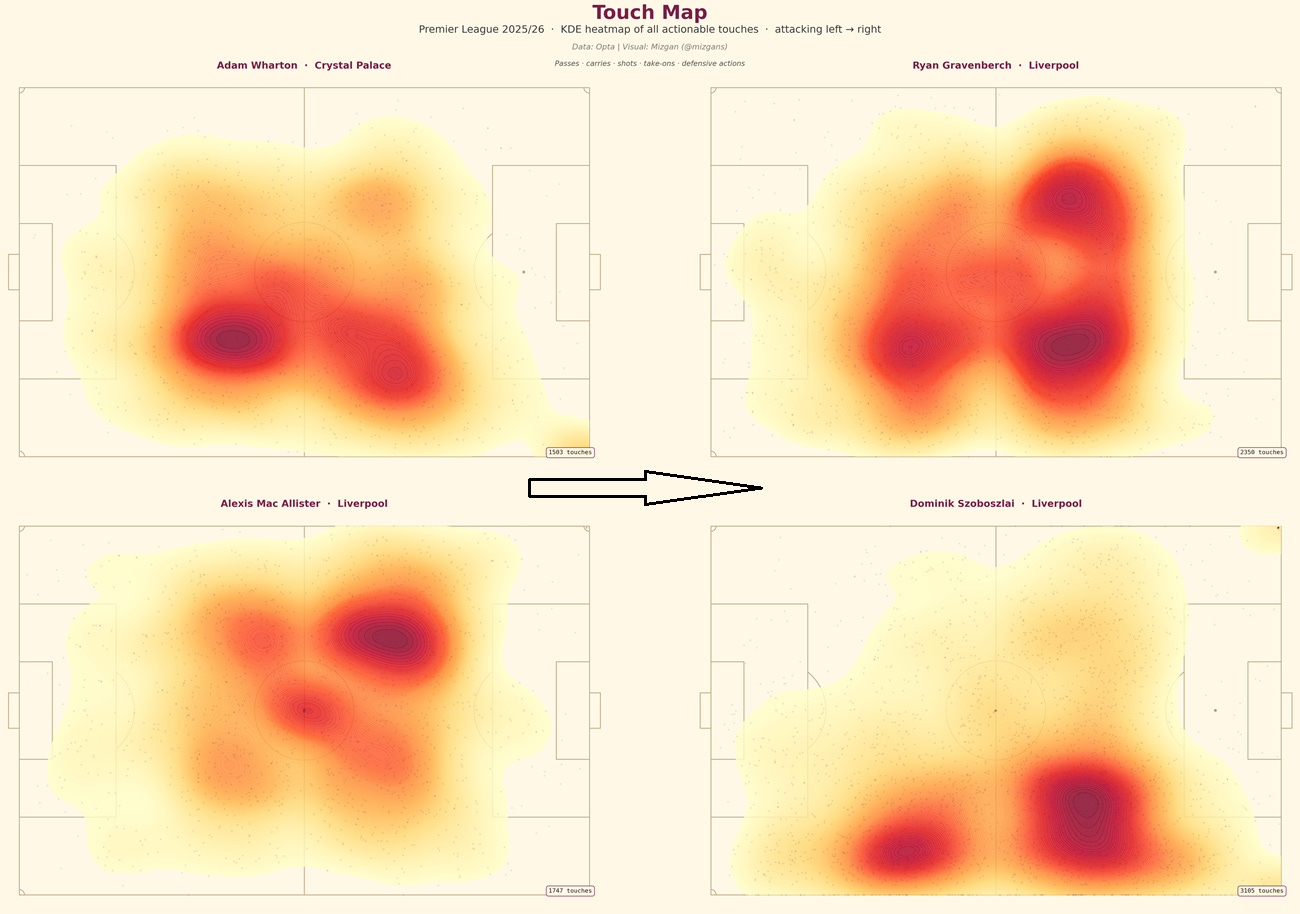
Seeing this, it is clear the zones where Wharton has had most of his touches this season: the right-hand side of midfield, with a good proportion of them in the half-space around 20 yards into the opposition half, where he plays key passes threaded into the box or chipped balls to the far side and more.
Gravenberch has been asked to do quite a lot this season, with him often situating himself on the right in build-up and also becoming a presence closer to the final third, either after completing ball carries or making runs to the edge of the box to combine with the forwards. The latter is the part of the game where, I would say, and the numbers back it up, Wharton is much better (passing while higher up and connecting with the forwards).
Szoboszlai’s touch map has a bias towards the right-hand side because he has played quite a few games at right-back (10 of his 32 appearances in the Premier League have been at right-back). The Hungarian, anyway, prefers operating on the right-hand side even when starting as a number 10. Mac Allister has always been more of a left-sided central midfielder.
Next up, we have final third passes (from open play), followed by expected threat generated per zone, with the highest threat areas shown in darker shades, based on overall passing.
The rest of this article is for paid subscribers (only £3.50 to access six data-driven breakdowns, player and team analysis, scout reports per month; £4 off for an annual subscription).