
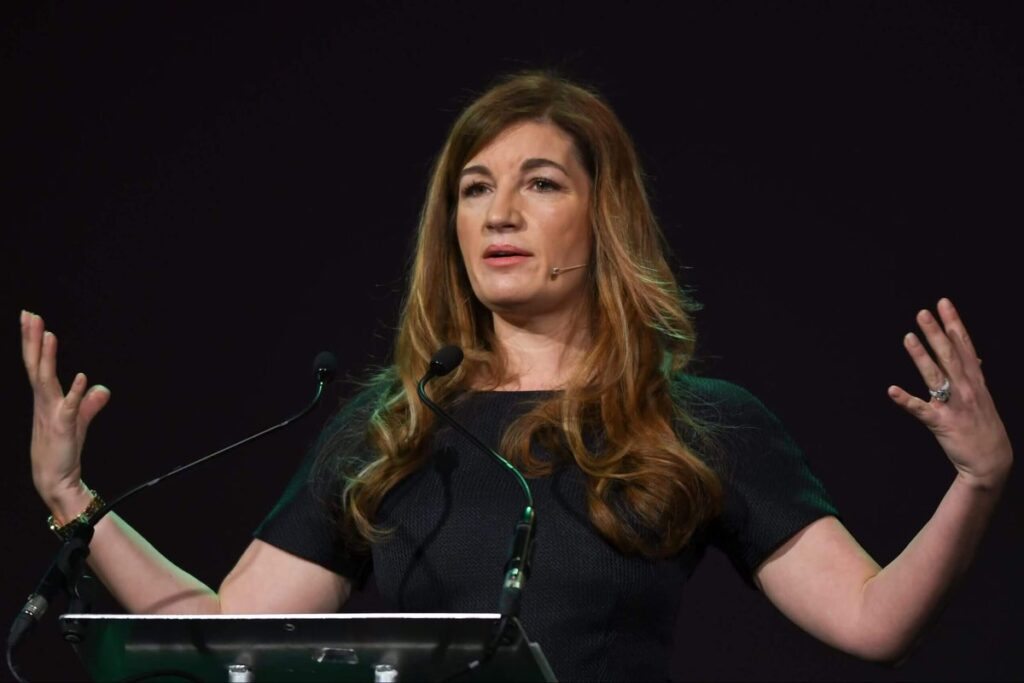
Karren Brady’s decision to step down from her role as vice-chair of West Ham United after 16 years is unlikely to trigger a surge of grief across east London.
To call Brady a divisive figure would be understating it. Yes, she moved West Ham from Upton Park to a new 60,000-capacity home at the former Olympic Stadium but … she also moved West Ham from Upton Park to a new 60,000-capacity home at the former Olympic Stadium. For all the extra commercial revenue it raised — a factor behind West Ham winning the 2023 Europa Conference League — it alienated many supporters.
But while her legacy at West Ham will be fought over, her status in demolishing barriers that have traditionally been in place for women in English men’s football is beyond dispute.
Brady was 23 when David Sullivan first hired her as managing director of Birmingham City in 1993. When he did, he gave her a stark warning: “You are going to have to be twice as good as the men to be considered even half as good.”
Her response — “Luckily, that’s not difficult” — encapsulated the bullishness which has helped her to navigate a world where, at the time she arrived, women were banned from boardrooms and banished to the ‘ladies’ room’, an area reserved for directors’ wives.
In 2002, Brady became the first female executive in England’s top flight when Birmingham were promoted to the Premier League, leaving seven years later after securing the club’s sale. At West Ham, she became one of the most high-profile female leaders operating within the men’s game — a dealmaker, and influential voice at Premier League shareholder meetings where clubs have the opportunity to vote on proposed new rules or amendments.
“She was an enforcer, a very strong character,” said former Crystal Palace chairman Simon Jordan on talkSPORT yesterday. “There was that old expression, ‘How do you know when Karren’s not lying? Her lips aren’t moving’. Karren was hard but a very capable operator.
“Karren was always in all of the meetings, whether it was the Premier League or Football League. She was the intellectual capital. She’s very resilient… in a sport which didn’t necessarily welcome women in positions of management.”
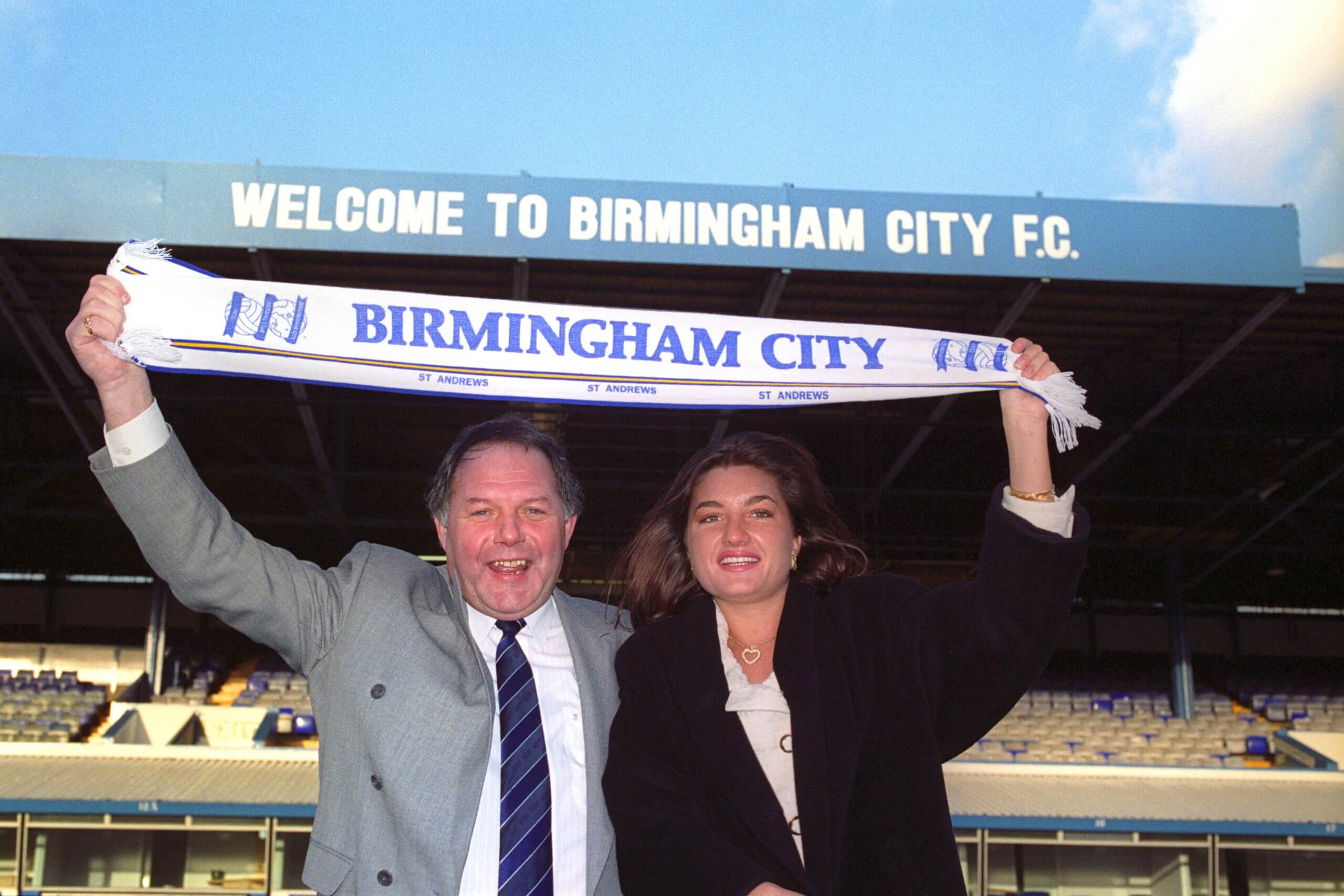
Karren Brady arrives at Birmingham City in 1993, with the club’s then manager Barry Fry (David Jones – PA Images via Getty Images)
Brady’s absence will be felt in the Premier League ecosystem and it maintains a distinct trend of senior women leaving positions of authority at the country’s leading football clubs.
Donna Maria Cullen (Tottenham Hotspur, executive director), Maria Granovskaia (Chelsea, director), Amanda Staveley (Newcastle United, director), Denise Barrett-Baxendale (Everton, CEO) and Susan Whelan (Leicester City, chief executive) have all departed their roles in their last two years.
Next season, it is conceivable that Lina Souloukou, Nottingham Forest’s CEO, will be the only female club representative at Premier League board meetings, given that Crystal Palace (whose CEO is Sharon Lacey) tend to be represented by chairman Steve Parish.
This exodus can be contrasted to the trend in Germany, where the men’s top flight, the Bundesliga, welcomed its first female CEO in RB Leipzig’s Tatjana Haenni this year (not to mention its first female head coach in Marie-Louise Eta at Union Berlin this month). Speaking on Tuesday, Haenni said she did not think the choice of a club CEO should be about gender, but about quality.
“As a CEO, you bring in expertise and quality as a leader, in your management skill, and in your strategic work and international background,” she said.
On the importance of diversity, she added: “Generally speaking, I’m a big believer in diverse leadership teams, because it’s about growing, about being innovative and being ahead, and to do that you need all different opinions and discussions.”
Research has consistently shown how important gender diversity is to the successful running of business. And the Premier League is just that: a private company, which is owned and controlled by its 20 member clubs, each one an independent shareholder that holds a single share, providing equal voting rights on policy, rule changes, and commercial matters.
It’s also about visibility for women across the men’s and women’s game, says Women in Football (WIF) CEO Yvonne Harrison, who warns that the growing success of the women’s game has bred a “dangerous narrative that women can work in women’s football and leave men’s football to the men. Football won’t benefit from that; it needs diversity of skills and thinking to be successful.”

Amanda Staveley left Newcastle United in 2024 (Stu Forster/Getty Images)
A survey carried out by WIF last year revealed that the environment within the men’s game remains a difficult one for women, with 78 per cent of women surveyed experiencing discrimination based on their gender in the workplace.
“Seventy-seven per cent of women are optimistic about the prospects for women in the football industry” says Harrison. “But there is more work to be done to increase the volume and normalise female leaders in the men’s game.”
In 2014, research by Morgan Stanley Capital International (MSCI) found that boards with gender diversity above and beyond regulatory mandates or market norms had fewer instances of governance-related scandals like bribery, corruption, fraud and shareholder battles.
That has been backed up by almost a decade of studies by management consultancy firm McKinsey & Company that show, fairly conclusively, that a true commitment to diversity generally — and gender equity more specifically — can have concrete financial benefits.
For example: companies with the greatest proportion of women on executive committees earned a 47 per cent higher rate of return on equity than companies with no women executives. Companies in the top 25 per cent for gender diversity are 27 per cent more likely to outperform their national industry average in terms of profitability. And companies in the bottom 25 per cent for gender diversity were significantly less likely to see higher profits than their national industry average.
The financial behemoth that is the Premier League is not suddenly going to hit the skids commercially, but it is clear that those companies with more gender diversity are better for it, culturally as well as commercially.
This is not to say that every female executive listed above did a flawless job (just as not every male executive does). Tottenham and Leicester are at risk of humiliating relegations this season, while the reputation of Granovskaia — for all her undoubted effectiveness as an operator — is complicated by her close links to Roman Abramovich who was sanctioned by the UK government for his alleged links to Russian president Vladimir Putin in 2022, claims he has always denied.
The reasons behind each woman’s departure from the top table of English men’s football will vary from case to case and the smaller numbers involved means it makes more of an impact when a top female exec leaves compared to a male counterpart. It should be said that there are female chairs of the FA (Debbie Hewitt) and the Premier League (Alison Brittain). But largely, the demographic of Premier League powerbrokers now feels distinctly homogenous, and that is rarely a good thing.
The bright spot is that there are other female executives climbing the ladder at pace, thanks in part to the rise of the women’s game. Norwich City’s executive director Zoe Webber; Women’s Super League CEO Nikki Doucet, the youngest CEO in English football; Sarah Guilfoyle, who is managing director at Wigan Athletic and Polly Bancroft, CEO of Grimsby Town, are all highly rated and surely destined for bigger things.
It will, however, take some time for them to reach the top. In the meantime, the next Premier League shareholders meeting will be missing one of its loudest, most influential voices, leaving the floor open to be dominated by an almost all-male chorus.
Additional reporting: Sebastian Stafford-Bloor