
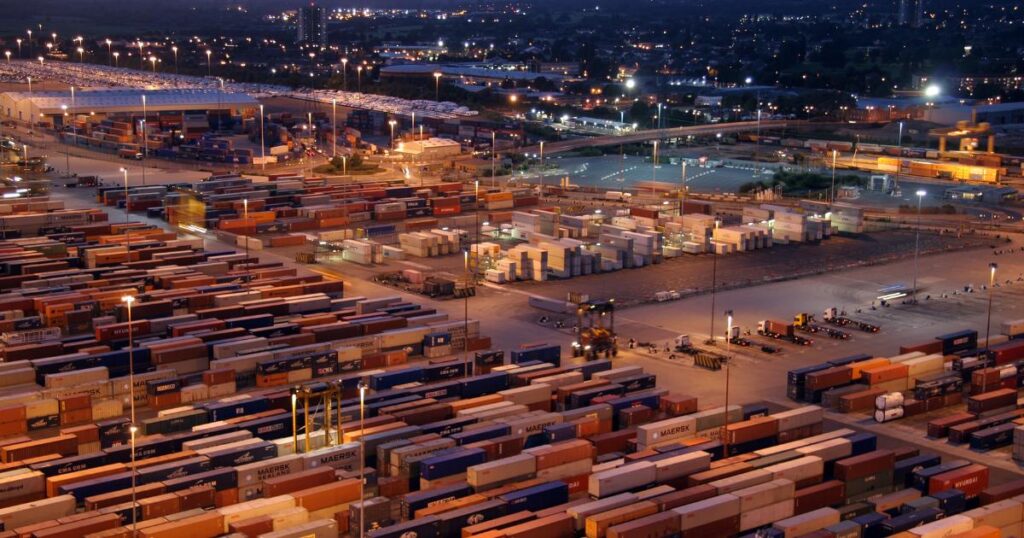
DP World is introducing “port-based carbon insets” at its Southampton terminal, allowing customers to include emissions savings from the container port in their own supply chain targets for the first time.
Carbon insetting is where a company tackles its own climate impact by funding projects that cut or absorb emissions within its own operations or supply chain
The emissions savings are generated through the use of biofuels such as HVO, port-wide electrification, and renewable electricity at DP World Southampton.
READ MORE: Plant hire firm boosts work to improve sewer system
John Trenchard, vice president – sustainable international supply chains, Europe, said: “At DP World, we believe decarbonising global supply chains requires practical solutions that deliver measurable impact today.
“This scheme will turn real emissions reductions at Southampton into verified savings our customers can count towards their Scope 3 targets.
“By working with partners like Bureau Veritas and 123Carbon, we’re scaling a model that recognises the critical role ports play in driving lower-carbon logistics across road, rail, and sea.”
The resulting emissions reductions are converted into Container Terminal Inset Certificates, which customers can use to report lower Scope 3 emissions across their supply chains.
Each certificate reflects a share of the 250kg CO₂e allocation and will be automatically applied to qualifying cargo moving through the Southampton terminal from April 1, 2026.
Customers will receive independently verified documentation to support their sustainability reporting.
The programme forms part of DP World’s broader Carbon Inset Programme, launched in January 2025 in partnership with the global carbon insetting platform 123Carbon.
In its first year, the programme registered more than 250,000 TEU of cargo and issued more than 9,000 tonnes of CO₂e savings.
Originally planned as a 12-month trial, it was extended to December 31, 2026.
READ MORE: Huge fuel company told to pay £350,000 over diesel spill in River Test
Jeroen van Heiningen, chief executive of 123 Carbon, said: “This project is a landmark milestone, as it represents a new standard on how carbon reductions realised in port operations can be shared with owners.
“The development of such a standard together with industry leaders as DP World is necessary to ensure companies can safely and securely reduce transport-related emissions from origin to destination, regardless of transport type and including container handling at ports.”
The UK Carbon Inset Programme is funded by the Energy Transition Contribution, which is applied to all import-laden containers through DP World UK ports.