

Here is the problem with politicians and their attitude to football. They never have a plan to make a club money.
They know how to give one club money, by taking it from another bigger, more successful club; but that’s like arguing that the chancellor knows how to make money by putting up taxes. Wealth redistribution is a plan, sure, but it’s not the same as an actual business plan. No politician has ever invited the football clubs to Westminster to inform them of a fabulous initiative guaranteed to boost turnover.
Stopping the advent of the Super League was uniformly agreed to be a positive political manoeuvre, but it was not as if the government then suggested an alternate revenue stream. It just put the mockers on the one Real Madrid had dreamt up.
This is, in its way, similar to the pressure placed on the Premier League to outlaw betting companies as main shirt sponsors. Whether you agree with the decision on moral grounds is not the point. If the government felt so strongly that vulnerable people should be protected, gambling itself would be banned. Instead, it is an increasingly bigger part of public life, from 24-hour casinos to online games of chance and the state-sponsored National Lottery.
 Harry Wilson celebrates scoring against Burnley last month while displaying the online betting company logo that will no longer adorn Fulham’s shirts as prominently after this seasonJohn Walton/PA Wire
But, as always with football, different standards are applied. The Premier League felt the weight of political compulsion and finally announced that, from the 2026-27 season, gambling companies could no longer be front-of-shirt sponsors. It is a change in commercial partnerships that it is now estimated will cost Premier League clubs about £80million, and that revenue stream has been replaced with nothing.
And this wouldn’t matter so much if the government’s other grand plan, through its football regulator, wasn’t to fund the impoverished lower leagues with Premier League money. No better ideas there, either. So the mid to lower-range top-division clubs take an £80million haircut, all the while being asked to fund those clubs with ambitions to replace them, who can, by the way, still chase gambling sponsors because different rules apply.
So this is about the Premier League’s own squeezed middle. It is not even an elite club problem. Sir Keir Starmer will not hear much complaint when he picks up his tickets for the next game at Arsenal because the biggest clubs do not have betting companies as sponsors. They attract money from blue chip investors: the Emirates airline, Etihad Airways, AIA, Standard Chartered. Lower down the division, the allure of betting companies is that they pay more, they pay a premium in a very competitive market.
This is where the missing £80million comes in. Those clubs with a gambling sponsor — there are nine remaining — are now seeking replacements. But the companies they are courting will not pay what the betting concerns pay. So clubs such as Fulham, Sunderland, Crystal Palace or Everton are expecting to take a hit. It is economic illiteracy to think the rump of the Premier League can have its resources siphoned again and again without impact.
 The exact financial figures behind an Asian betting company’s sponsorship of Sunderland’s shirts have never been revealed but were described as “record-breaking”. Brian Brobbey and his team-mates have certainly delivered value for money Ian Horrocks/Sunderland AFC via Getty Images
One of the contentious issues holding up the money intended to support the EFL clubs concerns who pays what. The elite, unsurprisingly, think every club should be treated equally — which is quite the change from their typical stance. The rest see how the elite have insisted on dividing the international broadcast revenue, which used to be an even 20-way split but now goes on league position, greatly favouring the establishment — and they want that to be the case with the trickle-down payments too.
They think Arsenal should pay more than Bournemouth because Arsenal earn more than Bournemouth, and can afford to pay more. Arsenal believe they should be treated no differently to Bournemouth, while still getting a bigger slice of the financial pie. So far, so self-serving.
Meaning the position of successive governments — “I met the Premier League and certainly encouraged them to take this stance,” said the Conservatives’ gambling minister, Stuart Andrew, in 2023 of the shirt ban — has shafted those in the middle, twice. Firstly, by preventing the access to boosted commercial revenue from the gambling companies, then by putting in place a regulator who sees their now impacted turnover as the way to fund the lower leagues.
This is not, by the way, a defence of the gambling companies. The way they target the young, the clueless, the increasingly addicted and run scared of anyone who may actually wish to bet responsibly — by studying and researching their subject therefore providing an enhanced chance of winning, for instance — is obscene.
 Under the new legislation Leicester, at present destined for League One, would be able to retain their sponsor’s logo…Getty Images
 …but top-flight Bournemouth, whose crowds are only a fraction of Leicester’s, must lose theirsRobin Jones – AFC Bournemouth
Yet many of the Premier League’s shirt sponsors are companies in foreign markets that are close to impossible to access in the UK. Incomprehensible scripts, unfamiliar names, if these logos were truly so powerfully habit-forming, why do the new regulations allow them to appear as smaller, less lucrative, sleeve sponsorships instead? Equally, why were EFL clubs exempted from this legislation? Why can Leicester City (average gate 29,099) have a gambling shirt sponsor, while Bournemouth (average gate 11,173) cannot? Is gambling only a bad influence on followers of the Premier League?
That gambling commercials continue to appear before, after and during many sports events is far more dangerous than a mysterious logo on the shirt of a player few will recall ever being here in two years time. In the United States players are regularly banned for gambling, while here the FA did a deal which allowed professional gamblers to actually own big clubs, and their Premier League contemporaries have never even seen copies of these arrangements.
It’s another mess. All we know is that the government is very keen that the Premier League supports those that are worse off, with money it has campaigned to make sure it doesn’t have. Still, any further smart ideas on how to plug this, or any other, financial gap would be welcome and can be popped into the suggestion box next time your local MP collects his comps at the ticket office.
Exodus in adversity bodes badly for run-in
It wasn’t a minority. And it wasn’t just the last five minutes, either. The exodus from the London Stadium during the FA Cup quarter-final against Leeds United on Sunday began in the 75th minute, the moment Dominic Calvert-Lewin’s penalty hit the net. It continued, ever stronger, until the fourth official signalled 11 minutes’ additional time. So the earliest adopters, in total, missed more than an hour of open play, plus a penalty shoot-out.
The home section of the stadium was more than half empty before West Ham United pulled one back in the third added minute in normal time. Those that then returned to their seats — the ground was probably two-thirds full once it got to 2-2 three minutes later — had either not left the concourse, or were near enough to swiftly double back and get in through the gates still open for departees.
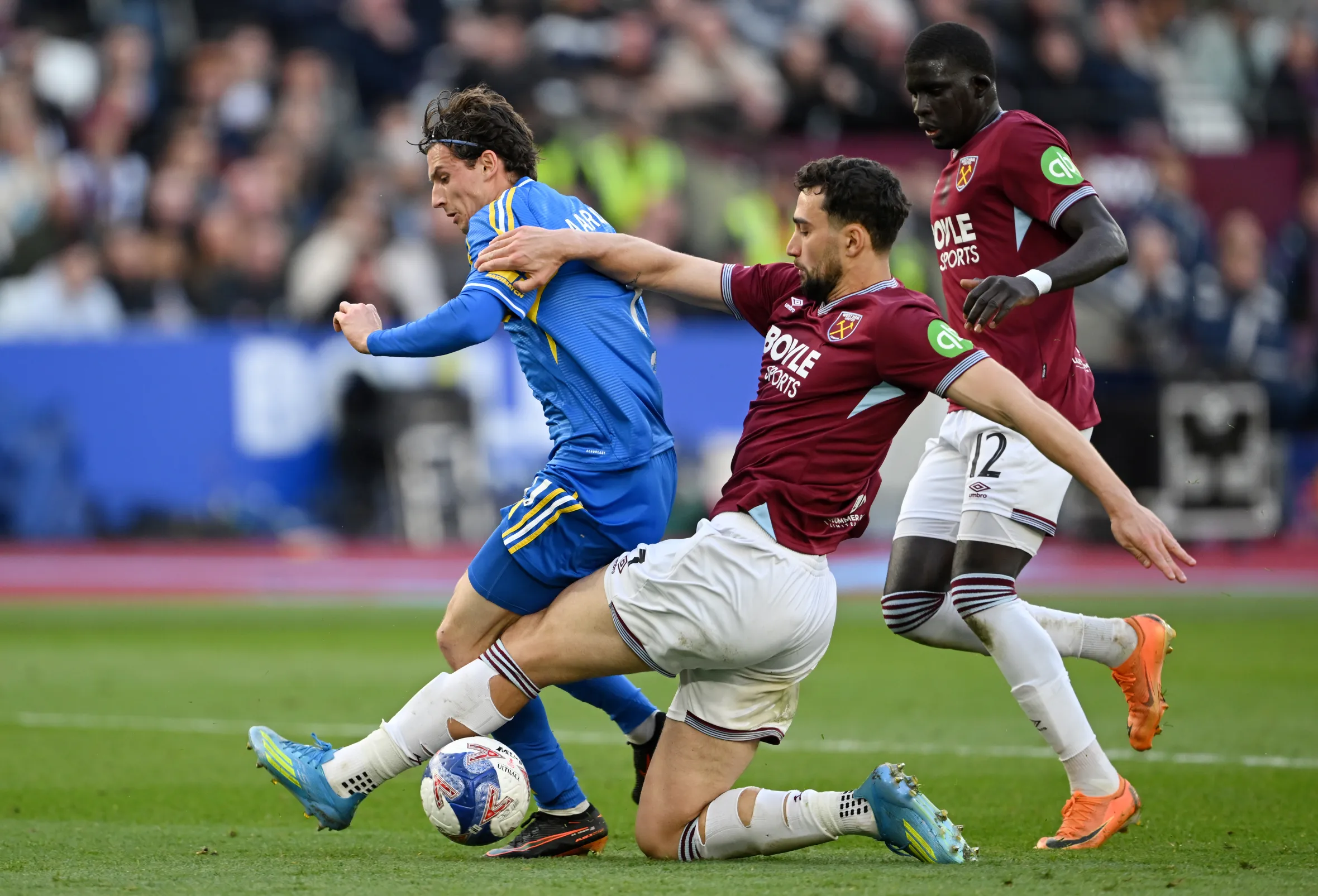 Kilman, who was at fault for the Leeds penalty, was booed every time he touched the ball for 15 minutes afterwardsMike Hewitt/Getty Images
Normally, my attitude is that if you’ve paid for your ticket, you can do what you like with it — including leaving early or not turning up at all. Yet there is a lot of toxicity around the London Stadium, much of it centred on a loyal and unswerving fan base betrayed by the owners with the move away from Upton Park. When the away end sing derogatory songs about the new ground, some of the locals applaud or join in.
Yet events on Sunday challenged the steadfast narrative. The majority were no help. Max Kilman, who was at fault for the penalty for the Leeds second goal, had his every touch booed for a good 15 minutes after that, although it died down the emptier the ground became. We can see how well those tactics worked on goalkeeper Guglielmo Vicario at Tottenham Hotspur.
The exodus in adversity is becoming an increasing problem at a number of grounds — even famously loyal Anfield — but at the London Stadium it is now an epidemic. West Ham have a match against Wolverhampton Wanderers on Friday that could define the season. Win, and Tottenham will start Roberto De Zerbi’s era away to Sunderland in the bottom three. Fail, and, in all likelihood, the club are doomed to the Championship. West Ham cannot leave it late again; but, by the same token, the fans cannot leave it early.
Chelsea-style PSG humbling will do Slot no favours
Had Liverpool been outplayed by a more typical Premier League team on Saturday, there may not be such trepidation around the match in Paris on Wednesday night. Unfortunately, Manchester City are not among those relying on set pieces and penalty area skirmishes this season. They stick resolutely to Pep Guardiola’s principles, ones that make them much nearer in essence to the football played by Paris Saint-Germain.
When PSG kick off, they will try to find touch deep in Liverpool’s half as is, inexplicably, the modern trend. Yet that is likely to be the last uncultured hoof Liverpool receive. From then on, they will need to contain one of the most quick-witted, fleet-footed, counterattacking teams in the competition.
Troublingly, this is also being held up as the referendum on Arne Slot’s time as Liverpool manager, which seems horribly harsh. All managers face challenges over a season but it is hard to think of too many whose issues have been as beastly as Slot’s.
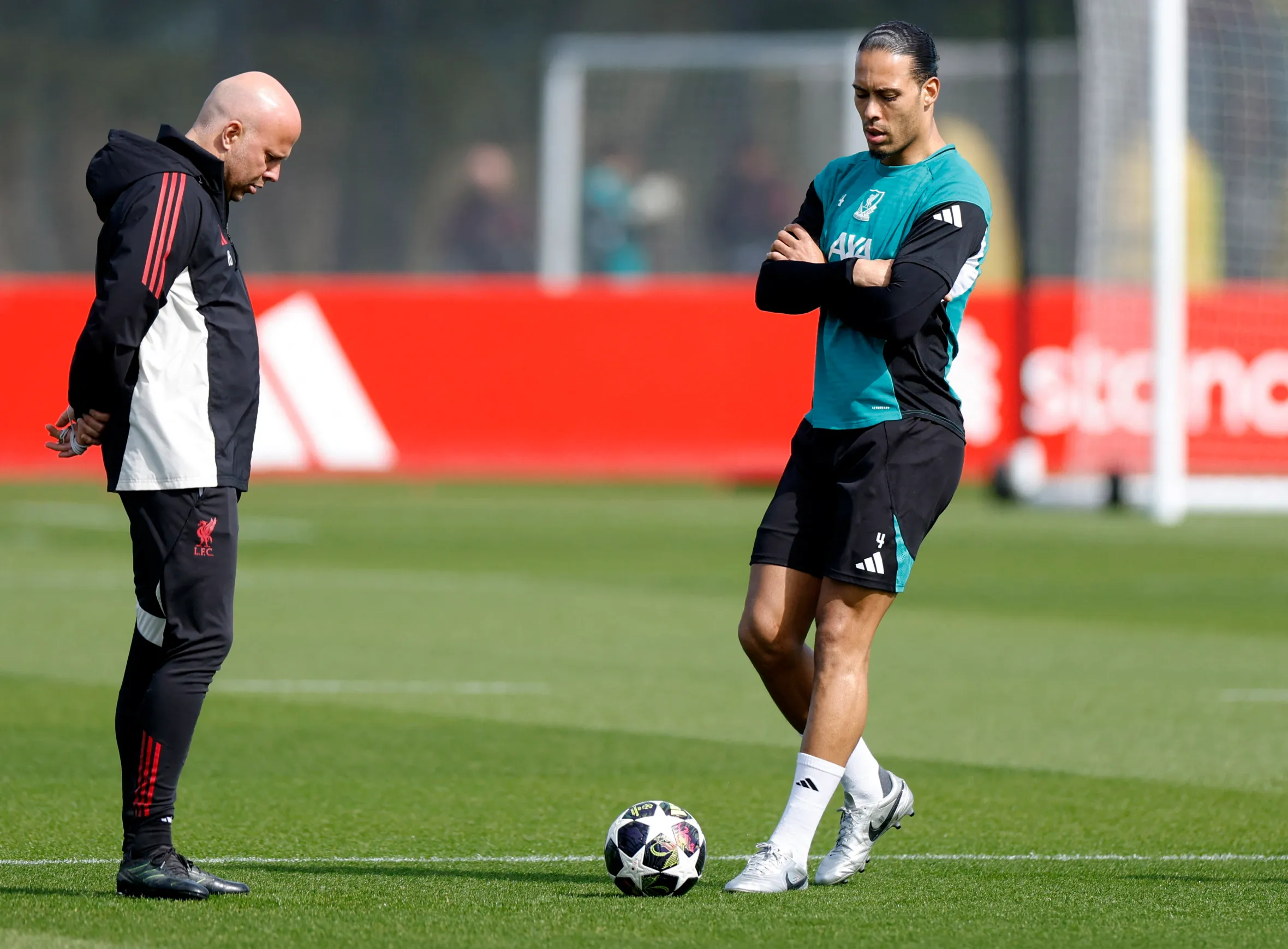 Slot, left, and Van Dijk will both be under the microscope against PSGReuters/Jason Cairnduff
Pain from the tragic death of Diogo Jota cannot easily be healed and new signings have needed to find their place within a dressing room in mourning. The departure of Trent Alexander-Arnold then impacted on the form of Mohamed Salah, his foil on the right, who reacted poorly to Slot’s attempt to deal with that.
The recruitment of Alexander Isak left him with the worst of all possible worlds, because it undermined Hugo Ekitike’s confidence in his status at the club, only for Isak to get injured — depriving Slot of both strikers, for differing reasons. Equally, the failure to secure the transfer of Marc Guéhi in the summer exposed a defensive weakness which has never been resolved, in turn affecting Virgil van Dijk, who is beginning to look his 34 years.
Van Dijk may still be a high performer in an inferior league — Serie A, for instance, where Fikayo Tomori continues to impress for AC Milan operating at a level that was beyond him at Chelsea — or with a defender of Guéhi’s calibre by his side, but for Liverpool he is increasingly vulnerable. None of the solutions are easy, all of the problems may need a summer to resolve, at least.
After delivering the title in his first season, it may seem incongruous to argue that if Slot can nip into the Champions League via the extra fifth spot he has had a good year, but there are too many mitigations to ignore. He could do without the humbling Chelsea received over two legs against PSG, mind.