
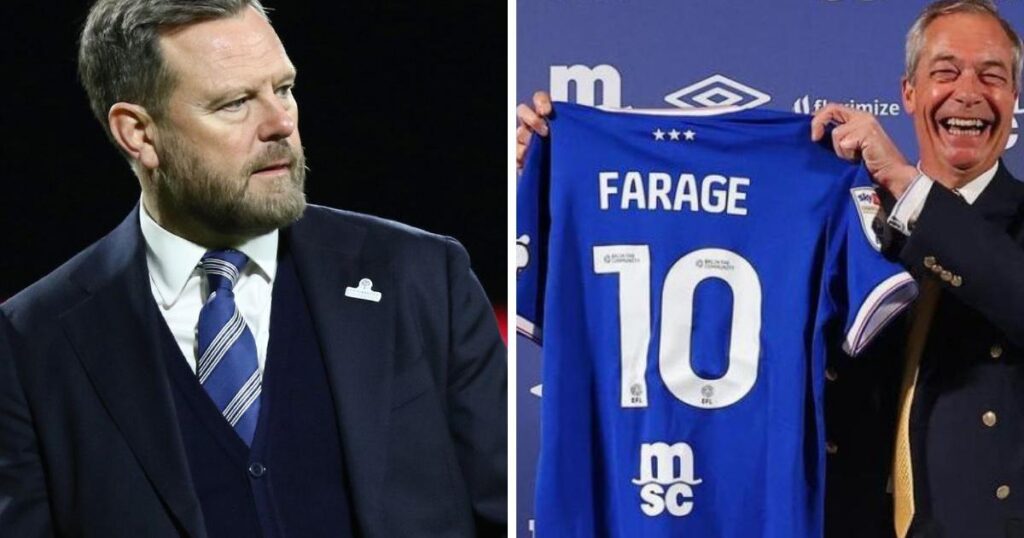
There’s a clear sense of fatigue around the whole episode. Too much noise, too much attention, and not nearly enough clarity.
So let me offer a different perspective.
Before I moved into writing, I spent years working in crisis communications, including running my own PR firm in Denver.
On one occasion, I was flown out at short notice to Jamaica, where the BBC – fronted by Raphael Rowe – was camped outside Tranquility Bay, a tough school (now closed) for troubled American teenagers, investigating allegations of abuse.
Rather than shut the doors, we opened them. I let the cameras in and arranged for a senior student to guide Rowe and his team around the facility. The resulting report was balanced. Not perfect, but fair. That was the objective.
Which brings me to Ipswich Town.
Let’s be clear: the issue here is not Nigel Farage’s visit.
Reform UK leader Nigel Farage’s visit to Portman Road caused controversy (Image: Reform UK)
Whether you agree with his politics or not, he is a major national figure and a likely candidate for Prime Minister. It is entirely reasonable – and arguably in the club’s interests – to engage with senior politicians across the spectrum. Only those opposed to him politically seem genuinely outraged by his presence.
No, the issue is what happened next.
In crisis communications, I’ve sat across from many CEOs who believe their status allows them to make a story go away – either by ignoring it or by bending the truth. It never works.
I recall one case in Colorado after cannabis was legalised in 2014. A child became ill after consuming a chocolate bar handed out at a public event – a product that was supposed to be cannabis-free. It later emerged that a disgruntled former employee had tampered with it.
I advised the CEO to invite the media into his facility, demonstrate safety protocols, and address the issue head-on. He told me he was making so much money he didn’t need to do anything.
He was gone within months.
Arrogance has a habit of overriding both humility and common sense. Which is why the handling of this situation by Mark Ashton is so disappointing.
Town chairman Mark Ashton eventually apologised over the Farage fiasco (Image: Ross Halls)
My suspicion is that, like many executives, the first call was to lawyers. But lawyers (and I speak as one myself) are often the last people you should turn to when your reputation is at stake. Their instinct is to minimise legal exposure – “no comment,” partial disclosure – but that approach can inflame public opinion.
That appears to be exactly what may have happened here.
The club initially suggested that Mr Farage’s team had independently arranged a stadium tour. That later proved to be untrue. The drip-feed of information that followed indicated to journalists that the full story had not yet emerged – and for any competent reporter, that is like blood in the water.
Mark Heath, the EADT’s football editor, quite rightly pushed for answers. That’s not aggression, it’s journalism.
Then came the revelation that Mr Ashton and another senior executive had hosted Mr Farage for lunch. At that point, the issue was no longer political. It was about trust. The club had, in effect, misled its own supporters.
From a crisis management perspective, this is amateur hour.
A simple, honest statement, ideally on camera, in the same direct manner as the later apology — would have closed this down immediately:
“The club engages with senior politicians and public figures across the political spectrum. We believe it is in the best interests of the club, the town and the county to maintain constructive relationships with those in positions of influence.
“Mr Farage’s team approached our senior leadership, and we saw an opportunity to discuss issues directly affecting the game, including the proposed football regulator. A lunch and a tour of Portman Road were arranged.”
That’s it. No drama. No vacuum for speculation.
Town manager Kieran McKenna said he didn’t like to see discord amongst fans (Image: Ross Halls)
Instead, the absence of a clear, upfront explanation allowed the story to grow legs, ultimately forcing Mr Ashton into a public apology that should never have been necessary.
What’s more, this episode reflects a broader pattern.
In my dealings with the club for this paper, I’ve found access and messaging tightly controlled. When I sought to interview owner Brett Johnson, I was vetted and given clear direction on how the interview should be conducted, including topics that were off-limits.
That approach may feel safe internally, but to any serious journalist, it is counterproductive. Independence and credibility matter.
When I worked in PR, I never tried to control journalists. Instead, I prepared my clients properly: media training, scenario planning, and the ability to handle difficult questions with composure.
Control, when overused, tends to backfire. And here, it appears to have done exactly that.
If Ipswich Town secure promotion this season, this episode will likely be forgotten. But if they fall short, moments like this don’t disappear; they linger.
Ipswich Town fans’ group Blue Action weren’t happy about the visit (Image: Ross Halls/Reform)
Supporters groups such as Blue Action are apparently already unhappy with Mr Ashton. If results don’t go the right way, that discontent may deepen.
Because in the end, this wasn’t about Nigel Farage. It was about judgement.
And on that front, the club got it badly wrong.