
As with many of the streets in the town, it’s a historical record, a way of commemorating someone who played a key role in the development of the town.
In this case, the avenue was named after Sir Francis Wyatt Truscott, an eminent Victorian dignitary from outside Bournemouth whose claim to local fame rested on his one-time spell as the Lord Mayor of London.
To understand how Truscott came to be associated with Bournemouth, you have to cast your eyes out to sea.
The town’s relationship with its piers had hitherto been somewhat fraught with difficulty.
Sir Francis Wyatt Truscott (Image: Archiives)
The original pier was nothing more than a 100-foot wooden platform on wheels that could be rolled out into the sea on a set of rails.
The first permanent wooden pier that followed, which had been opened in 1861 by Sir George Meyrick, was eventually consumed by the English Channel after being damaged first in an accident and then in a severe gale.
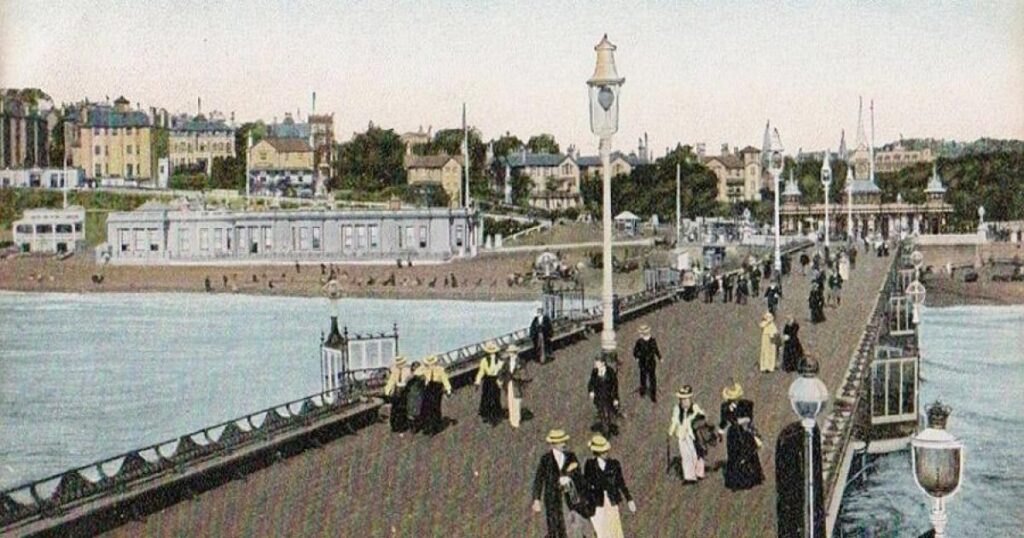
Its replacement was a far more solid, cast-iron construction.
Designed by a famous engineer from Westminster, Eugenius Birch, it was specifically engineered to withstand the ferocious wind and waves that had destroyed the original wooden pier with such ease.
A pier made of cast iron called for a grand opening, and the town sought out an honourable guest from the capital.
On August 11, 1880, Sir Francis Wyatt Truscott made the journey south from London to officially open the splendid new structure.
In his own speech at the opening, Truscott lavished praise on the rapidly expanding seaside resort, describing Bournemouth as “the garden city of the south”.
Truscott’s presence marked the milestone event with a rare sense of occasion and privilege, earning him a permanent place in the history of the town’s most cherished landmark.
The connections between the Truscott family and Bournemouth Pier didn’t end with Sir Francis.
In the three decades that followed, the new pier enjoyed enormous popularity, confounding the naysayers who had gloomily predicted that it would saddle the ratepayers with luxury debt.
Sir George Wyatt Truscott (Image: Archiives)
Instead, it benefited from major new developments, with a 1,000 foot extension bringing the total bill for the original project and its later additions up to £50,000 by 1909.
In a remarkable twist of history, when the next major extension was ready to be opened in 1909, the town once again invited the Lord Mayor of London to carry out the ceremony.
And it just so happened that the Lord Mayor of the day was Sir George Wyatt Truscott – Sir Francis’s own son.
Truscott Avenue remains a quiet but permanent commemoration of this unique piece of local history – a reminder of the day when a Lord Mayor of London travelled to the coast to usher in a new era for Bournemouth, and to mark the occasion for a durably cast-iron pier that defines “the garden city of the south”.