

The scheme is part of a broader push to improve the quality of academic discussion
The University of Liverpool is set to trial a new seminar policy requiring every student to speak at least once per session, in what staff are describing as an effort to “increase engagement and accountability.”
Under the new scheme, students will be expected to contribute verbally during seminars, with tutors instructed to ensure that no one leaves the room without having spoken. The policy is being piloted across a number of humanities and social science modules this term.
A leaked email to staff outlined that the initiative aims to address concerns around low participation, with some seminars reportedly dominated by a small number of students while others remain “entirely silent.”
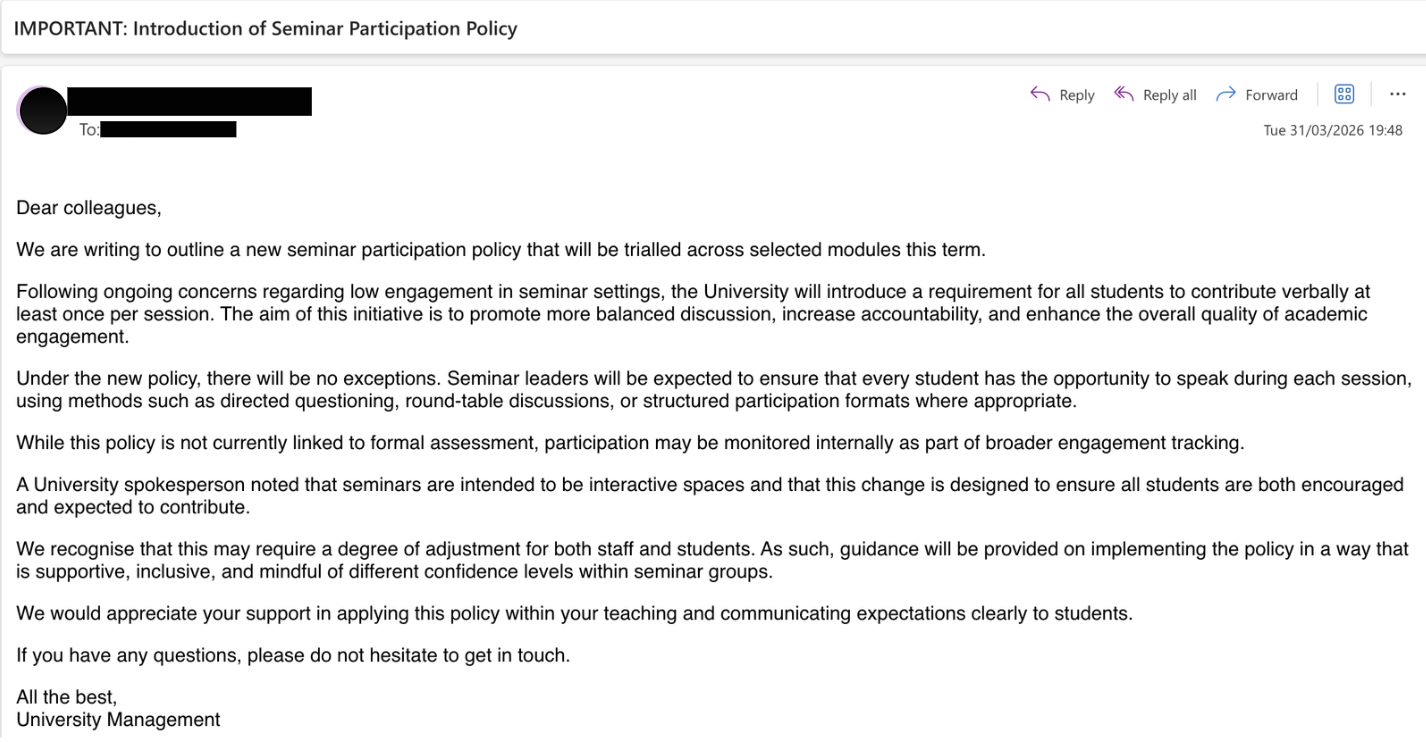
The email explains that there will be “no exceptions,” with all students required to contribute regardless of class size, topic familiarity, or personal preference. Suggested methods include direct questioning, round-table formats, and what has been described as “targeted contribution prompts.”
Students who fail to participate may see their engagement reflected in internal monitoring, though the university has stressed that the scheme is not formally linked to grades at this stage.
A spokesperson for the university said the policy is part of a broader push to improve the quality of academic discussion.
“Seminars are designed to be interactive spaces,” they said. “We want to ensure all students feel both encouraged and expected to take part.”
Reactions from students have been mixed.
One second year student, April, said: “I get the idea, but sometimes you just don’t have anything to say. Being forced to speak feels a bit intense.”
Another, Mike Take, added: “There’s always that one person who carries the whole discussion, so I guess this balances it out – but I’m not sure I’m ready to be called on every week.”
Others have expressed concern about the potential pressure the policy could create, particularly for students who are less confident speaking in group settings.
However, some students have welcomed the change, suggesting it could lead to more balanced discussions.
A third year student said: “It might actually make seminars better. At least everyone will have to do the reading if they know they’ll be asked something.”
Staff have reportedly been given guidance on how to implement the policy in a “supportive and inclusive” way, though the “no exceptions” rule remains central to the trial.
If successful, the university has indicated the policy could be rolled out more widely across departments in the next academic year.