
Wolverhampton Wanderers booked a £15.3million ($20.2m) loss in their 2024-25 Premier League season, even as they reaped £117m in player-trading profits — by some distance a new club record.
Wolves extended their accounting period, moving their May year-end date to June, and in doing so were able to book the sales of Matheus Cunha and Rayan Ait-Nouri, to Manchester United and Manchester City respectively, into last season’s accounts.
Those deals combined with the summer 2024 exits of Pedro Neto (Chelsea) and Maximilian Kilman (West Ham) to offset an underlying operating loss that ballooned to a record £121m deficit, driven by declining income and increased player costs.
The latter were, in part, created by the extended accounting period.
An extra period of costs in an off-season month where no TV money arrives as income generally makes club finances look worse, but Wolves’ latest books also paint a picture of a club in decline on the pitch, very much setting the scene for their awful 2025-26 campaign.
They have been bottom of the Premier League table since losing 4-0 to Manchester City on the opening weekend of games in August.
Wolves’ revenue fell by £5.7m last season, driven by dropping from finishing 14th in the Premier League in 2023-24 to 16th and also having two fewer games selected for live broadcast (15, against the 17 a year earlier). Those factors reduced broadcast income by £8.4m, and that revenue stream is likely to decline further this term.
Like most Premier League clubs outside the ‘Big Six’, Wolves rely on TV money for a majority of their income, so waning on-field performance has a clear impact on finances.
Revenues from gate receipts at Molineux held about steady at £21.8m, with matchday income almost tripling since their most recent promotion at the end of the 2017-18 campaign. On available figures, their gate receipts were the Premier League’s 11th-highest last season, but a drop is expected in this area for the next one.
Interim chairman Nathan Shi recently announced “significant” season-ticket reductions, and one source with knowledge of the club’s operations, speaking anonymously to protect relationships, advised The Athletic that Wolves are expecting around a 30 per cent drop in 2025-26’s £14m in season-ticket income, if relegation to the Championship occurs — as feels inevitable.

Wolves’ matchday income has almost tripled since 2017-18 (Dan Istitene/Getty Images)
A substantial reduction in hospitality income is being budgeted for, too, and, on the surface of it, Wolves’ commercial income has actually declined during their time in the top tier. That, though, owes to the club shifting to an outsourced retail model in 2023-24: revenues are lower, but so are costs.
The Athletic understands Wolves’ partnerships income has almost doubled during these eight straight seasons in the Premier League, though that level of revenue is unlikely to be maintained if they go down.
Even after adjusting for that extended accounting period, Wolves’ wage bill increased — up from £142m in 2023-24. The 13-month wage bill hit £163m, or £150.4m adjusted to 12 months. Several Premier League clubs are yet to release their 2024-25 financials but, based on those we do know about, Wolves’ (adjusted) salary costs peg them at an estimated 16th in the wage-bill rankings. That makes finishing 16th in the actual table an underperformance, albeit hardly a huge one.
Of greater concern would be those increased wages combining with lower turnover to push Wolves’ wages-to-revenue metric upward.
That sat at a troubling 87.5 per cent even after adjusting for a month’s worth of extra cost. On the Premier League’s most recently available figures, nobody spent a higher proportion of revenue on wages.
Analysis of most clubs’ finances is hindered by the time delay between a season ending and the accounts for it being published, and that is especially the case for Wolves. With relegation yet to be guaranteed, but surely looming, their finances already look distinct from the previous set and will even more so if/when it is confirmed they are going down.
Despite a recent upturn in form and results, Wolves are still bottom and 13 points from safety with seven games left to play.
The same previously mentioned source told The Athletic that Wolves’ wages-to-turnover metric has already sharply reduced this term, down to around 75 per cent. That is better, although still above the 70 per cent threshold generally deemed healthy for clubs. Relegation would bring further challenges on that front, though, like most teams, player contracts at Molineux do include wage reduction clauses in that event.
The sales of Cunha and Ait-Nouri and the free-transfer departures of Nelson Semedo and Pablo Sarabia have contributed to this lower wage bill, as have several other sales since, including those of Jorgen Strand Larsen, Fabio Silva and Emmanuel Agbadou.
Player sales have been an increasingly vital provider of funds for Wolves, with last season being their second in a row spending less than they recouped. They have generated £275.6m from such sales in the past two years, albeit after spending a record £211.6m on new players in 2022-23.
The Athletic understands Wolves have, however, spent slightly more than they’ve received in 2025-26, even after the winter-window sales of Strand Larsen, Agbadou and Jhon Arias. The size of that spend will increase if, as is expected, Ladislav Krejci’s loan move from Girona is made permanent before the end of June.
Total transfer income of £152.9m was earned from sales in Wolves’ 2024-25 accounting period, a single-season level only previously surpassed by Chelsea and Manchester City (ballooning fees in this campaign and the previous one mean other yet-to-be-disclosed club financials may change that).
Yet while that is impressive, it is actually less than was expected prior to the publication of these accounts.
Previously reported fees across the sales of Cunha, Neto, Kilman and Ait-Nouri totalled over £180m, and Wolves’ own accounts detail further deals which generated player-sales income: the departures of Daniel Podence, Luke Cundle and Mario Lemina; add-ons crystallising from the previous exits of Morgan Gibbs-White, Francisco Trincao and Pedro Goncalves.
So that £152.9m sales figure marks quite a departure from expectation.
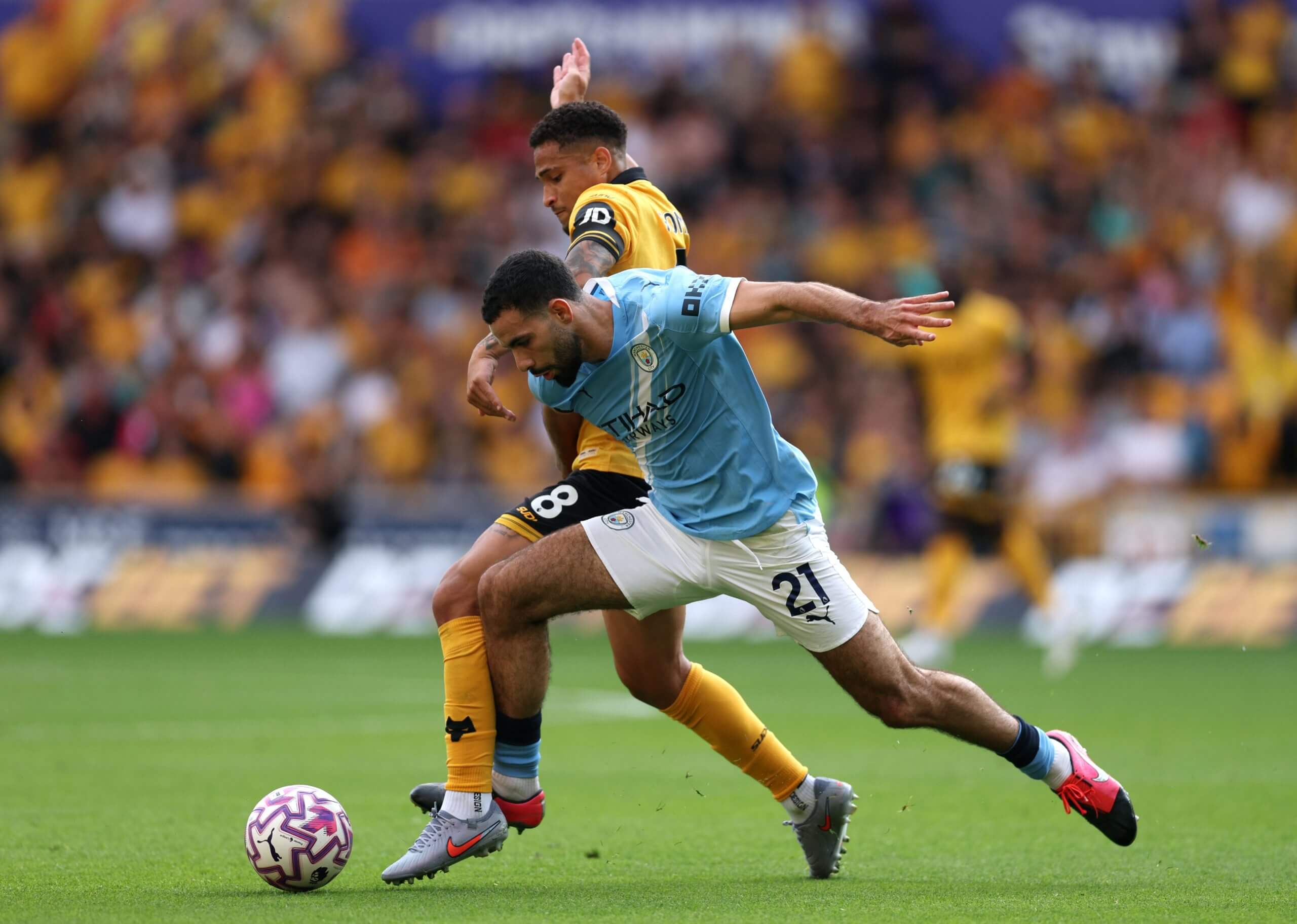
Wolves sold Rayan Ait-Nouri to Manchester City last summer (Michael Regan/Getty Images)
Some of the difference owes to sell-on clauses. Kilman’s move to West Ham generated a substantial sum for English non-League side Maidenhead United, and Angers of France previously held a clause entitling them to 50 per cent of any profit the club made on Ait-Nouri. Wolves, however, had the option of buying-out that clause for £8.5m. If they did so, it isn’t clear whether the correct accounting for that sum would reduce their player-sales figure.
Sources with an understanding of the club’s business told The Athletic the reasons for that ‘gap’ are three-fold: a combination of sell-on clauses, fees paid to agents for facilitating the deals and the impact of receiving transfer instalments in future years. The latter requires clubs to account for the ‘present value’ of sales, reflecting how receiving a fee in future years is less valuable than receiving it today.
That, however, is unlikely to account for the lion’s share of the difference. Sell-ons and agent fees are the main drivers.
Two years of negative net spend have seen Wolves’ transfer debt more than halve in that time, and at the end of June 2025, they owed a net £53.8m to other clubs. That’s very much at the low end for a Premier League team, and this season’s activity points to a similar level being maintained again, though it also helps highlight the financial gulf that exists between England’s top two divisions. That level of transfer debt would, perhaps will, be one of the highest in the 2026-27 Championship.
Wolves’ financial debt didn’t really budge, sitting at £101.4m to the end of last June. That remained the case even after a refinancing in September, whereby the club replaced an existing £100m bank loan with a new lender, PGIM, a U.S. asset management firm.
The refinancing sets a new repayment date of October 2031 and shifts the interest involved from variable to fixed rate. That rate rises half a percentage point to 7.85 per cent if Wolves go down, though that’s not too dissimilar to the amount they’ve been paying at variable rates.
The new agreement also includes measures to ease the tightening of cash flows that relegation brings, though the size of those interest payments would produce strain if Wolves spent any prolonged time out of the Premier League. Nearly £8m in annual interest is notable yet manageable when revenues near or breach nine figures. Those payments are a lot harder to service if turnover drops to the level of the second tier’s non-parachute clubs, where income tops out around the £40m mark.
Wolves relied on such external lending during the years affected by the Covid-19 pandemic but since then, owner Fosun has plugged funding gaps, recently as equity rather than debt. The group wrote off £126.5m in loans in 2020-21, and Wolves are currently debt-free to their Chinese ownership.
Fosun provided £8.8m as shares in 2024-25, and its investment in the club since the July 2016 takeover now totals £222m.
That figure may have risen further in 2025-26, and certainly has the potential to if Wolves spend next season in the Championship.
Occupying the Premier League’s basement for so long has given them a greater opportunity to plan for life outside the top flight than most enjoy (in the least applicable sense of the word) and, like the majority of recently-relegated teams, a combination of parachute payments and player sales would surely be used to fund an immediate promotion push.
Yet how much the club can manage from their own resources outside the Premier League will depend on those transfer exits and the amount of time they spend in the EFL. The Championship is a basket case where football finances are concerned, and relegated sides routinely turn to their owners to fund promotion challenges, which incur big financial losses.
Wolves have started working toward what the future brings them already, but without taking on extra external debt — a step both undesirable and unlikely — there’s a good chance Fosun will be called upon to help them try to get back to the top table of English football, just as the group propelled them there a decade or so ago.