

Written on 25/03/2026
Although Liverpool won the Premier League title last season, there was a general feeling that the team’s creative department could do with an upgrade, specifically in midfield, following the departure of their chief creator, Trent Alexander-Arnold, who had essentially been their ‘Kevin De Bruyne’ from right-back.
The club pursued the best possible option and signed Florian Wirtz to play as a number 10, serving as a long-term replacement for Dominik Szoboszlai in that role. The latter was an integral part of the title-winning midfield last season, operating as a 10 with central support from Alexis Mac Allister and Ryan Gravenberch.
In Wirtz, they got a player who, last season, produced very similar chance-creating numbers to what Alexander-Arnold produced in a Liverpool shirt before shipping off to Real Madrid. We have the table below to showcase that.
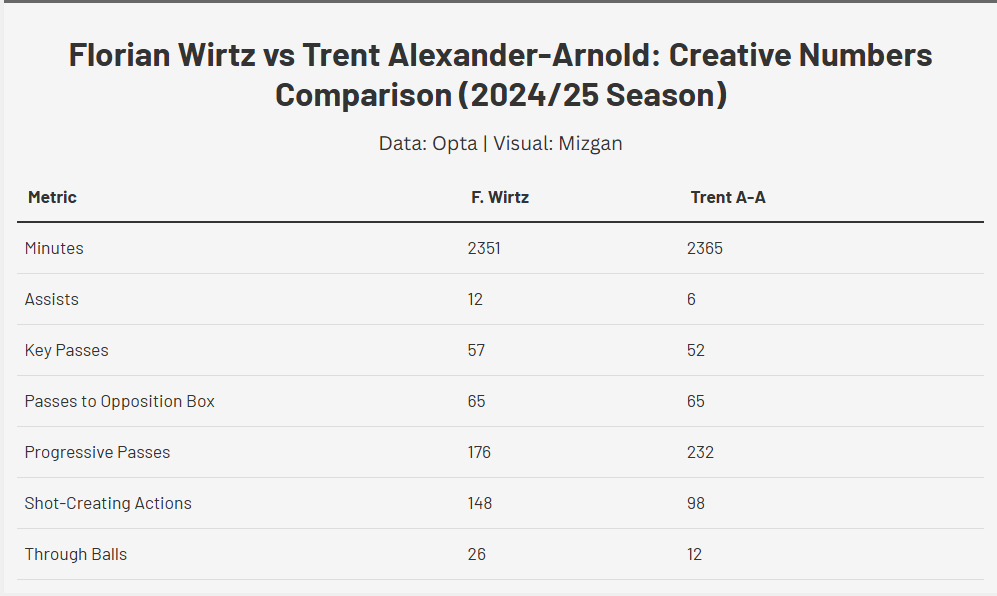
* Wirtz got 22 goals + assists (G/A) in the Bundesliga last season. Szoboszlai had 12 G/A last season for Liverpool.
So, it felt like ideal succession planning: adding more creativity to the team while signing two strikers and keeping hold of Mohamed Salah. Although things have not gone to plan so far this season, and the squad requires the addition of wingers this coming summer, this is a long-term plan that I am sure will work.
In the analysis below, we take a deep dive into the numbers to differentiate between the types of players Wirtz and Szoboszlai are, the specific profiles of number 10 they represent, and why the German is the right man for the position in the long run.
The modern game, especially in the Premier League, cannot afford to carry passengers, even if they are the most creative player in the team. Szoboszlai was one of the best at covering ground defensively last season, ensuring Mohamed Salah could stay high up the pitch to cause problems for the opposition.
That system worked exceptionally well. The Hungarian was also adept at covering the right-hand side to offer support to Alexander-Arnold, who often struggled defensively at right-back. In essence, he wasn’t required to be the ‘creative hub’ of the team even when starting as a 10.
This season, however, following Alexander-Arnold’s departure, the setup has changed. The number 10, while still required to put in the defensive shifts, must now become the central hub for chance creation and goal contributions. Things haven’t always gone to plan this season (far from it), but we have seen glimpses of what Wirtz can do when the components around him are even remotely functional.
To be fair to the German, after a testing start to life in the English league from a physical perspective, he has developed a bit since December. Let’s look at his off-the-ball numbers for this season compared to those of Szoboszlai last season.
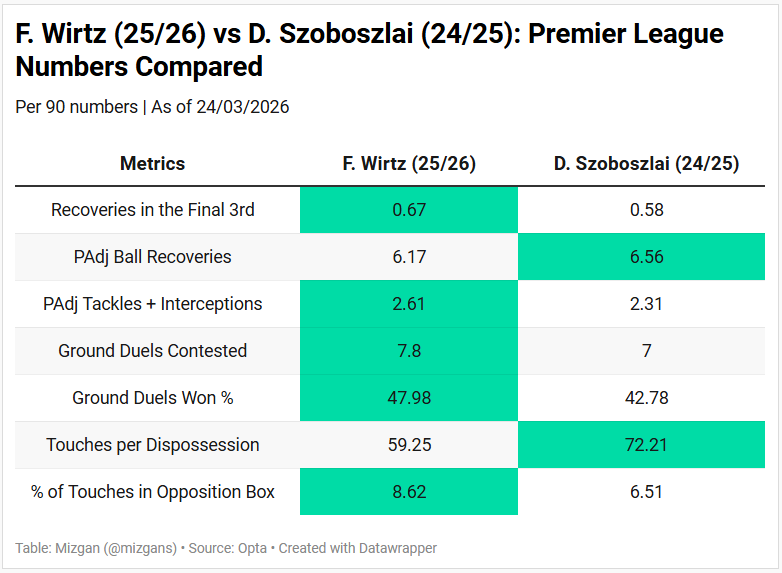
While Wirtz may never match Szoboszlai’s relentless ground coverage off the ball, his overall defensive numbers this season have been impressive and remain comparable to the Hungarian’s output in a similar role last year.
Furthermore, Wirtz’s high proportion of touches in the opposition box shows that he operates closer to the goal than Szoboszlai did by comparison (understandably so, even in the eye test).
Having said that, the German could do with improving his overall pressing and building more stamina to last longer in Premier League games, so he is in shape to impact games late on as well. That should come the more he plays, one would think.
We start with a season-wide analysis of how Wirtz and Szoboszlai have performed on the ball, especially regarding their passing and chance creation from the final third and beyond.
Once that is done, we will narrow the analysis to games in which they have played as a number 10 this season, to get an idea of how they differ as attacking midfielders, even in this new setup where the creative volume no longer comes from right-back as it did last season.
First up: season-wise data analysis.
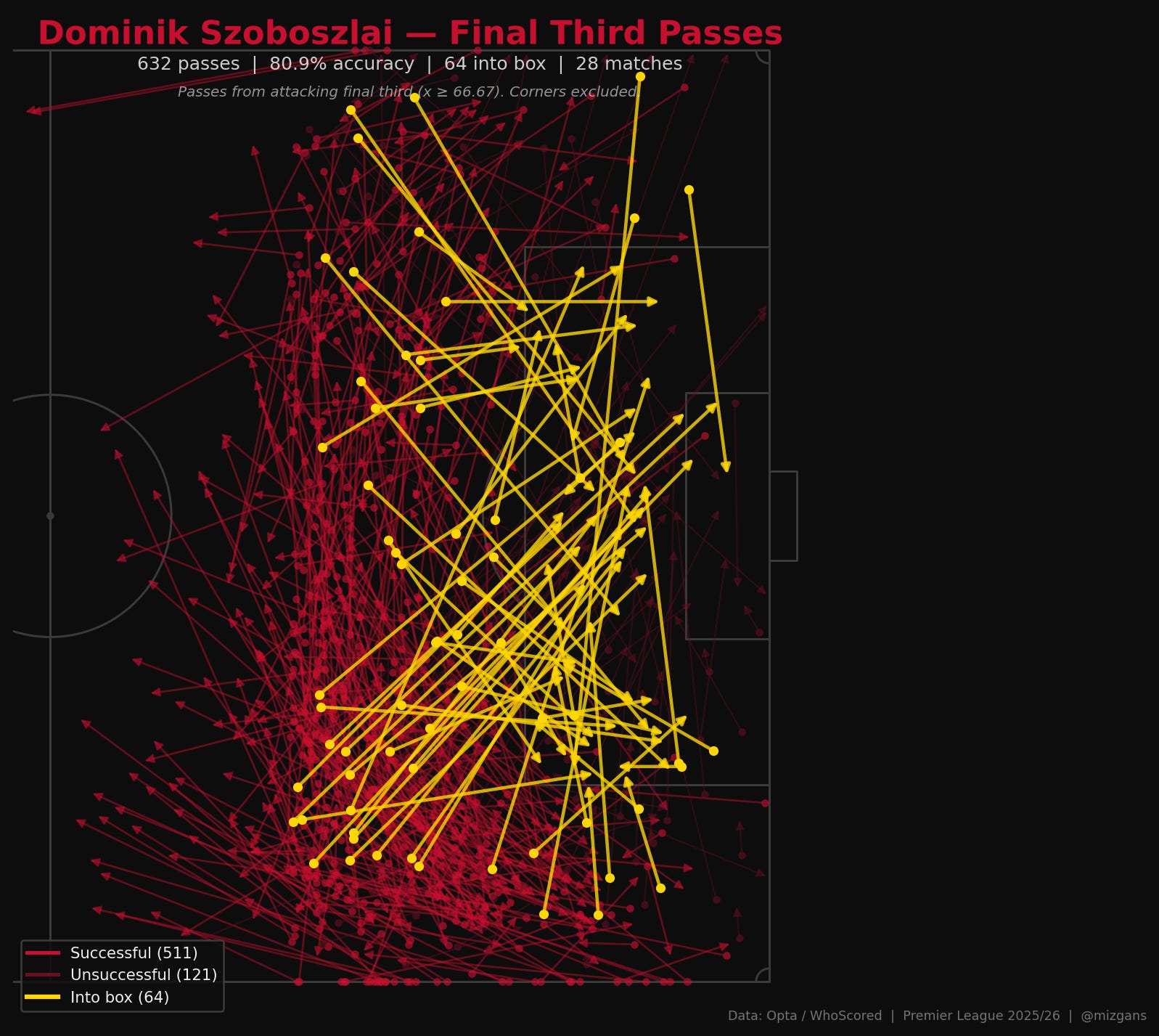
So far this season, 12.52% of Szoboszlai’s passes originating from the final third have gone into the opposition box (excluding corners). The visual above should be viewed in the context that the Hungarian has played as a number 10 and also in right-sided roles, whether in midfield or at right-back.
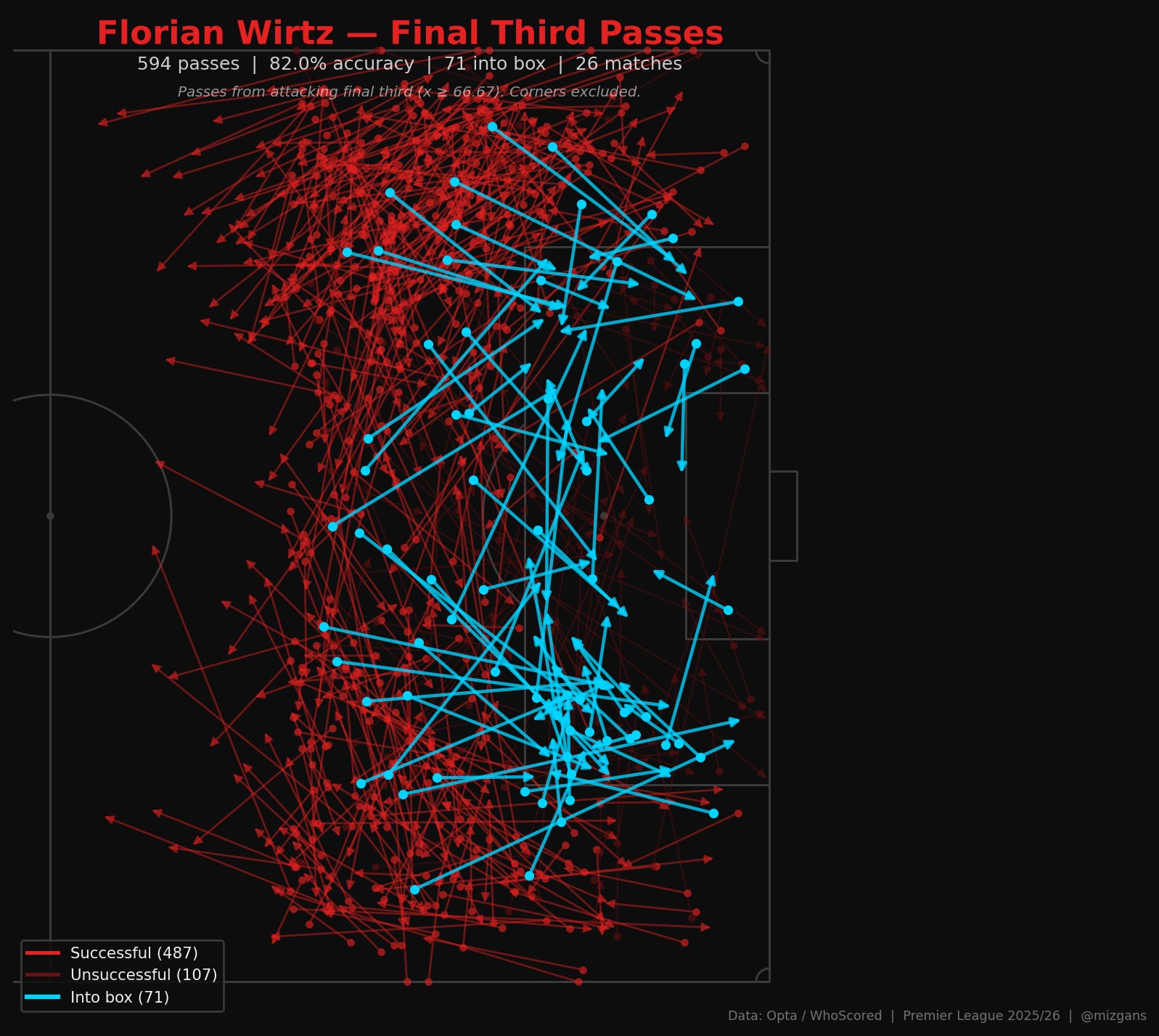
Compared to Szoboszlai, Wirtz has a 1.1% higher pass accuracy for passes originating from the final third. Although the difference isn’t massive, it is significant when discussing passes in such a specific zone. Compared to Szoboszlai’s 12.52%, 14.57% of Wirtz’s successful passes originating from the final third end up in the opposition box (excluding corners).
The German has mostly played as either a 10 or on the left wing, so his passing range is more centred around the edges of the penalty area. This is exactly the type of zone Liverpool will want him passing from, and into, in the coming weeks, months, and years.
Furthermore, key passes made from the final third zone or beyond per 90: Szoboszlai – 1.22, Wirtz – 1.73 (excluding corners).
The next section compares their overall expected threat (xT) created from successful passes across the pitch so far this season. This will give us a clearer idea of the specific zones from which they have generated the most threat with their passing.
The rest of this article is for paid subscribers (only £3.50 to access six data-driven breakdowns, player and team analysis, scout reports per month; £4 off for an annual subscription).