

As Crystal Palace cruised to a 3-0 away win against Irish club Shelbourne on December 11, everything seemed well with their world.
A place in the knockout phase of the UEFA Conference League was almost assured and they sat an impressive fourth in the Premier League. The travelling supporters in Dublin sang the name of manager Oliver Glasner almost non-stop for the final 10 minutes of the game.
Admittedly, Palace’s results had been rather deceptive. They had not always provided the exhilarating, fast-paced transitional football that had been their hallmark for much of last season or during the run-in to 2023-24 following Glasner’s appointment that February. There was a profligacy to Palace which was worrying, with plenty of chances created but too many not taken. But they were still capable of eking out results.
Then that changed.
It would be almost two months before Glasner and his players next celebrated a victory of any kind.
A winter of discontent also involved captain Marc Guehi getting sold to Manchester City, injuries ruling out Daniel Munoz and Daichi Kamada for long periods, and an unsettled Jean-Philippe Mateta also restricted by a persistent knee problem. Glasner fanned the flames by announcing his intention to leave Palace upon the expiry of his contract in the summer, and angered supporters with his words in multiple press conferences.
As the form dipped dramatically, so the relationship between manager and club fractured.
It has been a season of two halves for Palace and, in terms of the results, that game against Shelbourne seems to be the dividing line. Plenty has been a struggle ever since, with that winless run extending to 12 matches before the recent upturn. Their record at home, in particular, has remained underwhelming throughout.
The graphic below identifies periods of bad form in a team, marked in red, and compares Palace’s this season with how they did in 2024-25. As the shaded areas show, their slide is made all the more stark when put up against that previous campaign.
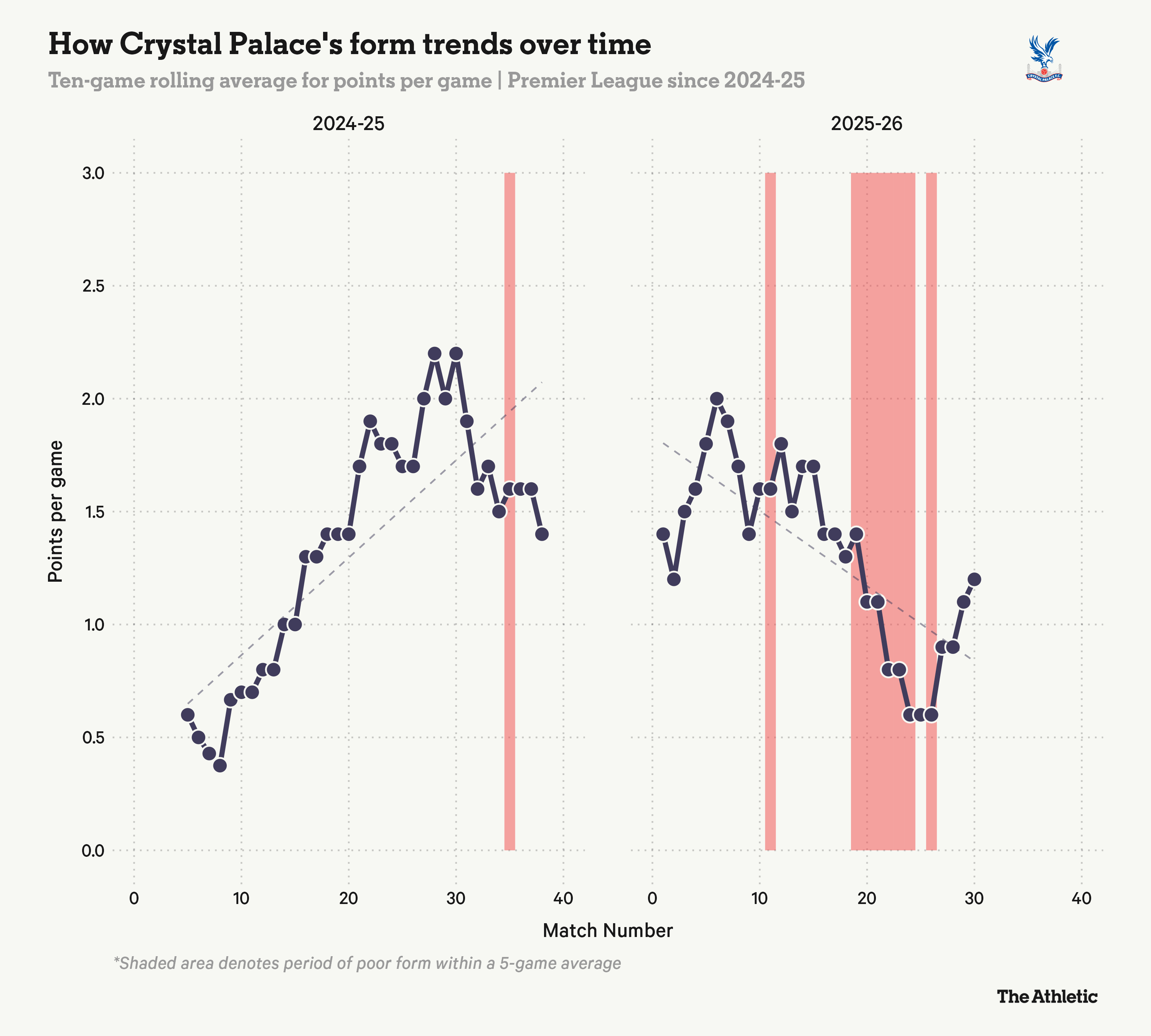
A team who were flying in mid-December in the Premier League, even at the expense of some of the thrill from earlier in the Glasner era, lurched away down the table and their chance creation dropped off significantly.
Here, The Athletic looks at what Palace have struggled with over the second half of the campaign so far, and whether there are parallels to be drawn from previous seasons.
Why have Palace struggled to make in-roads on the counter-attack?
In those games which followed that win in Dublin, Palace struggled badly against low blocks.
Yet their embarrassing 2-1 defeat at Macclesfield, from the sixth tier of football in England, as holders in the FA Cup’s third round in January was not against a team who massed resolutely in their own territory. Nor, indeed, was the following weekend’s Premier League loss away to Sunderland. Both were proficient defensively, but they did not simply sit and look to hit them on the break.
Regardless, Palace have been far less proficient on the break than they once were.
The reasons why are difficult to pinpoint, but it suggests a change in approach from Glasner. This has partly been forced on him, but is partly out of choice.
The Austrian is still wedded to his 3-4-2-1 formation and, on the face of it, has not changed much. Yet the graphic below shows a 10-game average of Palace’s direct attacks per game — as a proxy of counter-attacking — and indicates a sharp drop-off around the time of that 2-1 defeat by Sunderland, a match that coincided with the sale of Guehi.
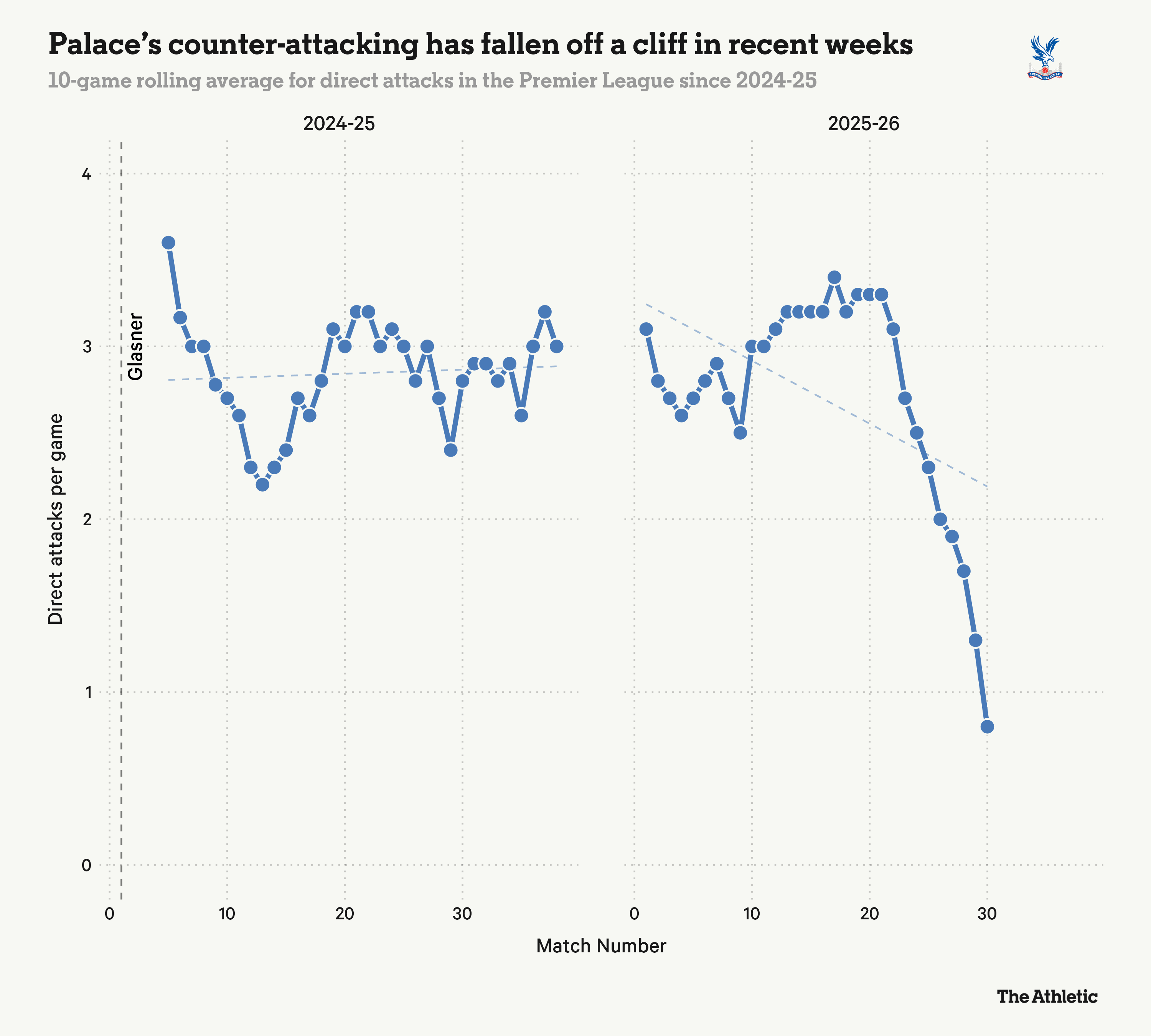
That in itself is unlikely to be the main reason, but it helps to explain why they are finding it more difficult to break teams down. Neither of his fellow centre-backs Jaydee Canvot and Chadi Riad is anywhere near as capable or willing to carry the ball into midfield or play those long crossfield passes to set a player free on the opposite flank.
Palace’s fixtures might help to explain things, too.
They have faced Nottingham Forest, Brighton & Hove Albion, Burnley, Wolverhampton Wanderers and Leeds United in their past seven matches. In each, they have had at least 60 per cent of the possession, with 67 per cent against Forest and Leeds, who were both reduced to 10 men for the second half. Against both, though, Palace laboured to create meaningful goalscoring opportunities.
This run of fixtures has seen them face sides who are more likely to play deeper, limit space and then counter-attack themselves.
Palace’s remaining eight games are more challenging than those listed above in terms of the quality of opposition but might, counter-intuitively, offer them a better chance of success as more space opens up to work into during transition.
Does the data tell us anything about the games since Shelbourne?
There is not a huge disparity in the data since December, but there are a few notable metrics: not least Palace’s increased amount of possession, from 43 per cent to 49.4 per cent, and field tilt.
Palace are effectively having the ball as often as their opponents, and that is relatively unusual under Glasner. He has not found a way to adapt his system with the players at his disposal to have the same impact as in the back end of last season or, indeed, the start of this one.
Results have picked up of late, with only two defeats in 11 across all competitions, even if they have not re-established that dominance on the break. Munoz appears to be affected still by the knee injury that led to his spell out and Guehi’s removal from the team is notable in the speed of their play, which continues to be slow and cumbersome.
An increase from 45 per cent to 51.8 per cent for their field tilt — denoting the share of touches in each team’s respective attacking third — dovetails with the idea that there has been a tweak to the playing style.
This means Palace have had more territory than the opposition across those games and, therefore, might have been expected to have more shots and more attacking situations, pinning the other team back more. But as the table below highlights, this has not been the case. Coupled with the recent drop in direct attacks, it shows they have not been able to implement the style that brought them success in the recent past.
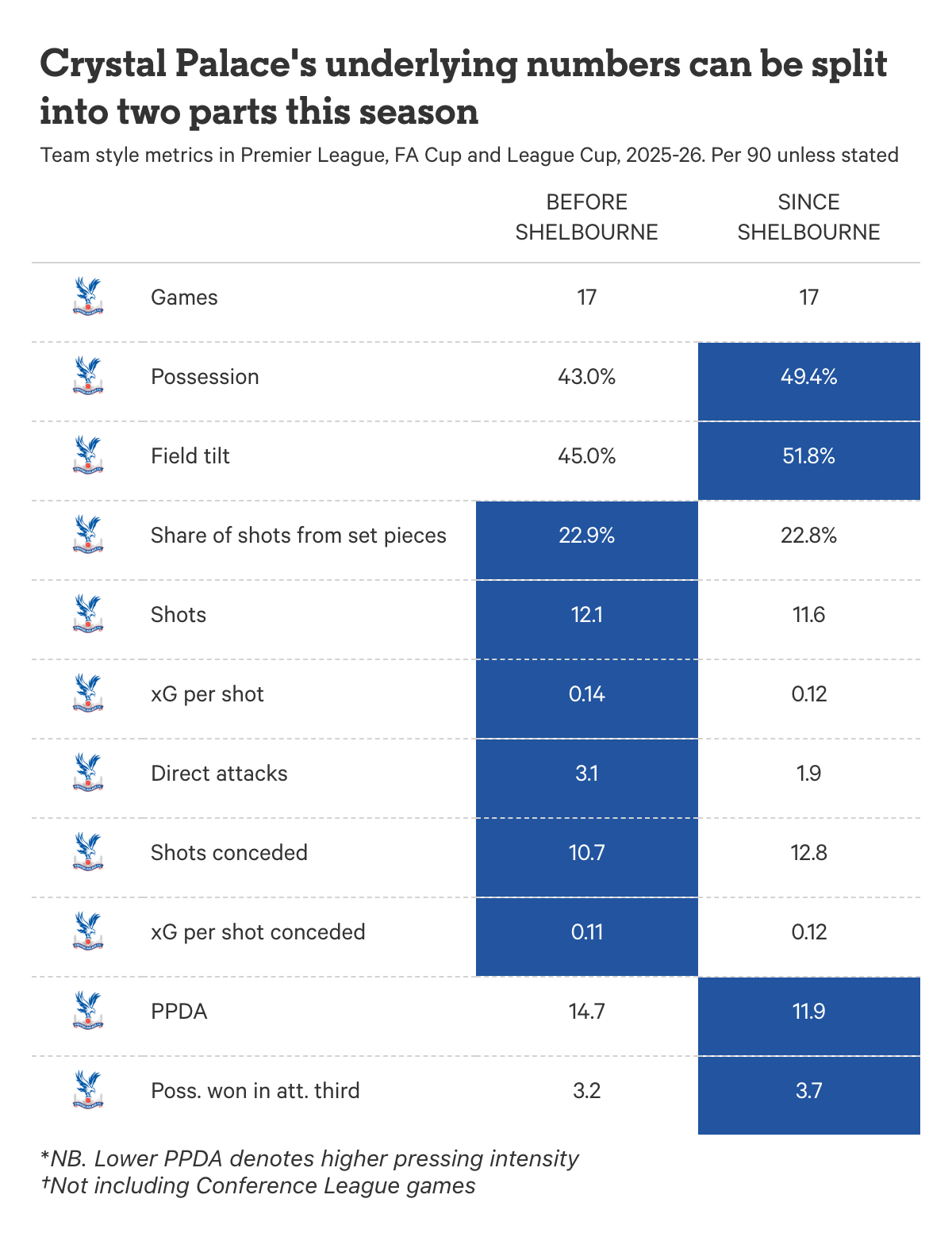
Again, though, this is not how Glasner prefers his teams to play, and Palace have continued to be wasteful in front of goal. Although this is a running theme of the season and not limited to this spell, it is even more apparent when the games are tighter and the direct counter-attacking less frequent.
There is not a huge disparity in the numbers per 90 minutes, but it accumulates into something more significant over the course of a season.
Losing to Munoz and Kamada to injury and Ismaila Sarr’s absence for more than a month helping Senegal win the Africa Cup of Nations no doubt had an impact on the speed of their play, with no direct replacements for any of those key figures.
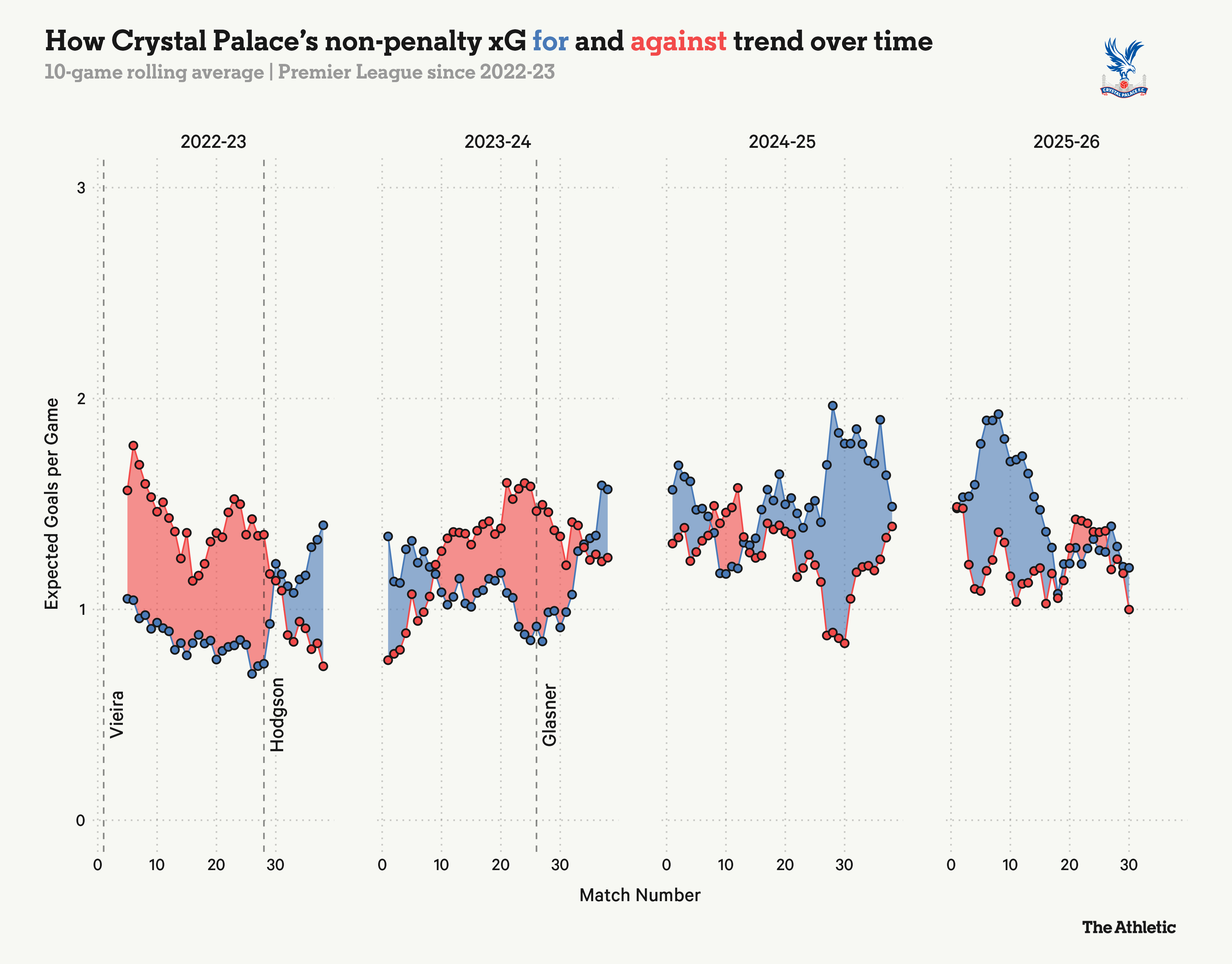
Palace went from creating chances but missing them, to a dip in both making chances and scoring. As shown below across a rolling 10-game average, Palace’s expected goals (xG) per game began to fall around the same time as that winless run began. Where previously they were creating chances of higher quality than they were conceding (identified by the blue shaded area), recent weeks have seen that picture become muddled — they are giving up as many opportunities as they are generating themselves.
So where does this season sit in the context of previous campaigns?
For all the misery that has accompanied the second half of this season, it is still one of Palace’s most successful in years.
Much of the frustration has stemmed from that winless run, punctuated as it was by forthright statements by Glasner in his press conferences. But when the manager points out where 2025-26 sits in the context of the club’s recent campaigns, he is not entirely inaccurate.
Only once since promotion back to the Premier League in 2013 have Palace conceded fewer goals after 30 games than the 35 they have shipped to date in this one — that being the pandemic-interrupted 2019-20 season, where Roy Hodgson’s side then lost seven times in their final eight matches after Project Restart, conceding 18 more goals, to wreck that previously solid defensive record.
That same season is the only time they have accumulated a higher points total (42) outside Glasner’s management after 30 Premier League fixtures than the 39 they have today.
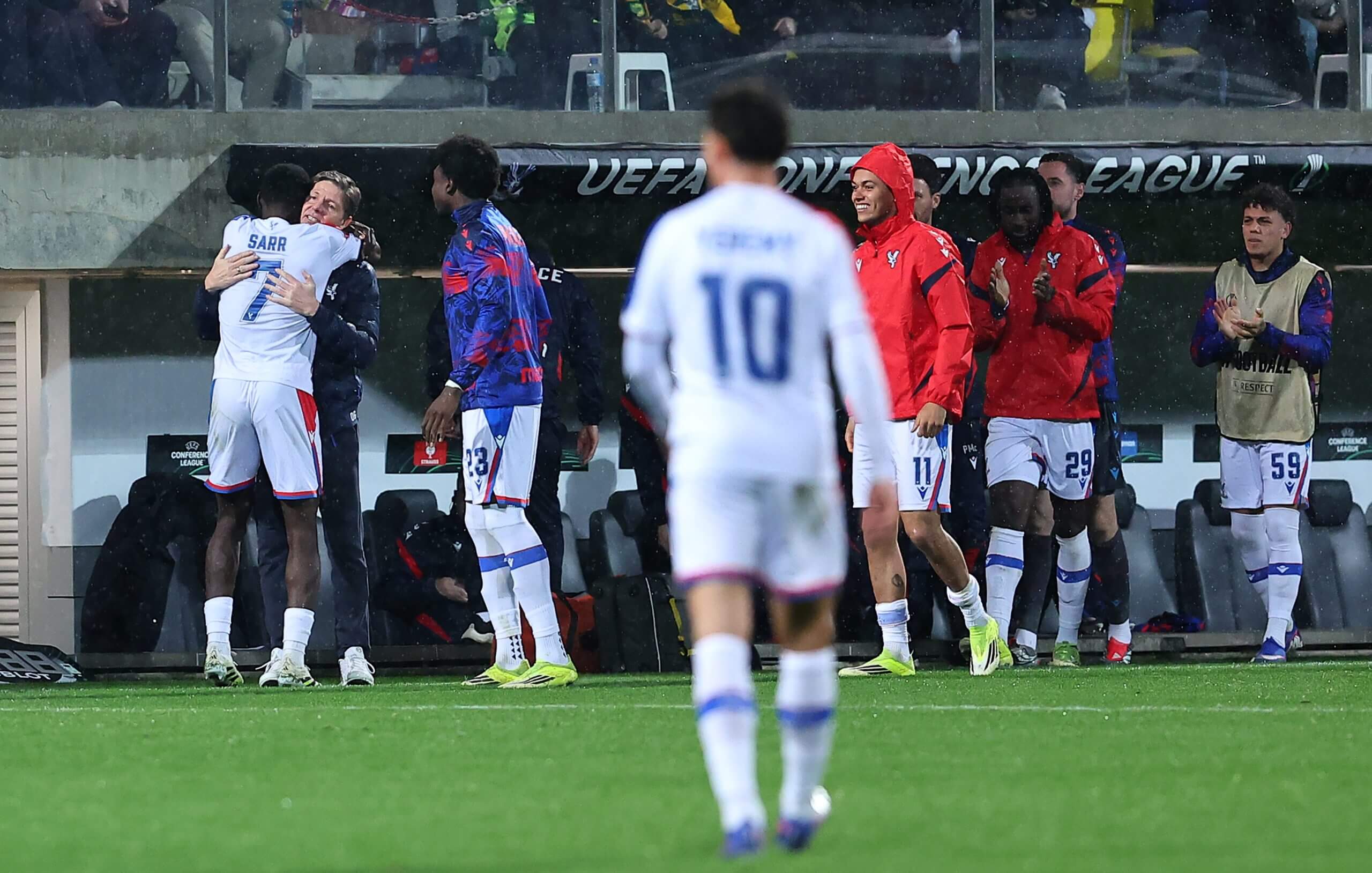
Ismaila Sarr hugs Oliver Glasner after scoring against AEK Larnaca to secure a Conference League quarter-final against Fiorentina (Chara Savvidou/Getty Images)
Palace have often been difficult to watch since December.
Naturally, there were exceptions — the recent 3-1 win at Tottenham Hotspur, for example — but the home form has generally been a grind in a season that promised so much. But Glasner, for all his faults in saying it so directly, is not wrong when he states that expectations have risen.
That is born of winning the FA Cup in May and then the Community Shield three months later.
Add that context to the drop-off in performances compared to last season and the final part of the 2023-24 campaign and the discontent makes sense.
Fans are entitled to want to be entertained, and to be frustrated that the European campaign has been a struggle, as well as by the problems Palace have endured when confronted by 10 men on several occasions of late. If they had not faced quite so many low blocks in matches at Selhurst Park, feelings might be a little different.
Still, it is worth remembering that this is the best Palace have been since the turn of the century, as shown by looking at their ClubElo rating as a measure of team strength.
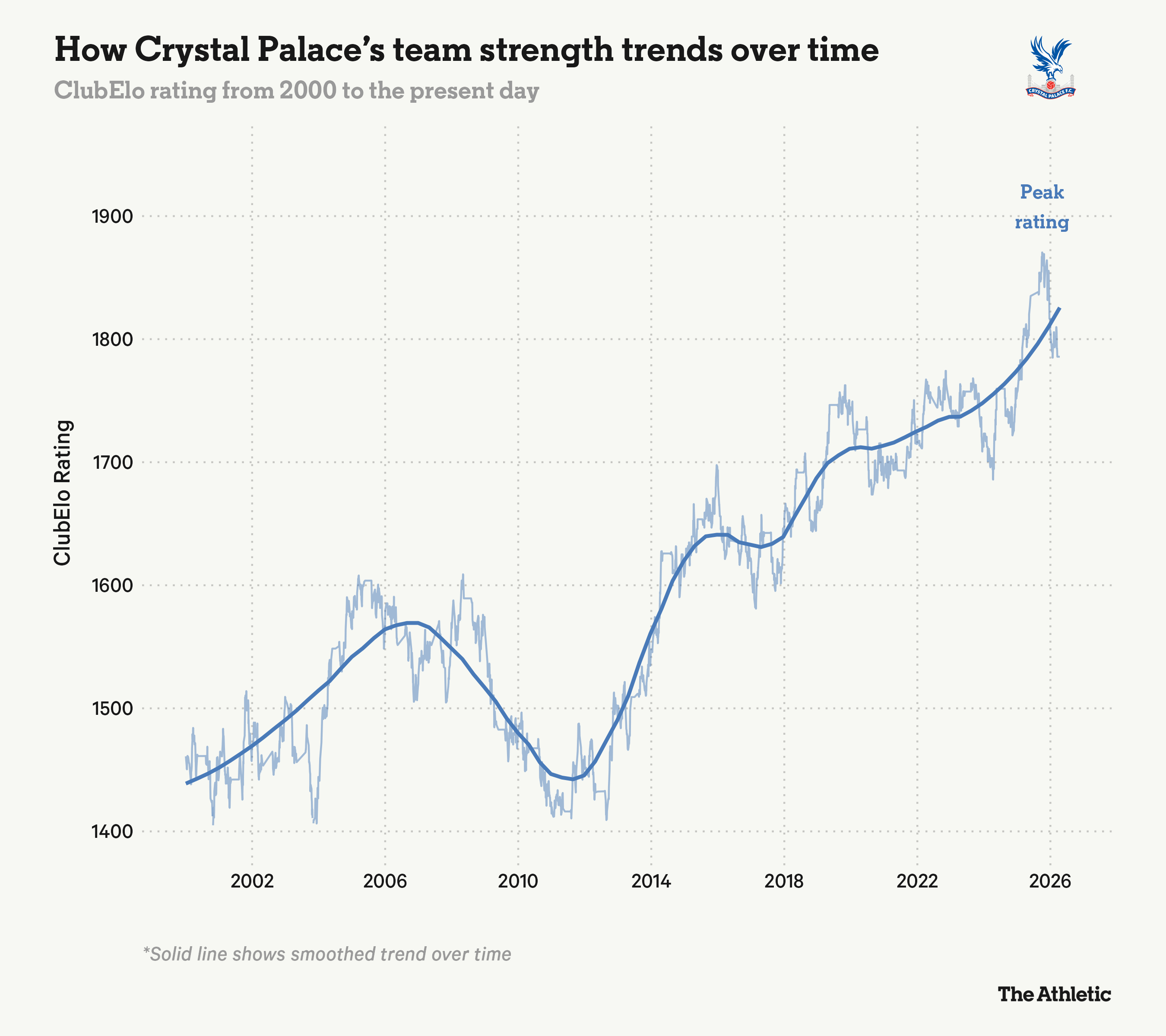
Palace’s season has, by and large, followed the ups and downs their previous years in the Premier League have included. The frustration of dips has been exacerbated by Glasner’s comments, Guehi’s departure and the unavailability of other key players. That the campaign has become a grind, with little entertainment on offer and an intransigence in the manager’s approach, has added to the sense of angst.
But Palace have played more games than before, lost key personnel at important times, and still come through to achieve something almost as good as they ever have. They are in next month’s quarter-finals of the Conference League and could yet achieve one of their highest Premier League points totals.
This season of two halves has not been as disappointing as it may seem at first glance — and the scope remains to achieve something special in it.