
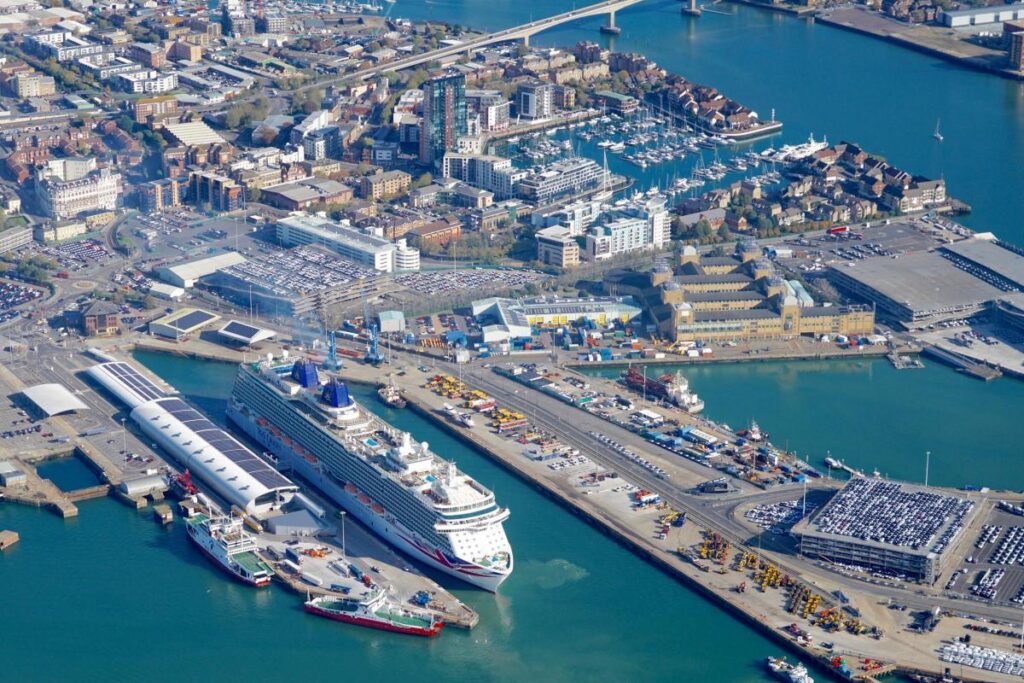
It is astonishing that the global cruise industry can be traced back to these docks in the mid-19th Century.
In 1844, the Peninsular and Oriental Steam Navigation Company, better known today as P&O, decided to try something completely new.
They launched the world’s first-ever commercial leisure cruise, fundamentally changing humanity’s relationship with ocean travel.
Before that time, going to sea had been something to be suffered rather than enjoyed.
An engraving of Southampton Docks in the 1940s. (Image: Echo)
Ships were workhorses, built to carry cargo, wage war or ferry mail and passengers who simply had to get from one land mass to another.
P&O had earned its initial spurs in the first flush of commercial globalisation, winning valuable government contracts to carry mail from England to the Iberian Peninsula and Egypt.
But the company saw a rising demand among the affluent Victorian elite for exploration and sightseeing and took a gamble on the outlandish notion that people might actually pay to travel by ship just for the pleasure of doing so.
That first ever cruise ship was not simply a passenger vessel undertaking a point-to-point journey when she left Southampton in 1844, but was instead sailing to the Mediterranean on a pre-scheduled itinerary solely for leisure purposes.
Read more:
For the first time, her delighted passengers were able to enjoy a series of exotic sun-drenched ports including Gibraltar, Malta and Athens. For the first time the voyage was the product, not simply the execrable cost of travel.
The notion was a resounding success: the thought of packing one’s trunk, embarking on a steamship in Hampshire and chugging off to discover the ancient ruins of the Mediterranean fired the Victorian imagination.
This led to a succession of ever-larger, ever-more luxurious vessels that prioritised passenger comfort over cargo capacity and would go on to include features such as extensive promenade decks, structured entertainments and fine dining at sea.
Although the first cruise may have left from London, because P&O were already well-established in Southampton, the leisure excursions on the Lady Mary Wood, Targus and other ships departed from there by July that years.
Targus. (Image: Echo)
Today, as enormous, floating resorts incessantly ply up and down Southampton Water, they are all taking part in a custom that began with that solitary, perceptive P&O voyage.
The 1844 voyage demonstrated that the sea didn’t have to be merely an intimidating obstacle at all – it could also be a vacation destination in and of itself.