
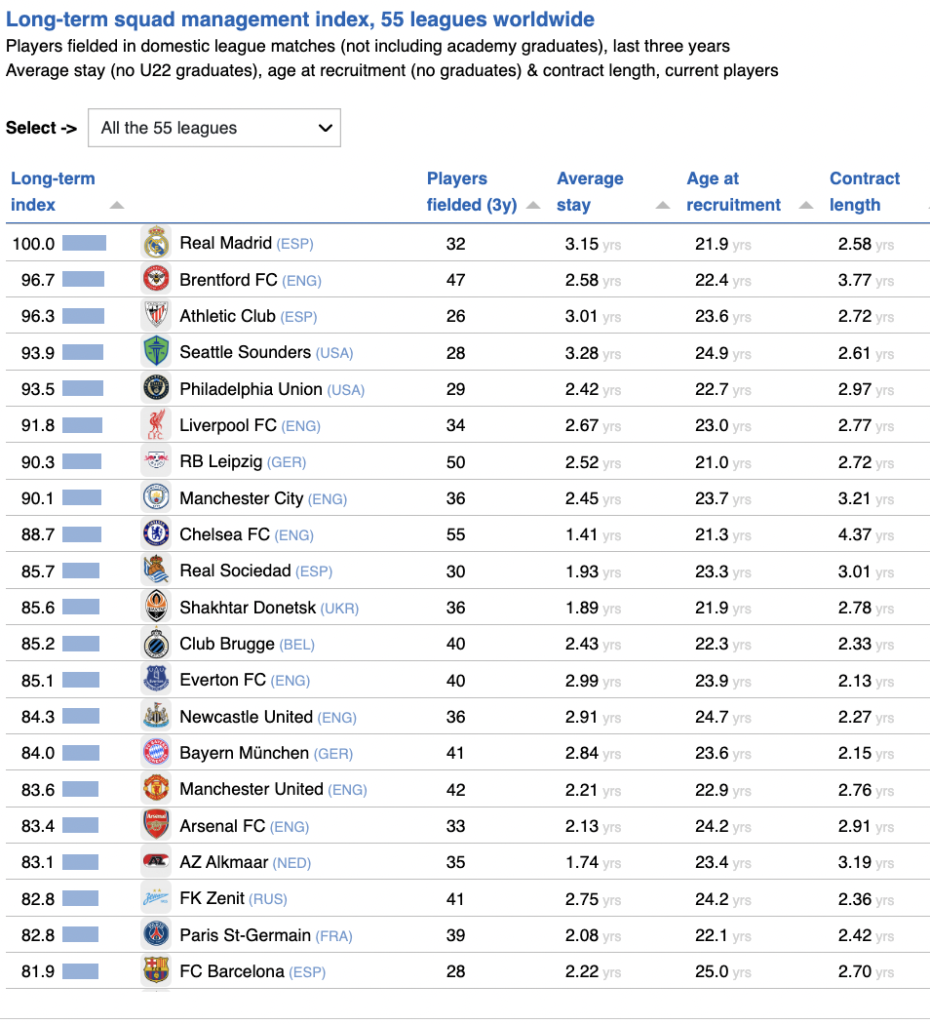
March 18 – Real Madrid top the global game when it comes to long-term squad planning, according to the latest study from the CIES Football Observatory – a reflection of a recruitment model increasingly geared towards the future.
The ranking, built on a composite index measuring squad stability, contract length, recruitment age and player turnover, places Madrid ahead of Premier League Brentford and LaLiga rival Athletic Club, with MLS clubs Seattle Sounders and Philadelphia Union completing the top five.
Real Madrid’s recent transfer strategy has relied upon acquiring high-upside talent early – players they can develop, extend and retain – rather than chasing short-term fixes. They also use their leverage as the world’s biggest club to attract the biggest stars coming to the end of their contacts, as they have with Kylian Mbappe, Trent Alexander-Arnold and Toni Rudiger.
It is a model that has brought both continuity and control, with longer contracts and lower churn helping to anchor the squad over multiple cycles.
There is, however, a balance to strike.
While Madrid’s long-term planning is clearly paying off on paper, the immediate picture is slightly less assured. Sitting second in La Liga, they are only six points off the pace in the title race, but there is a lingering sense that a squad built for tomorrow may, at times, benefit from a little more emphasis on the here and now.
Having beaten Manchester City comfortably over two legs in the Champions League Round of 16, they are nevertheless a force to be reckoned with.
Elsewhere, the study highlights a mix of approaches across Europe’s top five leagues.
In England, Brentford’s second-place ranking underlines the success of a data-led recruitment model that prioritises efficiency and resale value. They are joined by a collection of other Premier League clubs in the top bracket, led by Liverpool, Manchester City and Chelsea.
Beyond the traditional European power centres, the presence of Seattle and Philadelphia in the top five offers a reminder that Major League Soccer clubs – operating under different structural constraints – are increasingly optimised for longer-term planning alongside a reputation for signing big name players from European clubs at the end of their careers.

To see the full data, click here.
Contact the writer of this story, Harry Ewing, at moc.l1773839034labto1773839034ofdlr1773839034owedi1773839034sni@g1773839034niwe.1773839034yrrah1773839034