
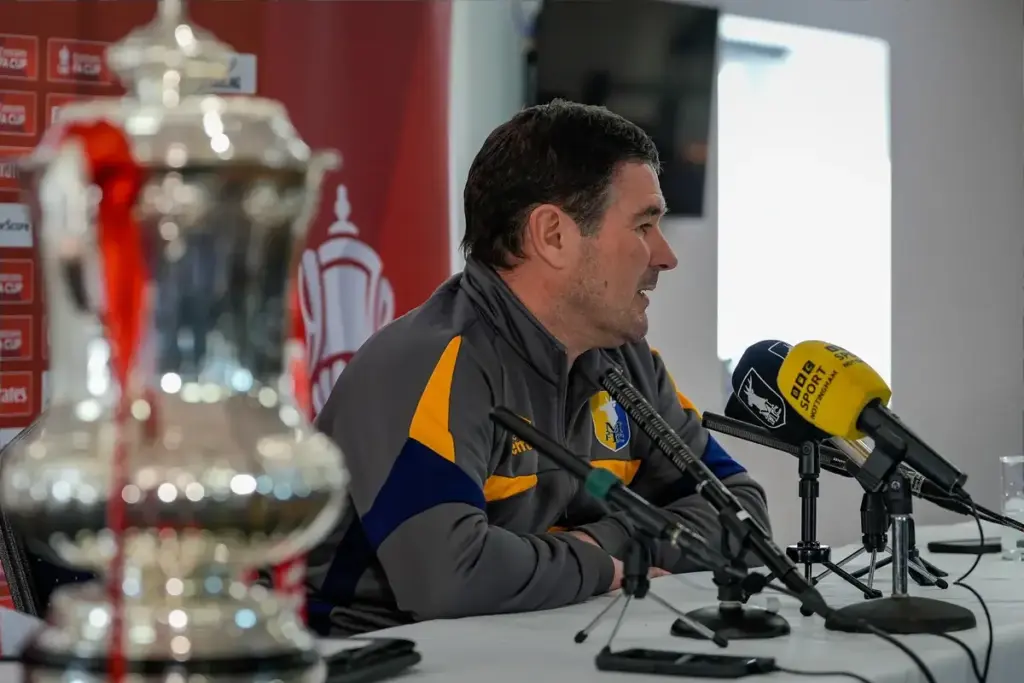
With Mansfield Town preparing for one of the biggest games of their season against Premier League leaders Arsenal, manager Nigel Clough sat down to discuss the challenge of facing elite opposition, the financial landscape of League One, and the lessons learned from nearly three decades in football management.
Clough also reflected on the mentality required for such a high-profile fixture, the importance of learning from past experiences in cup competitions, and the ongoing development of his squad.
Q: With such a big game ahead, how important is it to move on quickly afterwards regardless of the result?
Nigel Clough:
That’s probably the most important thing. However the game goes on Saturday, by half-past two or three o’clock you have to move on.
You can’t dwell on it for too long because within three days you’ve got another match. That’s football. Whether the result is good or bad, you’ve got to get it out of your mind quickly and focus on the next one.
That’s the challenge for players and staff — recovering mentally and getting ready for the next 12 or 13 weekends of the season.
Q: Your team has competed well in League One despite the financial power of some clubs. How pleased are you with the progress?
Nigel Clough:
It’s a good question because the spending power in League One is huge now. Some clubs are operating with budgets far bigger than others.
For us, we believe we’ve improved, even if the league position doesn’t always show that clearly. Defensively we’ve been very solid — I think we’ve had one of the better defensive records in the league — and our goal difference in the bottom half of the table is strong as well.
Sometimes the difference between moving up the table and staying where you are is just a goal here or a decision there.
For us, it’s about surviving again this season and continuing to progress. That’s the key thing — building year on year.
Q: Over your long managerial career, what has been the toughest decision you’ve had to make?
Nigel Clough:
That’s incredibly difficult to answer after 25 years in management.
One of the toughest decisions you make every single week is picking the team. That’s always the challenge. You’re trying to select the side that gives you the best chance of winning the game.
Of course, you don’t always get it right. None of us do. But you make those decisions with the right intentions based on what you’ve seen in training and how players are performing.
Sometimes you’re giving players minutes, sometimes you’re leaving players out — and those are difficult decisions because you know how much it means to them.
Q: What would success look like for Mansfield when facing a team of Arsenal’s calibre?
Nigel Clough:
When you play against a side like Arsenal, you just want to be competitive and give yourselves a chance.
If you can stay in the game and create opportunities, then for an hour or even ninety minutes anything can happen. Cup football has always been like that.
Sometimes you only get two or three good chances in games like this, and you’ve got to take them.
The main thing is to stay organised, work hard and give everything. If we do that, then we can come away feeling proud of the performance.
Q: Do you prepare specifically for the possibility of penalties in cup ties?
Nigel Clough:
Yes, we practise them. There’s nothing particularly special about it, but it’s something you need to prepare for.
In cup football you never know what’s going to happen. If it goes to penalties, you want the players to feel ready.
Q: You’ve crossed paths with some of the biggest managers in world football. What have those experiences been like?
Nigel Clough:
They’ve always been fantastic with their time. Managers like Pep Guardiola and José Mourinho will always stop and have a conversation after the game.
What’s interesting is that the first question is usually the same. They’ll ask how clubs like ours manage to achieve certain things.
They’re working with squads worth hundreds of millions, but they’re still fascinated by how smaller clubs operate and how we manage to compete and achieve things with far fewer resources.
Sometimes they ask how you’ve managed to do certain things — and the honest answer is that sometimes you can’t fully explain it yourself.
Q: You’ve also spoken about learning experiences in cup competitions earlier in your career.
Nigel Clough:
Yes, those experiences are important.
You think back to moments where players have had big chances in games when they were younger — maybe when they were 17 or just starting out — and those moments stay with them.
They learn from them. That experience makes them better when the next opportunity comes along.
Cup games especially give players those moments. They test you, but they also help you grow.
Q: Finally, what is the key mentality you want from your players when they step out onto such a big stage?
Nigel Clough:
The most important thing is that they go out there and give everything.
Football supporters want to see effort and commitment first and foremost. That’s something we always try to deliver.
If you do that, then hopefully the performance follows on top of it.
And when you’re playing a side like Arsenal on a big stage, that’s exactly what you need — organisation, hard work and belief.

Holly Wright