
Luck is the enemy of the control-obsessed modern coach. It is an unwieldy foe, refusing to submit to even the most carefully laid tactical plans. But just as this fickle force can snatch away titles and condemn sides to relegation, it can also deliver when it is needed most.
Over a four-day spell — starting with a 4-3 win against Burnley on Saturday and ending with a 0-0 away draw at Bournemouth on Tuesday night — fortune has favoured Brentford.
Keith Andrews’ side have been excellent this season and fully warrant their current position in seventh place, a spot that is likely to bring European qualification — something Brentford have never achieved in a long history that has largely been spent in the lower tiers of English football.
Could they really do it? If they do, this recent slice of luck could prove decisive.
On Saturday, they were spared by VAR. Burnley striker Zian Flemming had a goal ruled out after team-mate Jaidon Anthony’s shoulder strayed marginally offside, while Ashley Barnes had a late equaliser chalked off for handball.
Bournemouth manager Andoni Iraola praised Brentford in his pre-match press conference but pointed to their recent good fortune. “They are playing very well. They have amazing players, they are very well coached, but these things are going their way right now,” he said.
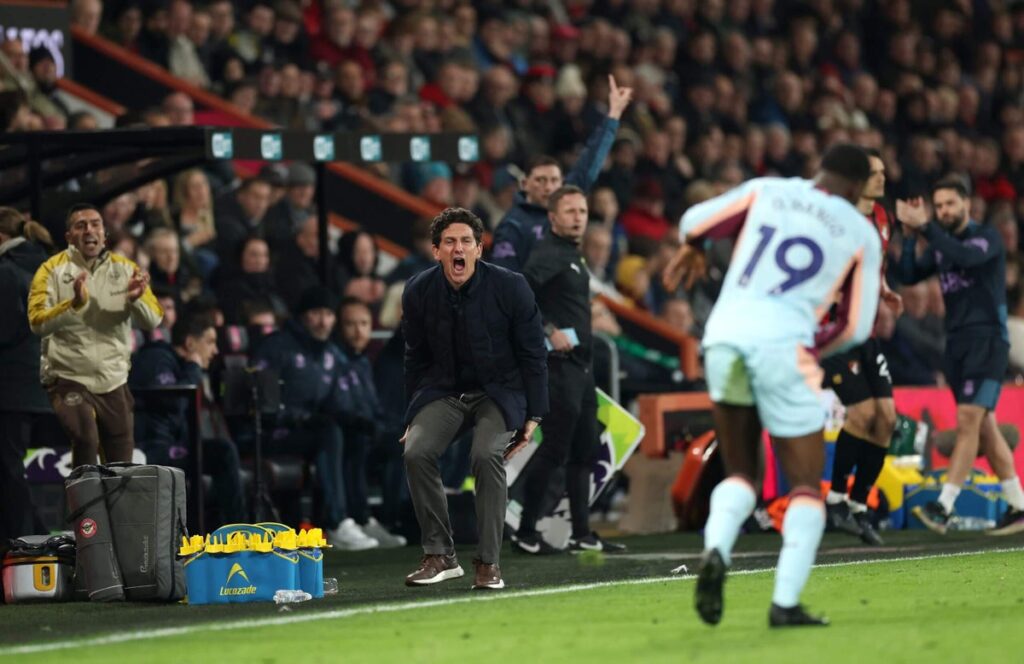
By the end of Tuesday night’s 0-0 draw, Iraola was left cursing his own luck. “Somehow we haven’t scored,” he said after the game.
Bournemouth racked up 2.0 expected goals (xG), missing a string of presentable chances. Eli Junior Kroupi saw a goalbound stoppage-time effort deflect wide off team-mate Enes Unal, while Ryan Christie squandered the game’s clearest opportunity, wriggling into the box before overrunning the ball as he attempted to round goalkeeper Caoimhin Kelleher.
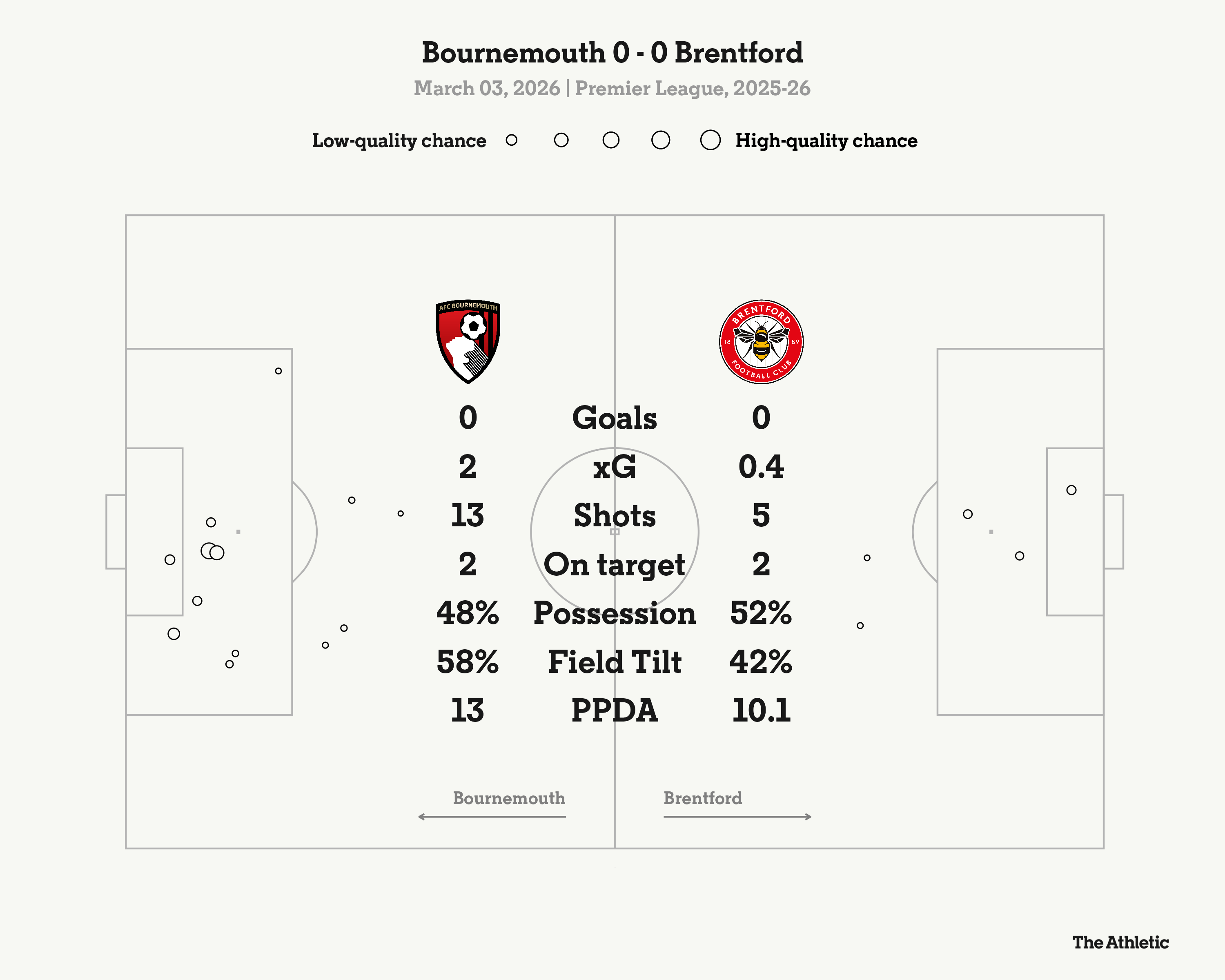
Iraola was particularly angry that Marcus Tavernier was not awarded a penalty at the start of the second half, after Michael Kayode caught his leg as Tavernier stretched to meet a cross. Fouled or not, Tavernier struck the post with the effort and later hit the woodwork again with a powerful shot towards the end of the game.
Rather than puffing his cheeks at this litany of narrow escapes and writing the game off as a lucky escape, Andrews took a different perspective, praising his side’s defensive resilience and saying that they had improved their off-ball work since shipping three goals on Saturday.
Andrews’ bullishness is understandable for a manager keen to maintain the optimism and spirit that has carried Brentford this far. In the cold light of the analysis room he will surely recognise that this was a far worse and more concerning performance than Saturday’s.
Turf Moor was one of those madcap one-off games that develops its own uncontrollable energy. Losing that control was concerning, but Andrews could still draw positives from a strong attacking display; it was the third time Brentford had scored four goals this season. The first came in their 4-1 home win over Bournemouth in November, which should have given them confidence heading into the trip to the Vitality Stadium.
Before Tuesday night, Bournemouth had lost five of their seven games against Brentford, a poorer head-to-head record than they have against any Premier League side except second-placed Manchester City.
Iraola acknowledged before the game that Brentford were a difficult match-up for his side.
“The things that we do that punish almost all teams don’t punish Brentford because they are very physical. They are very fast,” he said, adding that he may need to adjust his team’s approach.
In the end, it was Andrews who departed from his side’s typical style. Slick counter-attacks have been one of the core elements of Brentford’s success this season, and in that reverse fixture, they created 2.2 xG from fast breaks, more than any side has managed in a game this season.
On Tuesday night, Brentford were far more cautious, managing just two shots on target, neither of them clear-cut chances. With fewer bodies committed forward, Igor Thiago and Kevin Schade were often left isolated up front. This restraint was likely a reaction to their opponents.
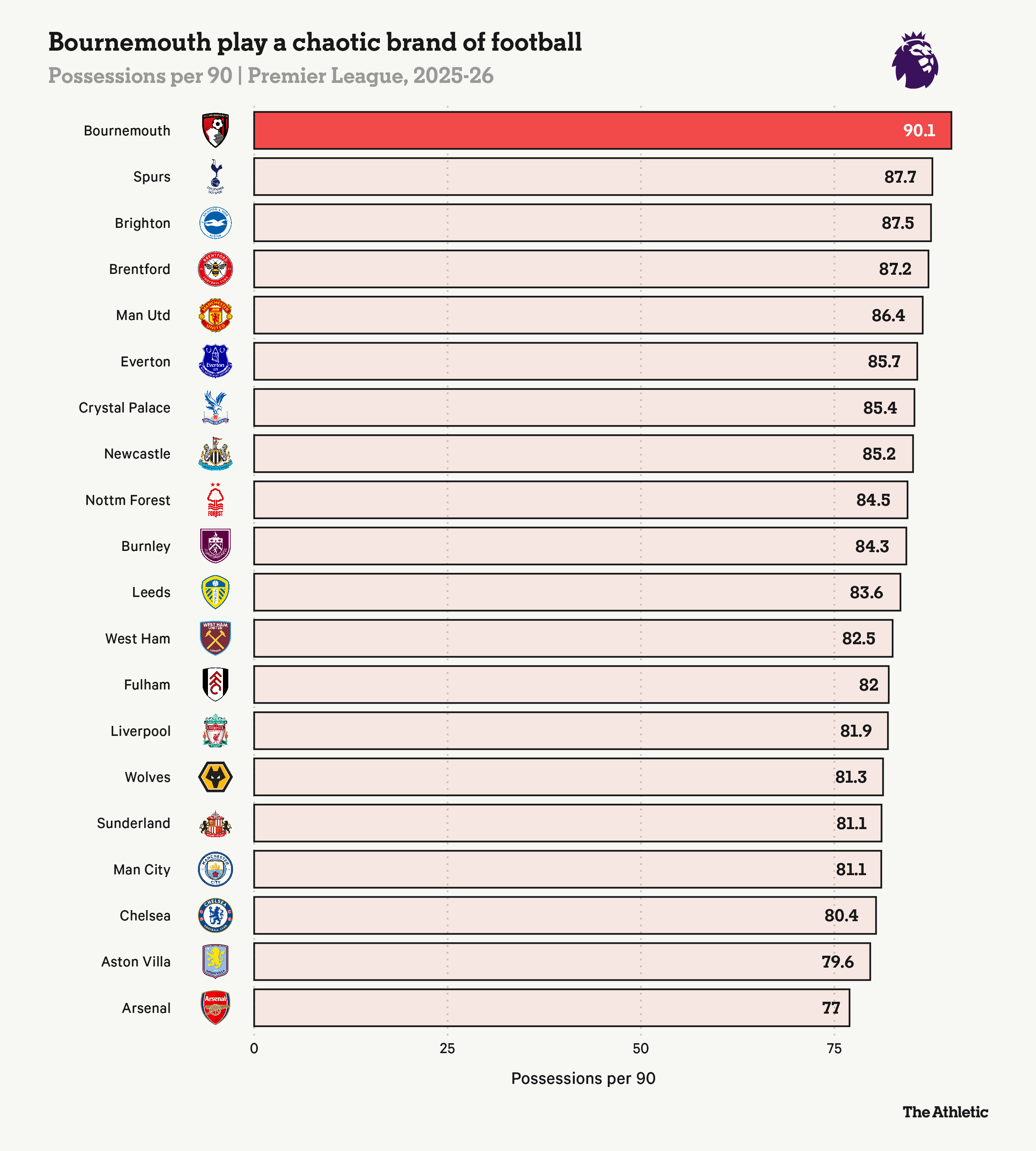
Despite producing 3.55 xG in that 4-1 win, Brentford’s best attacking output of the season, it was also their most defensively vulnerable display, conceding 2.72 xG. Like Brentford, Bournemouth lean heavily into a chaotic style built around direct passes, second balls and rapid transitions. The chart below shows that Bournemouth have more possessions than any other side, reflecting their desire to both play quickly and win the ball back quickly.
After the emotionally taxing rollercoaster of three days earlier, it was understandable that Andrews did not want to be drawn into another high-octane, pinball-style contest. But Brentford’s more measured approach was toothless, and with nine games remaining, returning to their usual, successful style may be wiser.
Andrews described the Burnley match as “an invaluable learning experience”, and said that how he incorporates the lessons from the past week will shape the rest of their campaign.
Brentford’s success this season has been driven by consistently high performance levels, and to attribute it to luck alone is to insultingly diminish their achievements. But even the most skilled poker player needs a pair of aces now and then.