
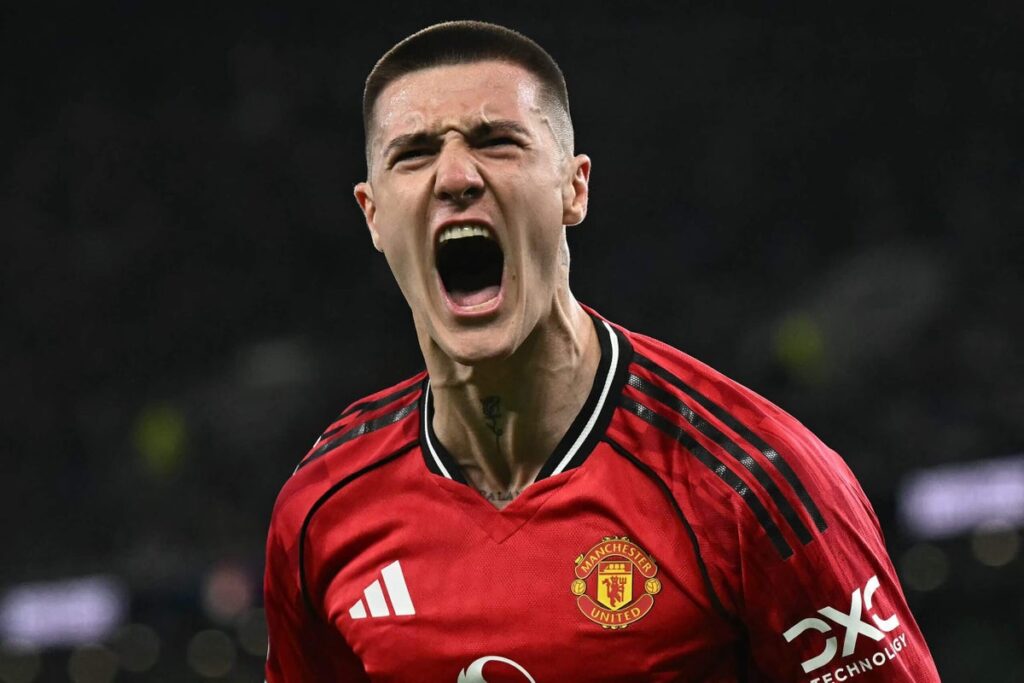
Benjamin Sesko’s 70-yard sprint, maxing out at 35.3 kilometres per hour (21.9mph), from one end of the pitch to the other to score the only goal against Everton took all of 12 seconds. But in a way, it was three and a bit years in the making.
A week earlier, Sesko had been jogging up and down a pitch in Dubai in his bare feet. Manchester United’s players had been granted time off during a 13-day gap between the 1-1 draw with West Ham United — a point salvaged by a late, instinctive Sesko finish — and last month’s trip to Hill Dickinson Stadium.
As part of a few days’ rest in the Gulf state, the 22-year-old striker revisited SPS Performance, a training camp run by Nic St-Maurice, a personal coach who specialises in making athletes more explosive.
Sesko began working with SPS during the 2022 World Cup, having reached out to St-Maurice after his country Slovenia failed to qualify for the finals. Red Bull Salzburg of Austria, his club at the time, had granted their players who were not on international duty two weeks off during the tournament, which was played in November and December of that year to avoid the summer heat in host nation Qatar. Sesko wanted to spend that time training.
“Out of the 14 days, he did 13 sessions,” says St-Maurice. A couple of close friends accompanied Sesko but there was no frequenting of Dubai’s night spots. It was just work. “He was more hungry than ever.”
Benjamin Sesko is on a roll this year 🛼
🔴 @ManUtd pic.twitter.com/BAp0e5el7A
— Premier League (@premierleague) March 2, 2026
Drills with Sesko during that two-week stay focused on unilateral exercises — jumping, driving or balancing off one leg — and strengthening the posterior chain, including the lower back, glutes and hamstrings.
Although St-Maurice mostly works with footballers, these techniques are similar to those NFL coaches use to make 140kg (310lbs) offensive linemen explode out of their stance at the snap of the ball.
Sesko is far from the only player seeking this sort of edge. Sadio Mane, Karim Benzema and William Saliba are among the high-profile names to have trained at SPS. Ryan Gravenberch, who failed to make the Netherlands’ World Cup squad, was in the gym with Sesko over the same fortnight in late 2022. United’s in-form striker left a lasting impression on St-Maurice, though.
“I’ve been telling everybody for the past couple years that he’s probably the best athlete out of all the football players that I’ve trained,” he says. “Obviously, he’s got that left foot, right foot. You see that on the pitch. But in the gym, some of the stuff that he could do, even when we played basketball, for a guy that size and that young, I was shocked.”

Benjamin Sesko has formidable athletic prowess (Carl Recine/Getty Images)
Similarly, the striker’s sheer acceleration on the move for the Everton goal would appear to be at odds with his size, but St-Maurice believes all 6ft 5in (196cm) of Sesko was essential to him bursting upfield so emphatically and leaving defender James Tarkowski eating dust.
“When you have guys that are shorter, it will help them to accelerate faster, but then if you’ve got to do a race, like you did for that goal, then if he was 5ft 5in, I don’t think that would have been possible,” St-Maurice explains.
“It’s a bit like watching Usain Bolt in a sprint. He won’t be the best starter but once he starts getting into that stride, it’s game over.”
Sesko’s pre-Everton visit to SPS was for just a single, light session focused on recovery. United’s players are given stripped-back strength-and-conditioning routines to follow while training away from the club, helping prevent injury.
Even so, there were still marginal gains to be found. For instance, why was he running barefoot in the video posted to SPS’s Instagram? “It helps to strengthen all the small muscles, the arch (of the foot), all the stabilising muscles in your foot, your ankles, your knees,” St-Maurice explains.
That attention to detail and Sesko’s apparently indefatigable dedication to bettering himself have underpinned a run of form that has seen him go from two goals in his first 17 United appearances to seven in his past eight, and finally add end-product to the fundamentals he has shown since arriving in Manchester last summer.
One of the things that has stood out in Sesko’s first season at United is his movement in and around the opposition penalty area.
Even before the centre-forward’s recent flurry of goals, he was making the right runs and putting himself in goalscoring positions, but missed out on the crucial final action.
In this example, from the 1-1 draw against Leeds United in January, Sesko moves towards the near post as Matheus Cunha and Joshua Zirkzee are attacking the left flank. When Zirkzee is in a position to play the cutback ball, Sesko dummies a run by subtly moving his legs, and maintains his position to distance himself from Jaka Bijol.
However, he narrowly misses the target with the eventual shot.

Three days later, Sesko’s goals against Burnley kick-started his scoring run, and they were examples of how his hard work off the ball eventually paid off.
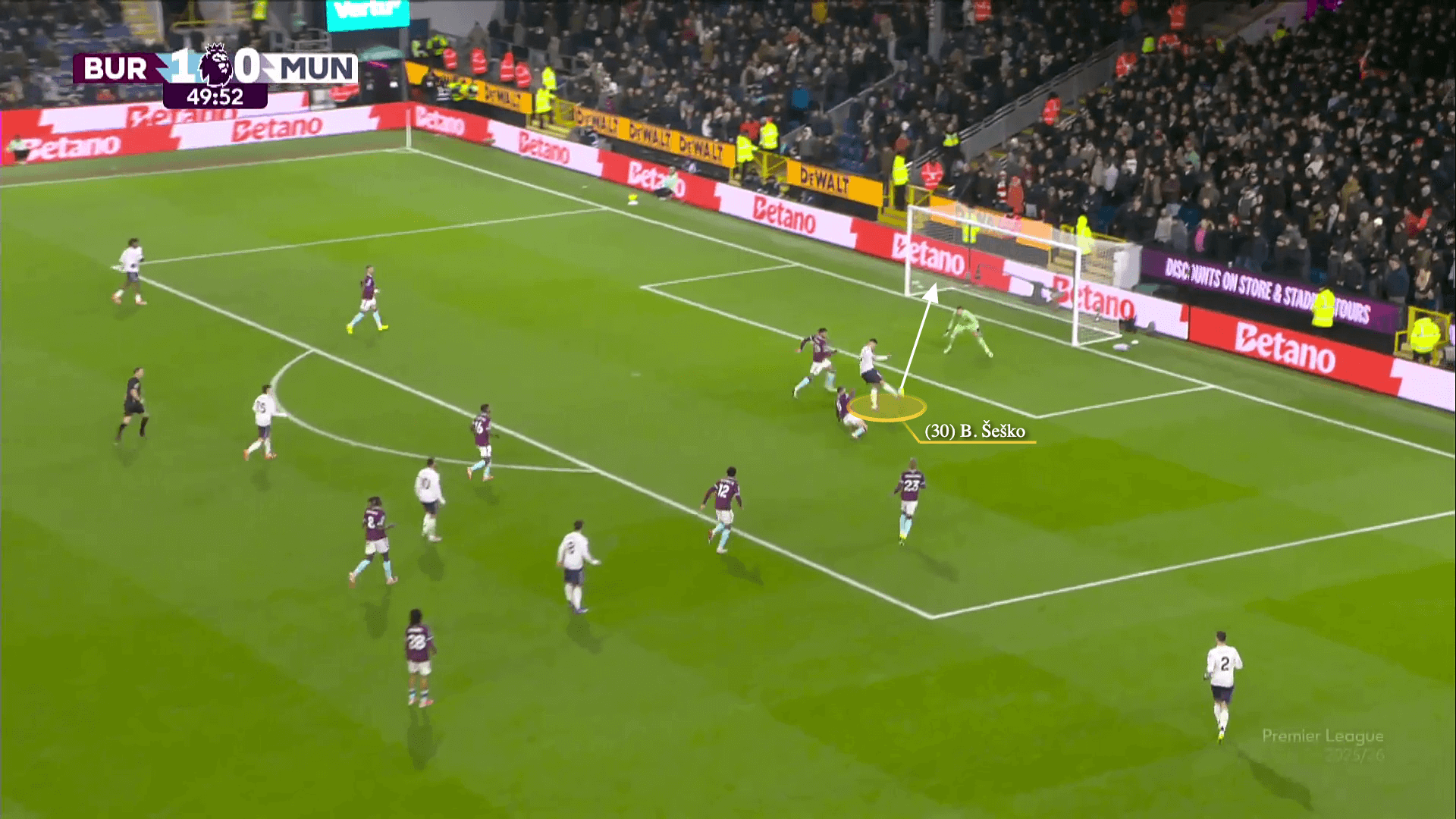
Below, on the first goal, he is initially positioned on the outside of Burnley’s right centre-back, Josh Laurent, but adjusts his position when United reset their attack down the hosts’ left side.
As Casemiro plays the ball to a free Bruno Fernandes, Sesko positions himself between Burnley’s right and middle centre-backs, which helps him attack a more threatening space behind the defensive line.
Fernandes duly finds his run…

… and he scores to make it 1-1.
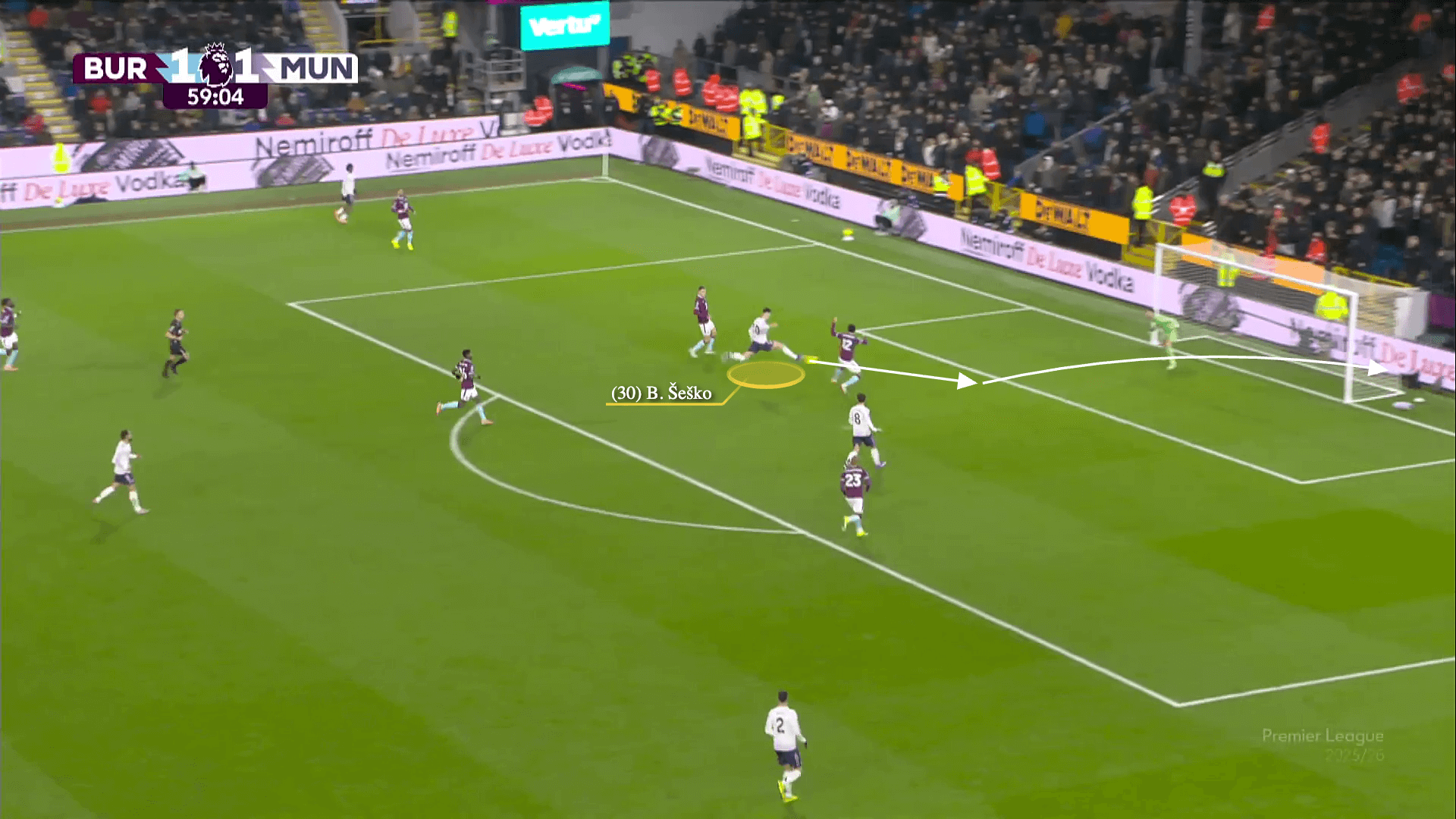
Sesko’s off-ball movement proved vital on his second goal that night as well.
In this example, he attacks the space towards the far post as Patrick Dorgu is preparing to cross into the penalty area.
However, Sesko changes direction moments before Dorgu connects with the ball, tricking Bashir Humphreys and separating himself from the Burnley defender.
By doing this, he creates a bigger space for himself when attacking the cross…

… before finishing the move to put United in the lead.
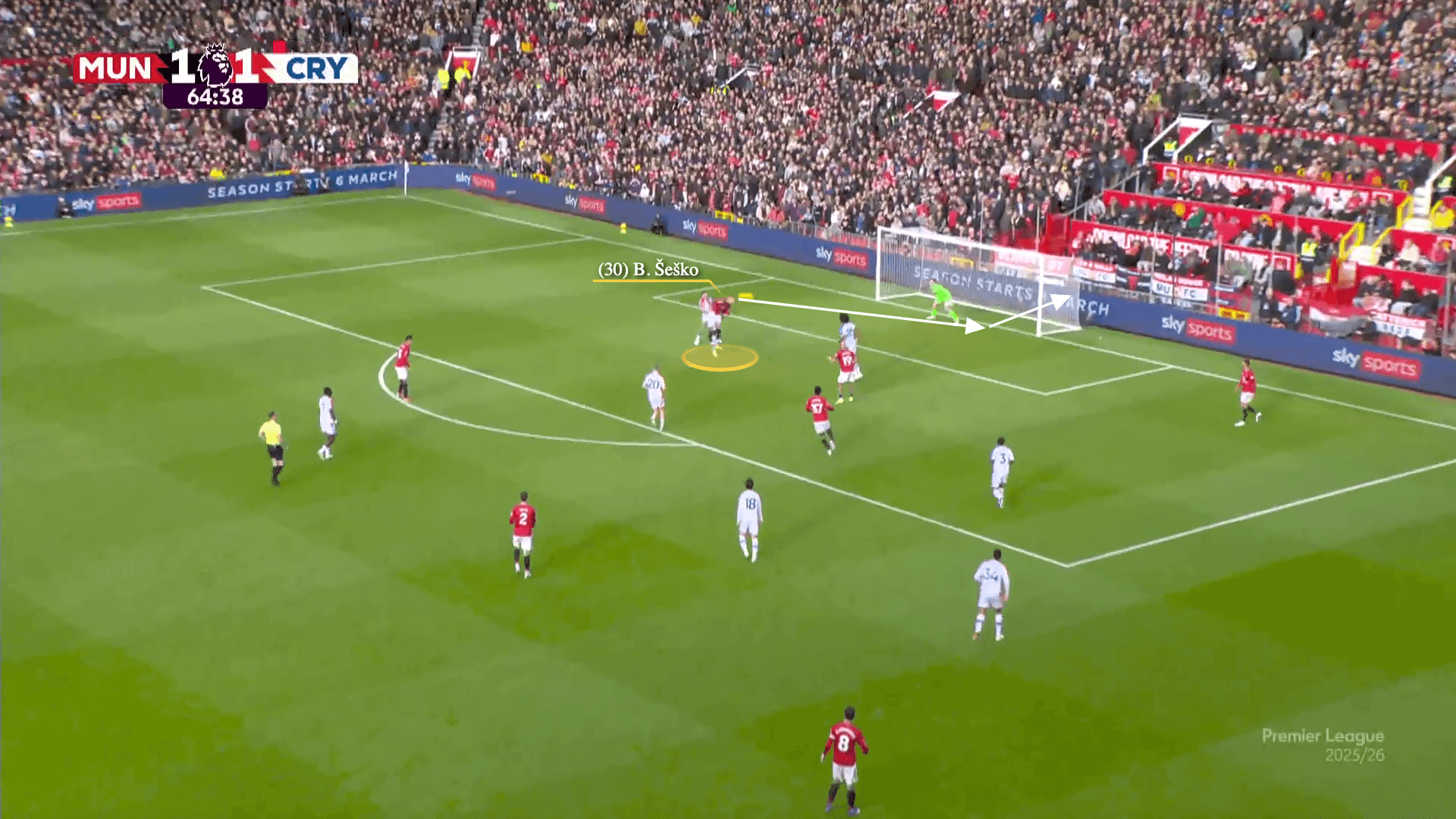
In another example, from the 2-1 victory against Crystal Palace on Sunday, Sesko readjusts his position when he sees Fernandes is going to cross the ball back into the penalty area.
The Slovenian striker takes a couple of steps back to position himself on the blind side of Jaydee Canvot, and stays in his shadow until the ball is near…

… before jumping forward at the right moment to beat the Palace defender and head the cross into the net.
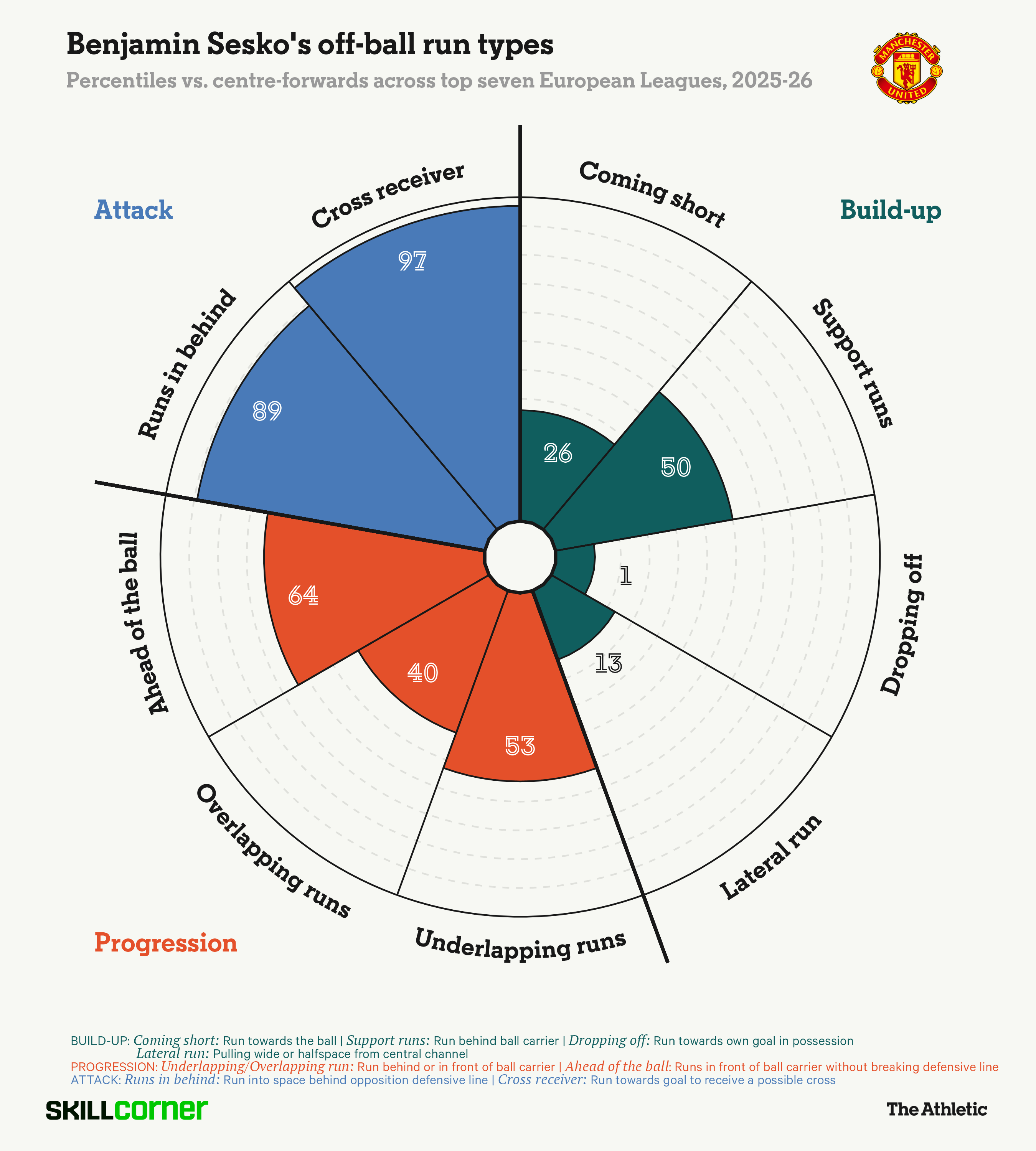
Sesko’s SkillCorner profile, which looks at his off-ball run-types per 30 minutes in possession, compared with centre-forwards across Europe’s top seven leagues, shows his eagerness to attack the space behind the opponent’s defensive line (Runs in behind: 89 out of 99).
Another aspect is his positioning and movement inside the penalty area when attacking crosses (Cross receiver: 97 out of 99).
Sesko could be somewhat obsessive — in a good way — about his own self-improvement, even before arriving at United from RB Leipzig of Germany. At previous club Salzburg, staff went as far as confiscating the wristband he used to access their team gym, as they were concerned he was overtraining.
He is developing a similar reputation at United, too, even though routines that are key to Sesko’s day-to-day preparations were slightly disrupted upon arrival. He spent his first few weeks in Manchester staying at the Lowry Hotel in Salford while trying to find the right spot to call home, and missed his usual rituals as a result.
If that partly explains a slower-than-ideal start to life at Old Trafford, his tally of two goals before the turn of the year did not spark panic.
Sesko had endured similar dry spells in the early days at his previous clubs. During the first of two seasons on loan at Salzburg affiliate side Liefering, he was sent off as many times as he scored (once). Yet in the following campaign, he hit 21 goals in 29 appearances.
Some close to Sesko conservatively estimated that he would score between 10 and 15 for United this season, knowing from experience that he can take time to get used to new team-mates and environments. Ideally, they say, he would have stayed in the Bundesliga for another year to develop further, but the widespread interest in him last summer made that impossible.
United were told not to pursue Sesko, who only turned 22 in late May, last summer if they expected him to be a 25-goal-a-season striker immediately. Old Trafford’s key decision-makers knew and accepted such a tally was unlikely, and that knowledge helped keep expectations in check as their £73.6million ($98.3m) signing found his feet.
Sesko has certainly settled in now. That is in part thanks to full-back Diogo Dalot, who put an arm around the newcomer upon arrival, and affectionately called him his fellow “early bird” when speaking to journalists after that win against Palace.
The pair have bonded over a shared interest in and disciplined approach to their own self-improvement, and they are often among the first players rolling into the car park at Carrington, United’s training complex, ready for an early-morning session in its new-fangled hyperbaric chambers.
“Ben [Sesko] is a really good mentality person”
Diogo Dalot praises Benjamin Sesko for his impact off the bench in recent games 🔴 pic.twitter.com/e8fi61h4ty
— Sky Sports Premier League (@SkySportsPL) February 26, 2026
Sesko’s first day in Manchester coincided with the official unveiling of the renovated men’s first-team facility at Carrington last summer. Part of the logic behind the £50million in redevelopment work was to encourage players to spend more time on site, and Sesko is regularly among the first in and last out.
Such is his obsession with bettering himself, Sesko has many of the same facilities at home, too. His house-hunt eventually ended with him moving into a property with a gym, a sauna, an ice bath and a purpose-built football pitch.
That is to say nothing of his gadgets, among them a device that tests and improves reflexes by flashing 10 LED lights at face height, challenging the user to hit them when they light up. Sesko has been known to test himself late into the evenings after training to help him stay sharp before matches.
At other times, he sits down and wears a virtual reality headset designed to help him visualise scenarios that could happen in forthcoming matches and practise his decision-making. Sesko later goes through these situations with an individual coach.
United tapped into the young striker’s belief in the power of visualisation during negotiations with him and his representatives in Leipzig last summer.
Christopher Vivell, United’s director of recruitment, and Matt Hargraves, director of football negotiations, showed Sesko a video presentation that spliced clips of his goals alongside fans walking around Old Trafford in No 9 United shirts with his name on the back.
He was then presented with one such shirt. Sesko tried it on for size, looked at the United badge and told those present at the meeting that it was exactly what he wanted. Sesko did not take the No 9 shirt on signing, however, out of respect for Rasmus Hojlund, who was still at the club at that point. There was consideration given to waiting until Hojlund departed, but Sesko instead opted for No 30. A switch to No 9 is possible next season, though, with Hojlund set to leave permanently if Napoli, where he is on a season-long loan, qualify for the Champions League.
Typically, though, you would expect whoever wears United’s No 9 to be a regular starter in the team. That has not been the case for Sesko of late, despite his four goals under January appointment Michael Carrick consisting of three match-winners and a crucial late equaliser.
Losing his place upon Carrick’s confirmation as Ruben Amorim’s replacement came as a surprise, especially after scoring three in two games under interim manager Darren Fletcher, but Sesko was determined to use his demotion positively.
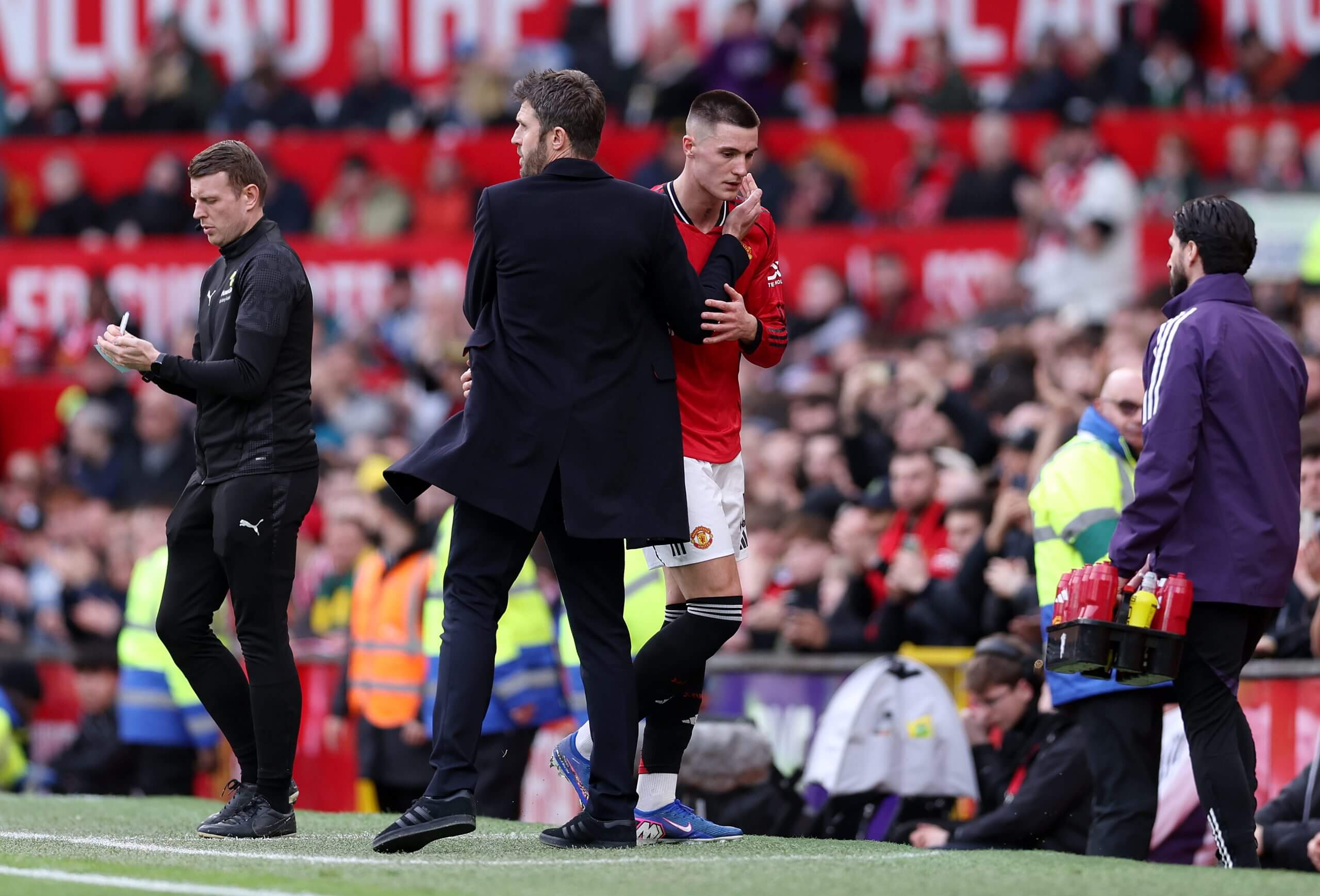
Benjamin Sesko has fought his way back into the team under Michael Carrick (Alex Livesey/Getty Images)
Carrick’s advice and mentorship to Sesko have been appreciated, so too was his gesture to seek Sesko out shortly after the final whistle blew on the 2-0 win in the Manchester derby, when he was an unused substitute.
Sesko has played at least some part in all six games under Carrick since and has scored in four of them, demonstrating that he has the mentality required to overcome minor disappointments and still contribute.
It might be easy to scoff at some of the new-age self-improvement techniques to which Sesko subscribes, but at the heart of the United striker’s recent upturn is a core belief that anyone can get behind: hard work should pay off.
In Sesko’s case, it finally is.