
 Add as preferred source on Google
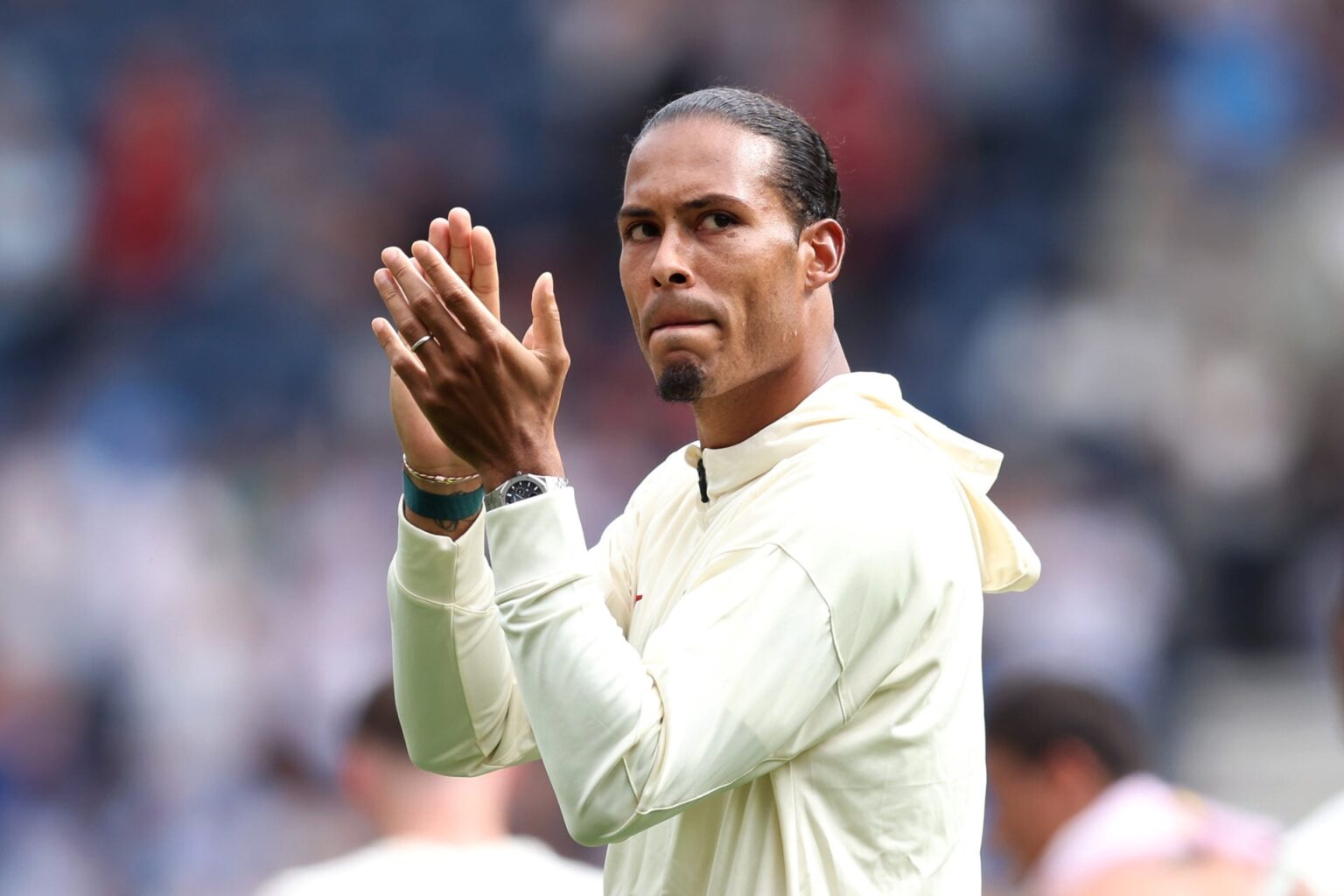
Virgil van Dijk’s arrival at Liverpool in January 2018 remains a defining moment of the club’s modern era.
Before the Dutchman’s signing, the team was characterised by an exciting but ultimately fragile style of play that often faltered under defensive pressure. His leadership stabilised a chaotic backline and provided the platform for every major trophy that followed in the next eight years.
Van Dijk’s journey to the top was a gradual ascent that began in the Eredivisie with Groningen. A move to Celtic in 2013 followed, where he dominated the Scottish Premiership, winning two league titles and proving he was a level above the domestic competition.
Pick your favourite modern Liverpool legend…
Two icons of the Klopp era 🔴🙌
 Mo Salah and Sadio Mane for Liverpool
Seeking a greater challenge, he joined Southampton in 2015, where he quickly established himself as one of the most complete centre-backs in the Premier League. Van Dijk’s performances on the South Coast, particularly his ability to read the game and initiate attacks from deep, made him the most sought-after defender in Europe.
Virgil van Dijk joins Liverpool
The transfer was a saga of its own, involving a public apology from Liverpool and a six-month delay, but the club’s persistence finally paid off with a world-record £75 million deal in January 2018. Jurgen Klopp famously urged supporters to “forget about the price tag,” insisting that the quality of the player would eventually make the fee look like a bargain.
The impact was immediate, with Van Dijk scoring a header on his debut against Everton in the FA Cup. Within his first six months, he helped lead the Reds to a Champions League final in Kiev, and though that night ended in defeat, it served as the precursor to a period of unprecedented success.
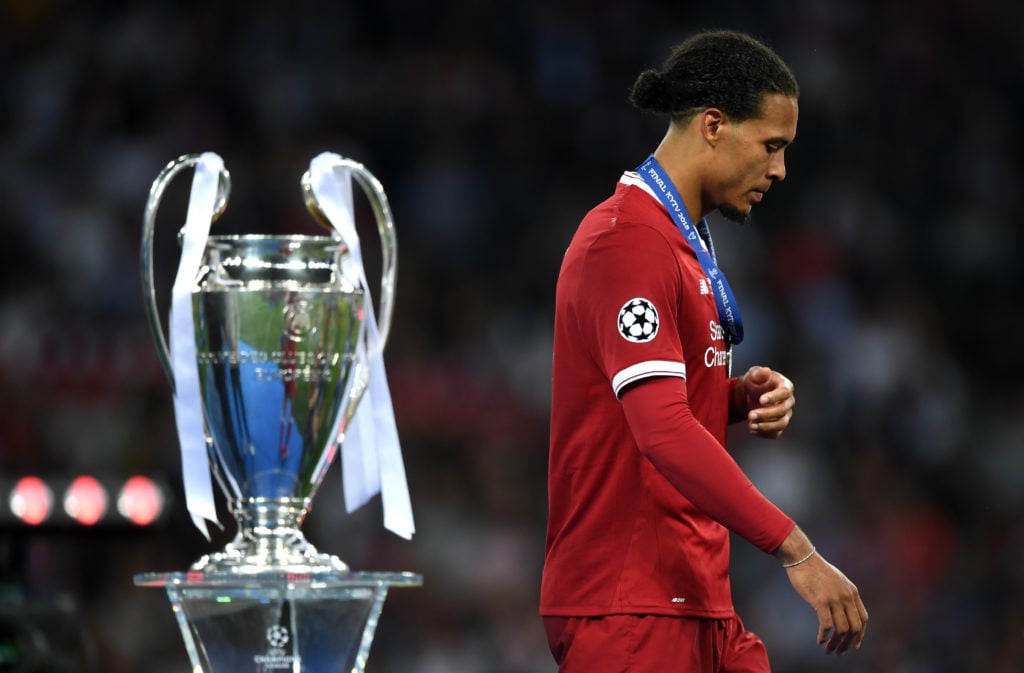 Photo by Shaun Botterill/Getty Images
Liverpool won the Champions League in Madrid the following season, followed by the UEFA Super Cup and the FIFA Club World Cup. He became the only defender to win the UEFA Men’s Player of the Year award, narrowly missing out on the Ballon d’Or to Lionel Messi by just seven votes — the closest a defender had come to the prize in over a decade.
The key to Liverpool’s dominance
During the 2018-19 season, Van Dijk went 65 consecutive games without being dribbled past by an opponent, a feat that underscored his near-supernatural ability to control one-on-one situations. His aerial prowess also became a defining trait, consistently winning over 70% of his duels and becoming a constant threat in the opposition box.
He often appeared to be playing at a different speed than those around him, using superior positioning and reading of the game to intercept passes rather than relying on desperate last-man tackles.
The 2019-20 season saw Van Dijk lead Liverpool to their first league title in thirty years. He played every single minute of that Premier League campaign as the Reds left all the competition in the dirt.
The trajectory of his career faced its greatest test in October 2020, when a serious ACL injury sidelined him for nine months. Many questioned if he could ever return to the same world-class level, yet his recovery and subsequent return to the starting XI in 2021 proved his elite mentality. He remained the first name on the teamsheet, helping the club secure a domestic cup double in 2022.
Which category does Virgil van Dijk rank in the best centre-backs in football history?
Is he even better than Maldini? 😱
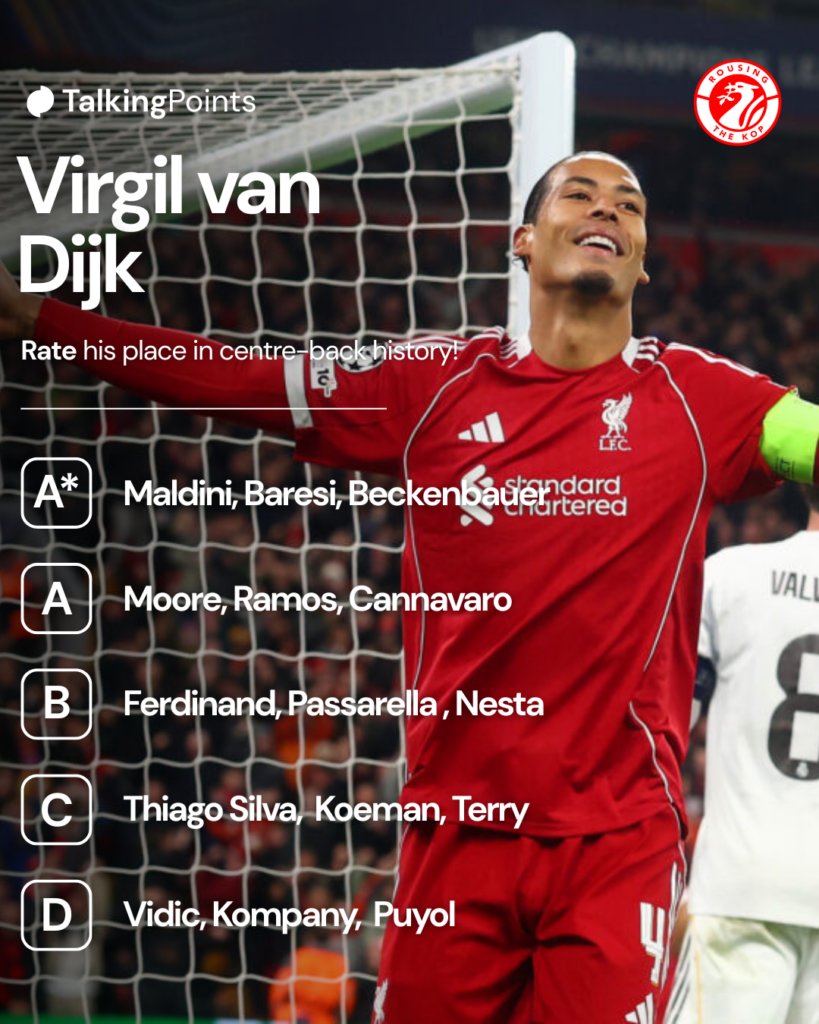 Photo credit: Getty Images/Chris Brunskill/Fantasista Van Dijk as Liverpool captain
Following the departure of Jordan Henderson in 2023, Van Dijk was the natural choice to take over the club captaincy. He stepped into the role with characteristic authority, leading a transition that integrated a new generation of players while maintaining defensive stability.
His leadership was particularly evident during the 2023-24 season, where his winning goal in the Carabao Cup final—a towering header in the dying minutes—secured another trophy for the Anfield cabinet, and when he led the Reds to another Premier League title in the 2024-25 season.
Under the management of Arne Slot, Van Dijk continues to defy the typical aging curve for a central defender. Now 34, he has adapted his game to suit Slot’s more controlled, possession-oriented tactical setup.
While he may no longer possess the raw explosive speed of his mid-twenties, his reading of the game has only sharpened, allowing him to organize the backline with minimal exertion.
The success Liverpool have enjoyed in recent years has to be credited in part to the defensive revolution Van Dijk started. His may be the biggest loss of any of the Klopp era stars when he does finally leave. Hopefully not for another while.
Join Our Newsletter
Receive a digest of our best Liverpool content each week direct to your mailbox