
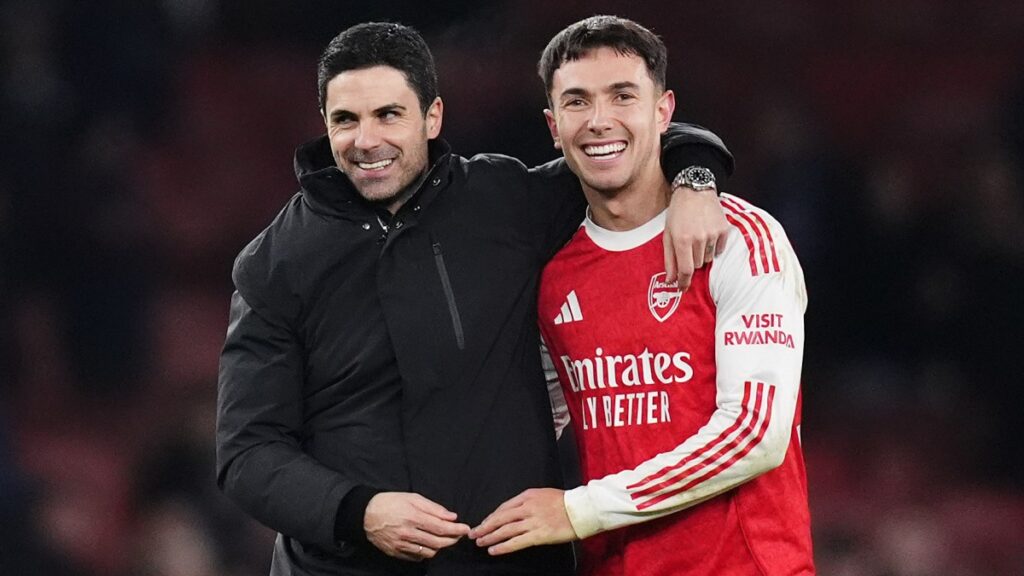
This has been the first clear midweek for Arsenal since December — and only their second since August — and, provided everything goes well for them, the schedule will be just as relentless for the rest of this season.
If they are to fulfil their ambition of reaching three finals — in the FA Cup, League Cup and Champions League — they could play 22 matches in 91 days, starting at home against Chelsea in the Premier League on Sunday. Furthermore, many members of Arsenal’s squad are set to be involved in two international matches at the end of March as they get a final chance to impress before this summer’s World Cup.
As the club’s results have become more inconsistent since the turn of the year, Mikel Arteta has had to address suggestions that some of his players, including Martín Zubimendi and Jurrien Timber, have looked fatigued — especially after the team were harried by bottom club Wolverhampton Wanderers. No one has run more in the league than Zubimendi, the Spain midfielder who has covered a total distance of 299.8km in his debut season and contributed to Arsenal covering the third-highest amount of ground in the league per game, behind only Manchester City and Leeds United.
Arteta and his sessions are a mix of professional intensity and quirky ideas to keep players engaged, such as using images, introducing an olive tree during meetings, and even hiring pickpockets to steal from his players during a team dinner to teach them to be alert at all times. However, downtime may be just as important before the final ten league matches, as well as their FA Cup and Champions League ties and next month’s Carabao Cup final against City.
This week Arteta gave the squad time off on Monday and Thursday, before they attended an Arsenal Foundation dinner that night. Pep Guardiola gave his City players three days off, saying: “You have to clean the minds and legs to come back better.” When Leicester City won the title in 2015-16, Claudio Ranieri gave his players a surprise week-long holiday. Arne Slot gave his Liverpool squad more time off before they were crowned champions last season.
It was not logistically possible for Arteta to take his squad to Dubai, as he did in the past two seasons, but instead he hoped that the players would make use of their time off and return refreshed. “That’s the theory and I wish we could be in Dubai,” Arteta said. “We’ll have one or two days, I can guarantee you that we were in Dubai for a few days. Everyone was dying for it.
“But then you get very surprised. Sometimes when I give them the day off you think they don’t want to see each other, and then I find out that eight or ten players were having dinner in somebody’s house or spent the whole afternoon together. That is the beauty of it, the fact that they want to be together as they feel that being together is the best thing they can do. That was the case this week in a lot of cases. It has been a different week, very good for our preparation, and hopefully we can show that.”

Rice is a key proponent of the intense and efficient game plan that Arteta has put in place at Arsenal
TIMES PHOTOGRAPHER BRADLEY ORMESHER
Arteta said his job has been to maintain his own mood level as well as that of his squad. The gloom of a 2-2 draw with Wolves was followed by them beating Tottenham Hotspur 4-1 last weekend. “Not too high, not too low, I try to be as stable as possible,” he said. “It’s something that I need, it becomes insane. You are like this every single day, I’m happy and sad like this. You cannot be like this.”
Six months ago Arsenal’s head of sports science, Tom Allen, published research showing that high-intensity distance covered by Premier League players has risen by 23.1 per cent and sprint distance by 36.5 per cent from 2015-2025.
Arteta is among the coaches who wants intensity out of possession. Declan Rice is in the top ten for distance covered in the top flight alongside three England team-mates — Elliot Anderson (Nottingham Forest), Morgan Rogers (Aston Villa) and Jarrod Bowen (West Ham United). Overall Arsenal have covered an average of 114.28km per league match, with City ranked top on 115.47km per game. In contrast, Sunday’s opponents Chelsea have run the least, with an average of 105.70km per match.
“It’s the efficiency of how far you run, where you run, and especially when you run, which is the most important thing,” Arteta said. “The intensity of those actions and the sprint distance, a lot of things. But the will to do the work when it’s necessary, that’s something that a winning team should have.”
He said that Viktor Gyokeres had started to feel the love, boosting his confidence and return in front of goal. The forward cost an initial £54.8million but Arsenal could have to pay an additional £3.5million in add-ons this season. Sporting Lisbon will be due more money if the striker hits 20 goals and assists combined. Gyokeres has 15 goals and two assists.
“Confidence is the fundamental pillar for any person,” he said. “When you feel like you belong somewhere and you are liked, you are loved, even better, and if you feel the trust of the people around you, then you can really hit the levels that everybody expects from you. Viktor now starts to get those feelings and that is a really positive thing, obviously, to perform. I’ve mentioned it a few times that he’s got that eye. When he looks at you, he can look a bit intimidating.”