
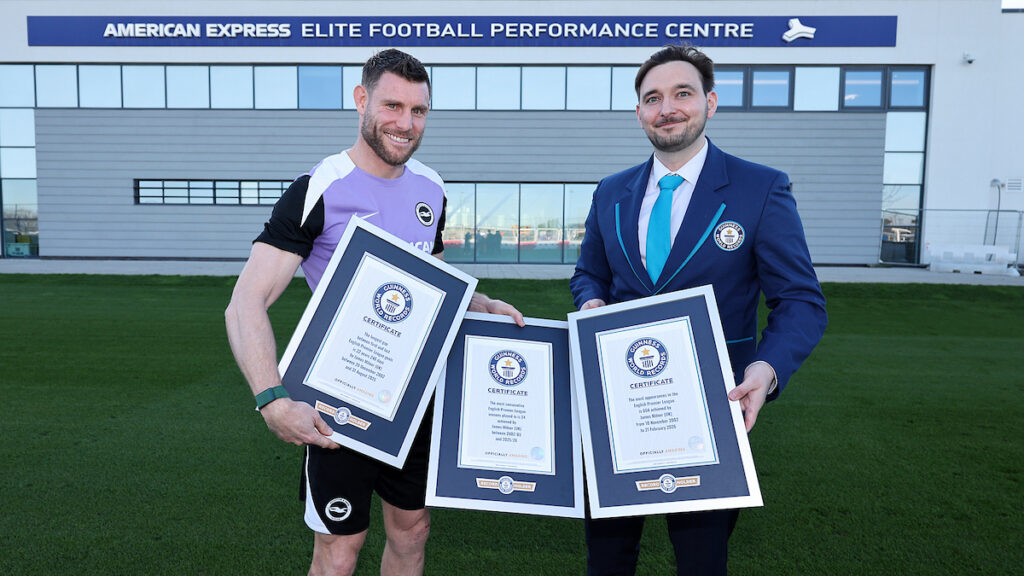
Ryan Giggs used to hold the record for Premier League appearances, then it was taken by Gareth Barry, and then, last weekend, Barry was usurped by James Milner when he played his 654th game in the top flight. But perhaps, rather than reaching for the familiar metaphors about passing the torch or taking up the baton, it would be more accurate to say that the sacred stretchy yoga band of longevity has been handed on.
Giggs was a devotee, Barry followed his example, and when Milner took up the practice “eight or nine years ago”, it was his former England colleague, whose record he would one day break, who put him on to it. Perhaps we should already start preparing the glowing tributes for Milner’s yoga buddy: Brighton & Hove Albion’s Greek striker Charalampos Kostoulas, who only has 639 appearances left to go. “We’re passing it down,” Milner jokes. “He’s only 18, so he’s starting well, starting young.”
Milner’s professionalism and care of his body is legendary. He has been teetotal since his teens, and if you’re wondering what it takes to still be playing Premier League football at 40 — one of only five outfield players ever to do it — he describes a typical day in which almost every detail is optimised for physical condition.

The late Terry Venables helps Milner celebrate his 17th birthday at Elland Road
ANDREW VARLEY
“I eat lunch at the club before training, have treatment, go in the gym and do a bit before the meeting, then come out, do another preactivation [session] in the gym, which gets longer and longer as you get older because of the little injuries you have to stay on top of: calf isos [isolation exercises], hammy isos, movement prep, hurdles.
“Then after training, I’ll be in [the gym again]: today was [upper body] and core, tomorrow will be maybe just core, the day after that will be leg weights. Then treatment, some days you might go in the spa.
“Yoga a couple of times a week . . . a steak and rice or veg [for dinner], summat simple. Supplements, I’ve got them all before bed. I’ve taken magnesium for years, then you have your joint support, Omega 3 and all this stuff. That’s just details of all those things, and drinking enough fluid, and things like that, really.”
Milner sounds like a fitness coach’s dream, but actually, he says, the reality is the opposite: his routines are not a model of unquestioning obedience, but rather the product of constant interrogation and refinement.

Milner celebrates his landmark achievement and a much needed win for Brighton away to Brentford
TIEGO GRENHO/ALAMY/MI NEWS
“It was interesting, a few of the messages I had over the weekend were [along the lines of], ‘You were a nightmare to work with,’ ” he says. “I always ask questions: ‘Why are we doing this? Give me the science behind it — why am I doing an ice bath? Where’s the proof to that?’ And then you build up what you think.”
Milner has often talked about how he is fuelled by wanting to prove people wrong: first it was his dad, who knew how to push his buttons by telling him he didn’t work hard enough and wouldn’t make it, then the papers, then the pundits, and latterly a useful army of critics on social media. “Football’s brilliant, isn’t it? You always have your doubters,” he says.
When, last season, he missed all but four games with a knee injury that required reconstructive surgery and left him unable to put weight on his leg, the same driving force kicked in. “Most people — the surgeon, the physio, people who knew what I had, probably every single person — thought I was finished,” he says. “That was the drive: I wanted to try to prove that I could get back from that, because I don’t think many people could.
“And it’s one thing getting back, then it’s, ‘All right, can you go and play in the Premier League?’ And then you move on to the next challenge after that.”

Milner appears for Leeds as a coltish teenager away to West Ham at the start of his career
MATTHEW IMPEY
What may that next challenge be? Will Milner be tempted to play on for another season, which would bring Teddy Sheringham’s record for the oldest outfield player in Premier League history, at 40 years and 272 days, within reach?
“I’m pretty open at this moment in time, whether I will or won’t, I’m not sure,” he says. “After the game at the weekend [the 2-0 win over Brentford, when he broke the record], some of the boys went, ‘You can’t retire, Milly, you’ve got to go again next year.’
“I wouldn’t say I fear [retirement] because I look forward to having that break and having time to do what I want, but I think most people say you miss the structure, what you’re training for every day. When you haven’t got that, I think I’d probably look towards doing marathons or something like that to give me something to go for again.”
It’s no surprise that Brighton’s players and their head coach, Fabian Hürzeler, seven years Milner’s junior, want him to stay: he’s an irreplaceable fount of wisdom and advice for a squad which has nine players who are 23 or younger.
At one point in his career Milner might have offered more of a kick up the backside than an arm around the shoulder, but he says he has become a more empathetic figure in the dressing room over the years.
“If someone is not doing their job then it’s easy to bark at them, ‘Why aren’t you doing it?’ ” he says. “But there’s normally a reason to that as well . . . some of these guys have been professional footballers for 18 months when they come through the doors. They are changing country, learning a new language and living in a new place. They are learning a new style of play.

Milner’s time at Liverpool coincided with landing most of the leading trophies
MARTIN RICKETT/PA WIRE.
“There are many reasons why they might not be getting to where they want to quickly and it’s our job to try to help them understand that.”
Milner feels that the best guidance he can offer, though, is on the field, talking his younger team-mates through the game. He is fascinating on the 22-year-old defensive midfielder Carlos Baleba, who has struggled for consistency this season after a breakthrough campaign last year.
“Carlos is obviously a massive talent, and maybe this season hasn’t gone the way he would have wanted,” Milner says. “Every day in training you’re talking to Carlos and trying to help him. But there’s nothing like being on the pitch.
“I’d love to get ten games on the pitch with Carlos in midfield and [try to] help him and push him through the game. That’d be amazing. But it’s the Premier League, you don’t get that luxury.”
Of his 24 seasons in the Premier League, Milner believes he was at his very best in his second campaign at Aston Villa, 2009-10, when he scored seven goals and supplied 12 assists from central midfield as Villa finished sixth. Famed for having occupied every outfield post bar centre back, what would he say if, in 20 years’ time, a group of schoolchildren asked him what position he played?
“Midfielder,” he says. “Just being involved in everything, engine, with and without the ball — I think that’s the position that suited me best.” Playing everywhere, though, he says, “helped me understand the game better”.
Indeed, with all those positions on his résumé, and having played for everyone from Terry Venables and Martin O’Neill to Pep Guardiola and Jürgen Klopp, Milner’s knowledge and breadth of perspectives on the game must be unrivalled. Is he tempted to try to apply those learnings as a manager?
“Sometimes it appeals to me, for sure,” he says. “Sometimes I think I’d love to put my stamp on a team. The competitive guy in you thinks, ‘I wouldn’t mind giving that a go and taking that on.’ I know it’s difficult but . . . I’ve got a great array of different managers from different countries to lean back on, so in one way I think it’d be a big shame to lose all that knowledge and experience I’ve built up, to not be able to use that.”
When the time does come to hang up his boots, though, before marathons or management, he will first take the advice of Klopp, his manager at Liverpool, and have a rest.
So much has changed since he made his Premier League debut in 2002, Milner reflects. “A bad first half, there could be teacups flying and walls being punched and stuff like that,” he says. “You don’t see much of that now. When I came through if boots weren’t clean, you knew you were getting filled in. The first tackle was free and you needed proper shin-pads.”
It’s easy to be nostalgic for what’s changed, but, Milner says: “There’s so much good in the game now as well compared to then. So I just feel fortunate. I played through two eras, one when I was emerging and now another. I just feel lucky to have been able to be part of both.”