
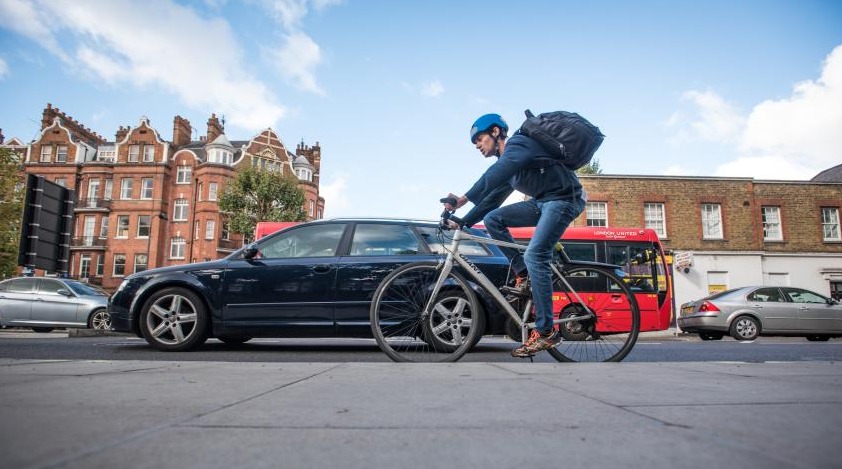
Two-thirds of riders feel their local area also has inadequate cycling infrastructure, reports Kumail Jaffer, Local Democracy Reporter
 credit Hammersmith and Fulham Council
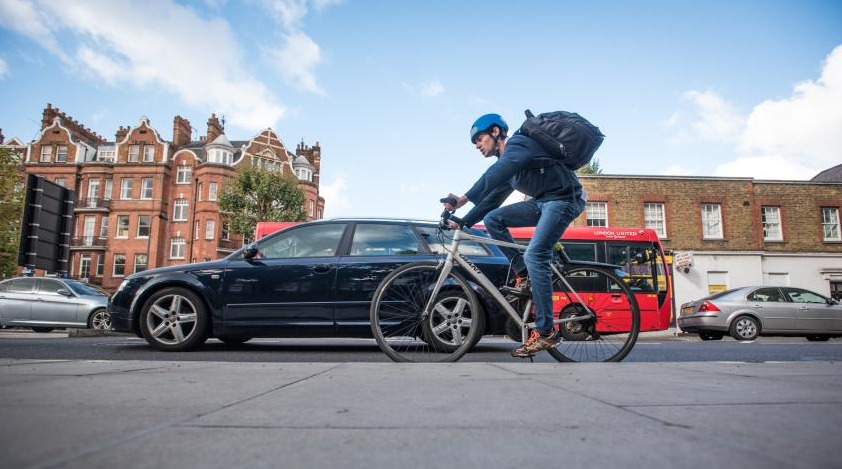
Almost half of London’s cyclists still feel unsafe on the capital’s roads despite mass investment in cycle lanes and safety measures, Transport for London (TfL) has been told.
New research shows that 43% of riders in London don’t feel comfortable, despite the city’s cycling revolution in recent years. This is a higher proportion than the north-west of England, where just over a third feel unsafe.
The data, obtained by law firm JMW and seen by the Local Democracy Reporting Service (LDRS), also shows that cyclists in London face a far more complex set of challenges than those outside the capital.
These include drivers of vehicles on narrow roads, the use of bus lanes creating “conflict zones” with large vehicles, unclear road markings and infrastructure, pedestrians in cycling areas and other cyclists themselves.
A little over a third – 36% – of cyclists believe their local area has adequate infrastructure. This is one of the lowest confidence ratings in the UK. As a whole, just 7% of London cyclists take to the road every day.
Last year TfL revealed that 1.5million cycle journeys are taking place in the capital on a daily basis, up 13% since 2024 and 43% since 2019. There are now around 270 miles of specialist cycle routes in London, where cyclists have dedicated and often uninterrupted lanes protected from traffic.
However, campaigners have warned that there is still “a long way to go” before London replicates the likes of Amsterdam.
Simon Munk, of the London Cycling Campaign, told the LDRS: “London is statistically very safe for cycling and as the network of safe, comfortable, direct cycle routes grows, more and a wider range of people are getting cycling. Daily cycle journeys now make up about half of all tube journeys.
“But there’s still a long way to go to reach the potential for cycling in London, and the kind of numbers Paris and many Dutch cities do.
“That’s because London’s cycle network is still far too patchy and often too poor quality too. We need a lot more cycle tracks, junction redesigns, crossings, routes through low-traffic neighbourhoods and more besides if we want far more Londoners to switch cars for cycling and eliminate fatal collisions from our roads – both of which the mayor and TfL are committed to.”
Hina Bokhari, leader of the Liberal Democrat group on the London Assembly, said the findings “expose a serious credibility gap”.
“When nearly half of London’s cyclists feel unsafe despite billions in investment, something has gone badly wrong,” she added. “A 7% daily cycling rate in a city of this size and investment isn’t a success story, it’s a failure to deliver from TfL and the mayor.
“Until every Londoner, regardless of gender or background, can get on a bike without fear, we haven’t come close to delivering on this city’s potential.”
Green Party London Assembly member Caroline Russell suggested that the erratic behaviour of some of London’s drivers was to blame, adding: “How people drive has a direct impact on whether others feel safe enough to get on a bike.
“Seeing drivers speeding or fiddling with their phones is frightening when you’re on a bike or simply trying to cross the road.”
The survey also shows that just 55% of London cyclists feel public bikes for hike – like Lime or Forest – are safe for general use.
Andrew Littlemore, head of cycling in the personal injury department at JMW, added: “London has been positioned as a world leader in cycling infrastructure, with dedicated lanes, bike superhighways, and extensive public bike schemes. Yet our research shows that nearly half of London cyclists still feel unsafe.
“The concern about Lime bikes and similar schemes is particularly noteworthy. These services are designed to make cycling more accessible, but if users don’t feel safe, we need to ask whether operators and regulators are doing enough to ensure rider safety and provide adequate training.”
A TfL spokesperson told the LDRS: “Walking and cycling infrastructure plays an important role in making our streets safer and encouraging more people to walk and cycle across London.
“We’re determined to ensure that everyone can cycle safely which is why we’re investing more than £150m this year to improve London’s roads, over half of which is invested through London’s boroughs. We have so far completed work at 46 safer junctions across London, including work that is due to complete in the spring at Lambeth Bridge.
“We also continue to work closely with the boroughs to expand London’s high-quality cycleways network, which now stands at 435km, up from 90km in 2016 and will be setting out plans for further investment with the boroughs in the coming weeks.”
Independent news outlets like ours – reporting for the community without rich backers – are under threat of closure, turning British towns into news deserts.
The audiences they serve know less, understand less, and can do less.
If our coverage has helped you understand our community a little bit better, please consider supporting us with a monthly, yearly or one-off donation.
Choose the news. Don’t lose the news.
Monthly direct debit


Annual direct debit

£5 per month supporters get a digital copy of each month’s paper before anyone else, £10 per month supporters get a digital copy of each month’s paper before anyone else and a print copy posted to them each month. £50 annual supporters get a digital copy of each month’s paper before anyone else.

More information on supporting us monthly or yearly
More Information about donations