
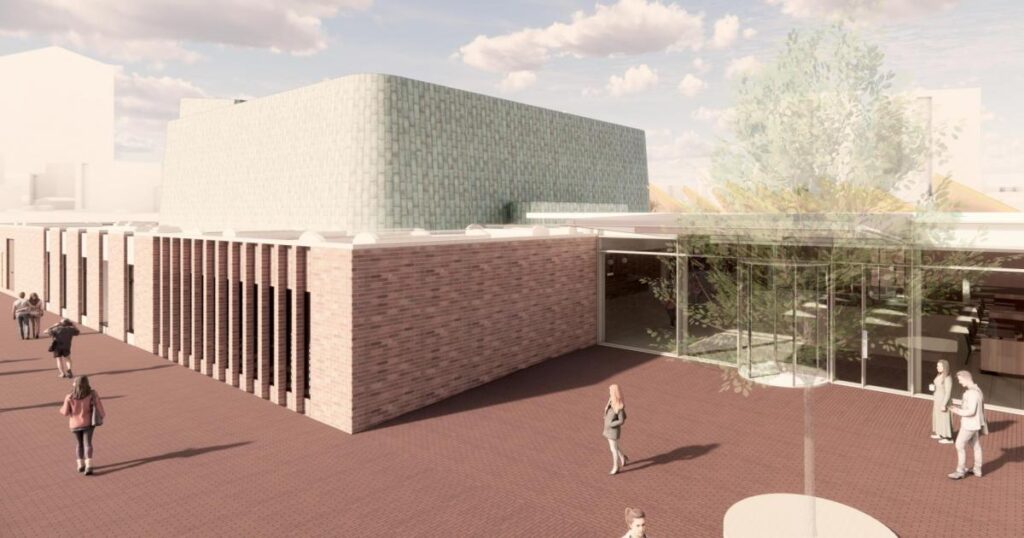
The University of Southampton said its plans to transform the copper-clad building in the centre of the Highfield Campus are scheduled to be completed before the end of the year.
The building is made up of an auditorium, that has sat largely unused for several years, teaching spaces, practice rooms and offices.
It was previously the long-established home for Nuffield Southampton Theatres, which closed down in 2020.
The Nuffield Theatre building at University of Southampton’s Highfield Campus. Picture: UoS/WilkinsonEyre/SCC planning portal
The university said the project will deliver an accessible and modernised lecture theatre and teaching suite, with the renovation enabling the venue to host conference events and theatre productions.
Kieron Broadhead, University of Southampton’s deputy vice-president for operations, said: “The Nuffield sits right at the heart of Highfield Campus and this refurbishment is part of our ongoing investment programme to provide our students, colleagues and the local community with inspiring places to learn, work, and visit.
“It’s an exciting opportunity to provide a new future for this building, which will ensure responsible use of our own estate to meet the university’s need for additional, large-scale teaching space.”
The university has tabled a permitted development application to Southampton City Council for the scheme.
A letter submitted as part of the application said the existing building, which was designed by the office of Sir Basil Spence and completed in 1964, is currently constrained by the presence of reinforced autoclaved aerated concrete (RAAC), asbestos-containing materials, outdated services and limited accessibility.
The refurbishment will involve removing the asbestos and addressing the structural RAAC issues.
The link structure between the site and Building 4 will be demolished and rebuilt to create a new foyer.
CGI of the refurbished auditorium of the Nuffield Theatre at University of Southampton’s Highfield Campus. Picture: UoS/WilkinsonEyre/SCC planning portal
Investment in the auditorium itself will see new seating installed and an optimised layout to enhance capacity and accessibility.
Kevin Argent, the university’s executive director of estates and facilities, said: “The prospect of taking this building and its 400-seat auditorium, which has so much valued history and shared community memory, into a new era is exciting.
“Our plans provide an opportunity for a new future for the space, while respecting its rich legacy, and we have secured a wonderful team of specialists to work on this with us.”