
New research led by the University of Southampton and Rutgers University suggests that even in a warming world, oxygen-depleted marine zones could eventually recover, offering a glimmer of long-term hope for ocean life.
The study, published in Communications Earth and Environment, analysed fossilised plankton from the Arabian Sea.
It found that during a period of intense global warming 16 million years ago, the region’s oxygen levels were higher than today.
READ MORE: Hampshire adventurers complete 3,000 mile row across the Atlantic
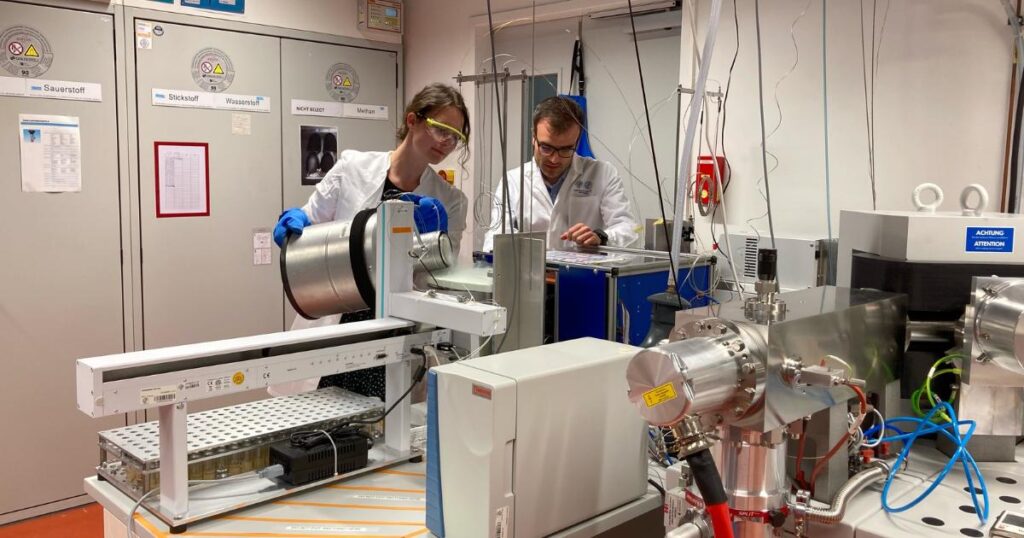
Alexandra Auderset and Alfredo Martinez-Garcia at Max Planck Institute for Chemistry lab (Image: Simone Moretti)
Dr Alexandra Auderset, co-lead author, of the University of Southampton, said: “Oxygen dissolved in our oceans is essential for sustaining marine life, promoting greater biodiversity and stronger ecosystems.
“However, over the past 50 years, two percent of oxygen in the seas worldwide has been lost each decade as global temperatures rise.”
The research team used core samples gathered through the Ocean Drilling Program to study foraminifera, microscopic plankton whose fossilised shells reveal past ocean conditions.
They discovered that while the Arabian Sea did have an oxygen minimum zone during the early Miocene period, oxygen levels only fell to critically low levels, disrupting nitrogen cycles in the water, several million years later as the climate cooled.
Dr Auderset said: “Today parts of the Arabian sea are ‘suboxic’, supporting only limited marine life due to minimal oxygenation.
“This same region during the MCO, under similar climatic conditions, was hypoxic – so comparatively moderate oxygen content, supporting a wider range of organisms.”
READ MORE: New Milton site officially recognised as nature reserve
Scanning electron image of fossilised planktonic foraminifera. (Image: Anya Hess)
The timing of oxygen loss in the Arabian Sea lagged behind similar changes in the Pacific by about two million years, suggesting that regional factors such as strong winds, ocean currents, and outflow from marginal seas play a major role.
Dr Auderset said: “Our results suggest that ocean oxygen loss, already underway today, is strongly shaped by local oceanography.
“Global models that focus solely on climate warming risk not capturing the regional factors that may either amplify or counteract those more general trends.”
The study points to a complex relationship between climate, ocean processes, and marine ecosystems, highlighting the need for adaptive strategies as the planet continues to warm.