

This is part five of a series on The Athletic taking the tactical temperature at each of the Premier League’s ‘Big Six’. How have each side evolved this season, what are they doing well, and what are the issues — if any — that need fixing?
Part one, on Manchester City, is here
Part two, on Arsenal, is here
Part three, on Tottenham Hotspur, is here
Part four, on Liverpool, is here
There are never easy starts at Chelsea, but seven matches in 21 days is a real baptism of fire for new head coach Liam Rosenior.
“I’m one game in,” he laughed in his post-match press conference after beating Championship side Charlton Athletic 5-1 in the FA Cup third round last Saturday, having been asked just how close that team performance was to his footballing ideals.
The 41-year-old former coach of Strasbourg — who are also owned by BlueCo, with Chelsea the flagship within their multi-club model — should fit the remit as a tactician. He replaces Enzo Maresca, who left by mutual consent on New Year’s Day.
Because this is Chelsea, where none of the past six permanent head coaches have lasted two years in the job (since Antonio Conte left in summer 2018), that suitability of tactical fit comes with a pinch of salt.
The whole point of what BlueCo is doing (rightly or wrongly) is to have Strasbourg operating and playing in a near-identical way to Chelsea, so that players and staff can move seamlessly between the clubs.
(Julian Finney/Getty Images)
“There are small, minor tweaks that I am making,” Rosenior told reporters after the 3-2 Carabao Cup semi-final first leg defeat by visitors Arsenal on Wednesday. “My style is very similar to the previous coach. But you always have to have your own way of playing and your own idea.”
Specifically, he elaborated that the “triggers” (for pressing) and “patterns” (for playing out from the back) were slightly different.
He earned a reputation at Strasbourg — leading them to a seventh-place finish in Ligue 1 last term — for tactical flexibility, a short passing game, dominating territory and aggressively pressing man-to-man, with statement home wins against France’s biggest clubs in Marseille, Paris Saint-Germain, Lyon and Lille.
Here’s how Chelsea have played under Maresca and now in the early days of Rosenior, as they try to work their way back up to the top of English and European football.
The 4-2-3-1 and box midfield
Chelsea have started off playing a 4-2-3-1 in every Premier League match since August 2024, which was the start of the Maresca era. They rotate the personnel plenty — they have to with such a deep, young and expensive squad — but always within that framework.
When attacking, the shape is fluid. The expectation is to dominate possession and territory. They use full-backs aggressively to create overloads. Sometimes the left-back becomes an auxiliary No 10 to create a box midfield, meaning they can make a four-v-three overload in central spaces.
Here’s Jorrel Hato doing that in the FA Cup game against Charlton last weekend, with right-back Josh Acheampong tucking in as a third central defender.

Often this is the job of Marc Cucurella, who frequently provides runs in behind and underlaps — increasingly a key tool considering how many deep defences Chelsea face. This helped them break down a stubborn Burnley block in the 2-0 away win in November, for example.

Depending on who is playing as the right-winger, the rotations can look different.
If Cole Palmer starts, as Chelsea’s key attacker he often moves centrally and right-back Malo Gusto pushes onto the last line — with Cucurella becoming the third centre-back.
Take this move away at Fulham last week, where No 10 Enzo Fernandez pulls wide, Palmer stretches the defence and Gusto becomes the connector between No 6s Moises Caicedo and Andrey Santos.

One more example, in Rosenior’s first home game, that cup defeat against Arsenal.
This move includes three of the four midfielders when Chelsea form the box. Centre-back Wesley Fofana splits the midfield with a ball to No 9 Marc Guiu, who sets it for the No 10, Joao Pedro.
Here is where the double pivot comes into play, as Santos and Fernandez connect.
Acheampong, the extra No 10 (moving from right-back), is the only one to not touch the ball, but still plays a key role by occupying left-back Jurrien Timber to create a passing lane direct to Estevao, the right-winger, who cuts in and forces a good save from David Raya.

Especially down their left, Chelsea are threatening from the wings, which is particularly impressive given their lack of a first-choice striker — Joao Pedro and Liam Delap offer wildly different profiles, as Joao Pedro prefers to drop in and play, while Delap runs channels.
Chelsea lead the league in back-post goals with nine. Their midfielders time their runs well in these moments, and the far-side winger does a good job of getting to the post, giving the crosser another option.

Neto especially provides some pinpoint inswinging left-footed crosses from the right. Only Tottenham Hotspur (13) and Newcastle United (eight) have scored more than Chelsea’s eight total goals from crosses this season.
There are two main criticisms of Chelsea on the ball: they have tried and failed to play through better pressing teams — see Aston Villa’s equaliser in their 2-1 win at Stamford Bridge last month — and have a tendency to self-destruct by overplaying.
Under Maresca, they conceded sloppy goals, which put games out of reach against Leeds United and Brighton & Hove Albion in the Premier League and in the Champions League against Bayern Munich. They also conceded cheaply in cup matches versus Lincoln City, from third-tier League One, and Wolverhampton Wanderers, who are bottom of the Premier League.
Pressing traps and defending crosses
Chelsea are undoubtedly a better pressing team than a box-defending one. At opposition goal kicks, the focus is to squeeze opponents, typically through a pressing trap.
This is where they lock on man-for-man almost completely across the pitch, but the left-winger positions himself high (versus the opposition right centre-back) while the left-back stays deep — this baits a pass into the right-back, which, when played, triggers the jumps to lock that down.

The purpose is to try to entice teams into building up out wide rather than centrally.
Chelsea have been carved apart plenty of times (their 40 through balls conceded is the division’s sixth-most this season), and constantly changing back-line personnel is, naturally, making it hard to establish the kind of relationships and understanding between players needed for an offside trap to function.
At times, they rely heavily on Caicedo’s outstanding awareness and ball-winning skills. The Ecuador international midfielder has the most interceptions in the Premier League this season (37), with Chelsea the top team for that same metric (211).
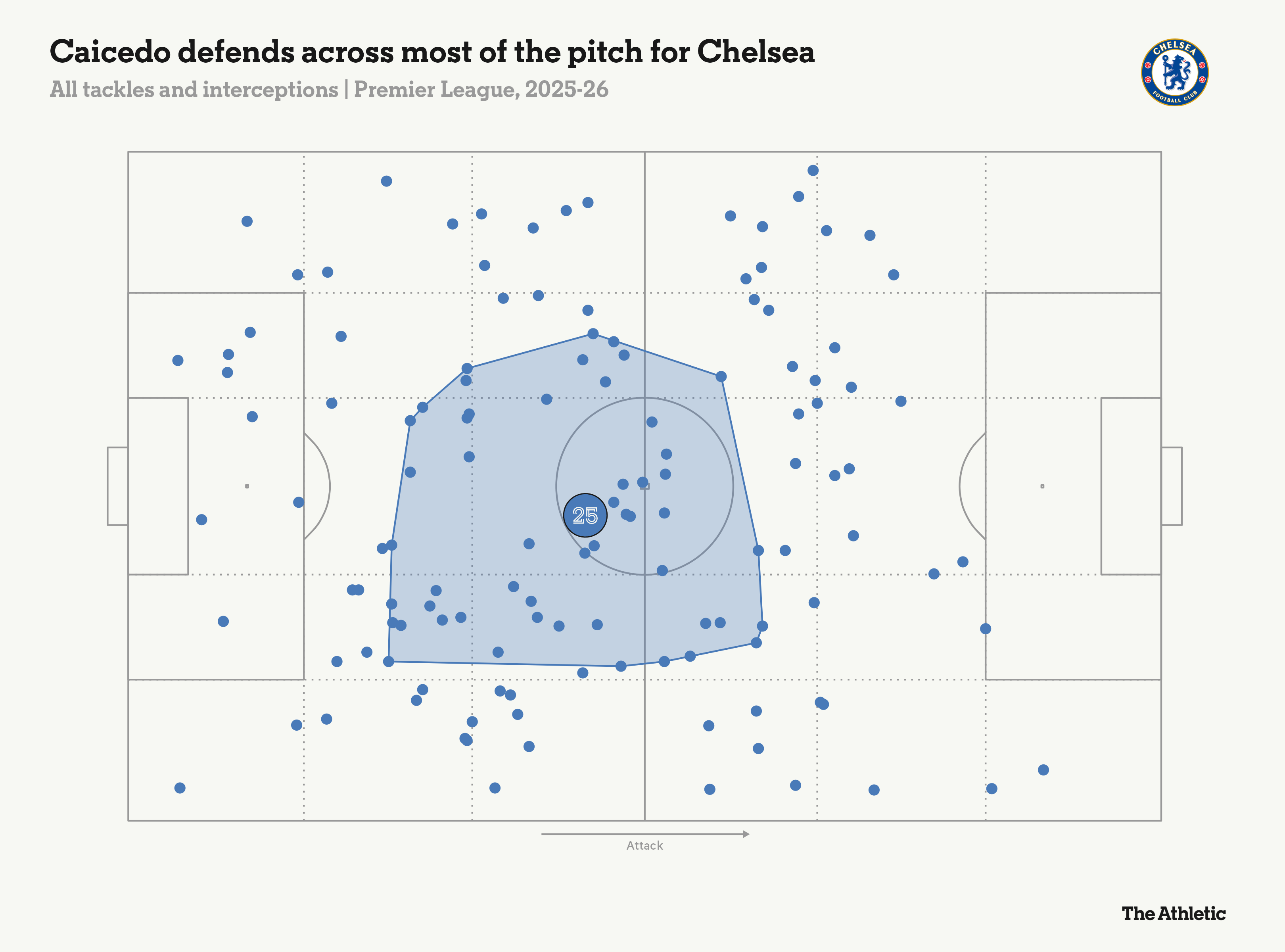
Notably, they are bottom for clearances and look incredibly vulnerable in defensive crossing situations.
Brighton scored twice from crosses in a 3-1 comeback win at Stamford Bridge at the start of the season, as did Newcastle to race into a 2-0 lead at St James’ Park in December. In both the league meeting in November and this week’s cup game, Arsenal scored tap-ins from deliveries down Chelsea’s left.
The second Arsenal goal in the latter — a match that marked the fifth time this term, in all competitions, Chelsea have conceded three in a single game — typified the problem.
Neto lost the ball high upfield and Arsenal countered, with Cucurella tackling Bukayo Saka, conceding a throw-in. Arsenal took this quickly down the line and Neto ball-watched, failing to defend Ben White’s overlap. Meanwhile, the back four were trying to squeeze up and out of the box.

This means Viktor Gyokeres can stand unmarked (and initially offside) knowing that White will bring him into play. Cucurella is unable to get out to stop the cutback, and neither Fofana nor Acheampong get tight to the Arsenal No 9, who taps in after the ball goes underneath goalkeeper Robert Sanchez.

This problem can be traced back to September, when they collectively switched off to Noussair Mazraoui’s cross, and Bruno Fernandes crashed in to score for Manchester United following Amad’s flick on.
Only Everton and West Ham United (both 10) have conceded more times from crosses this season than Chelsea (eight).
Those frailties have been exposed in cup games, too. Cardiff City (another League One side), Atalanta and Bayern all scored from similar situations.

Chelsea have a tendency to try to hold their line for too long on the edge of the box, leaving attackers unmarked.
That showed, with them down to 10 men, on Fulham’s opening goal in that 2-1 home win earlier this month.

This partly explains Chelsea’s struggle for clean sheets this term — none in the past eight matches, their longest streak since January/February 2025.
The lack of a senior centre-back in these moments is telling, and without a second aerially dominant defender to support Trevoh Chalobah, opposition forwards continue to have a lot of joy against Chelsea.
Inswinging corners and fast breaks
Two areas where Chelsea have massively improved over the past calendar year — and this follows league-wide trends — are at attacking corners and on counter-attacks.
They are among the most potent teams from set pieces currently, scoring nine times already from corners, a return better than they managed in the whole of last season (seven), and they need just one more goal from dead-ball situations to hit double digits, something they last managed in 2020-21.
The strategy has been consistent: prioritising inswingers towards the near post, which has reaped rewards thanks to positional bluffing and flick-ons. A healthy dose of short corners gets mixed in too, as Chelsea are among the league’s smaller sides and can produce some cutting passing moves when they rework a corner.
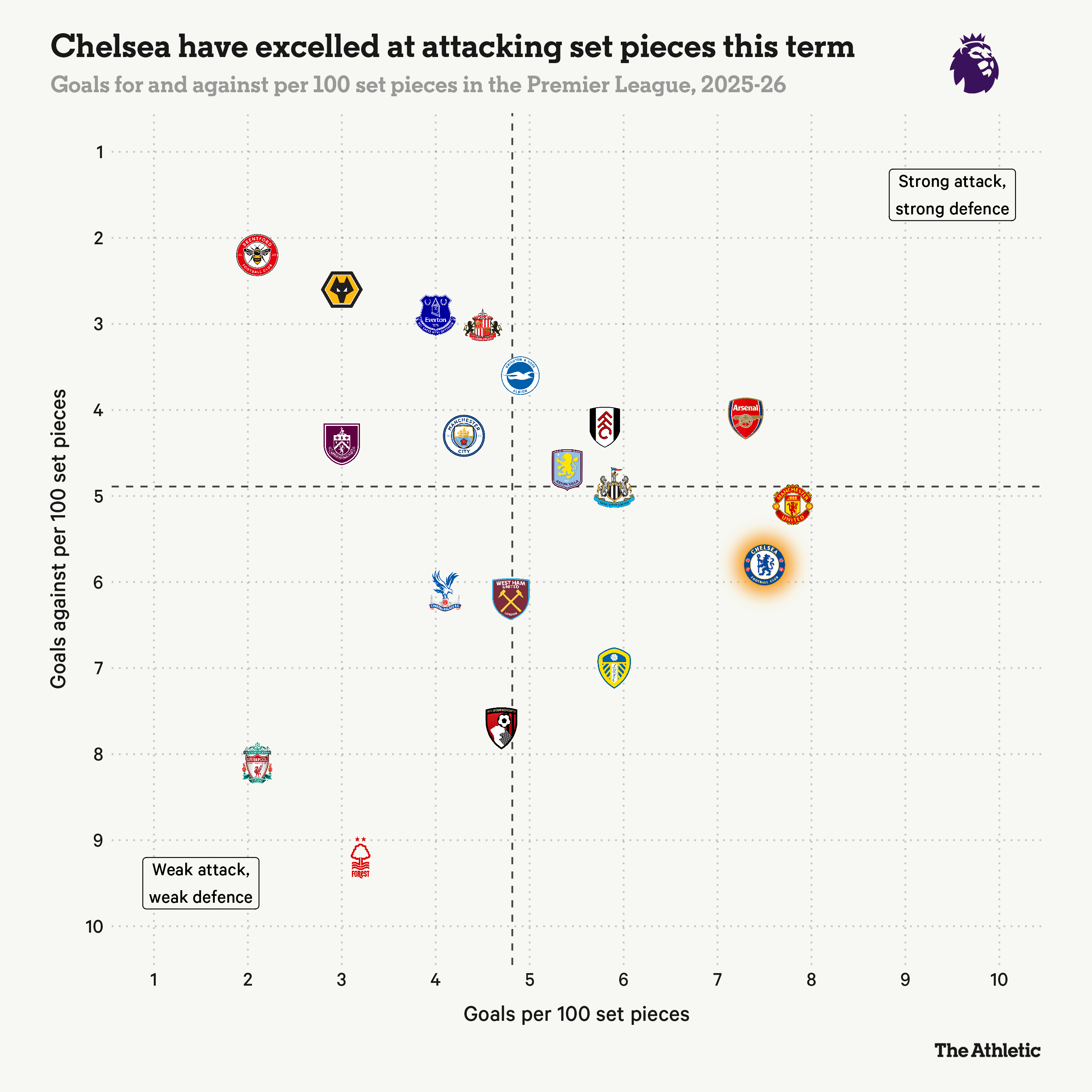
However, there are weaknesses at defensive set pieces, especially long throws. Twice, Bournemouth scored from such moves, with a flick-on finding a team-mate at the far post. Long throws by Brentford and Sunderland also created goals.
Alejandro Garnacho, the winger tasked with defending the back post, has been punished multiple times for switching off and letting his player run.
Set-piece coach Bernardo Cueva has toyed with keeping three attackers upfield at defensive set pieces, disrupting opposition routines, forcing them to keep defenders back, and giving outlets for counter-attacks while making more space for Sanchez to catch/punch.

So stacked are Chelsea with individual attacking quality and quick, direct dribblers that their counter-attacking threat has grown organically — and without Maresca even really wanting it, telling Sky Sports in May 2025 that his side were “not good enough for a transition game”.
Last season, they scored seven times from fast breaks, more goals than the previous four terms combined (six). Since August 2024, only Liverpool (71) have taken more shots following fast breaks than their 62.
This also highlights something of a profile imbalance.
Chelsea have plenty of forward-thinking attackers — for example, Neto, Estevao and Garnacho all have pace and can create through carries — which has led to some excellent back-to-front counter-attack goals against Burnley, Newcastle and Everton.
However, the consistency with which they drop points from winning positions (11, including three defeats this year) and earn them having been behind shows us a squad who struggle to dominate and win. They tend to manage one of the two.
Rosenior has plenty to work on as Chelsea target consecutive top-four finishes for the first time since 2020-21 and 2021-22. Providing there are no disasters in their final two league-phase matches in the next two midweeks, they should end a three-year absence from the Champions League’s knockout rounds.
There are major discipline problems and inevitable inconsistencies with such a young, deep team. The green shoots are there, though, shown with statement Champions League wins this season over cup holders Paris Saint-Germain and Barcelona, who were in the semi-finals in May.
“This is a team that won the Club World Cup five months ago, that won the Conference League last year,” Rosenior reminded reporters after the Charlton win.
Maresca has indeed left him a decent platform but it needs to be built upon.