
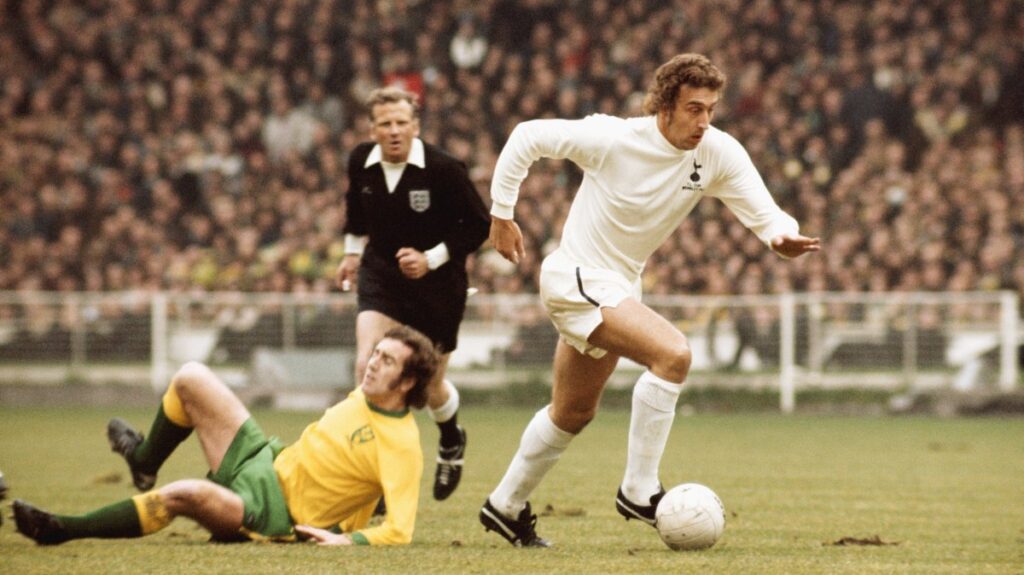
Only Harry Kane, Jimmy Greaves and Bobby Smith scored more goals for Tottenham Hotspur than Martin Chivers. But his prowess did not spare him from the wrath of his manager.
Bill Nicholson broke the British transfer record to sign the striker from Southampton for £125,000 in January 1968. It was money well spent as Chivers delivered 174 goals in 367 appearances. Yet he endured a slow start and their relationship was tense.
Fearing they had lavished a fortune on a worrier rather than a warrior, Nicholson and his assistant, Eddie Baily, regularly harangued the anxious Chivers in an effort to make him more aggressive and capitalise on his brawny physique.
Nicholson also ordered his centre backs to rough up Chivers in training, leading to a fight between the striker and the defender Mike England during a practice match. The manager deemed Chivers’s Essex home to be too distant from the training ground and further offended Chivers by handing him tickets to West Ham United so he could learn how to be a tough forward from watching Geoff Hurst.
“He simply had a way of geeing me up. Unfortunately, it looked terrible at the time and it was. We had so many arguments, to the point where I used to storm out of the dressing room but go and score two goals. So it worked,” Chivers recalled in a 2004 interview. “He had a way of dealing with me, but it was such hard work for me.”
Dubbed Big Chiv, he was skilful as well as strong, gifted in the air and a prolific goal-scorer. As a stylist in a brutish era, his reluctance to use his powerful 6ft 1in frame to its full bone-crunching potential saw the self-confessed “gentle giant” harshly denounced as shiftless by critics within the club, in the press and on the terraces who initially dismissed him as a costly flop.

Chivers in 1972
TONY DUFFY/GETTY IMAGES
Chivers insisted that he picked his moments in order to conserve energy. “I did have determination but I was not prepared to start knocking people around,” he told Hotspur magazine in 2009. “In my day tackles from behind were commonplace, the pitches were muddy and uneven, the ball was heavy and we did not have dieticians and psychologists.”
The last of these might have proved useful given his nervous nature. He took tranquilisers before matches in the Sixties and was afraid of the dark and of being home alone, he admitted to the author and journalist Hunter Davies in the classic 1972 fly-on-the-wall book The Glory Game. “I really am scared,” Chivers said. “I don’t like the dark and going to bed on my own. I worry if I’ve locked everything up. I never read books and I don’t like TV and I can’t cook anything for myself, so I go to pieces on my own. I must have company.”
This was an unusually frank admission, but Chivers was an unusual kind of footballer. The writer Norman Giller recalled meeting Chivers at London Waterloo and learning that the new Tottenham star had spent the train journey from Southampton tackling The Times crossword. Feeling edgy before his first game for the club at White Hart Lane, Chivers entered the toilets to compose himself and saw smoke emanating from a stall. Greaves was puffing on a cigarette.
A serious knee injury suffered as he attempted a pass during a match against Nottingham Forest in September 1968 threatened to end Chivers’s career aged 23. “There was a big hole where my knee should have been and a lump at the top of my thigh, which looked like the kneecap. I pushed it back down and straightened my leg,” he told an interviewer. “Cecil Poynton, the trainer, told me to bend my knee. I tried and my kneecap started travelling up my thigh. The players just walked away. I found out later that the club were in touch with the insurance company. They thought I was finished.”
Chivers was sidelined for the rest of the season but returned after extensive weight-bearing rehabilitation that included carrying Poynton up and down the terraces. His mind took longer to recover but he regained his self-belief after scoring past Gordon Banks with a fine shot from the edge of the penalty area in a 3-0 win over Stoke City in October 1970. No longer overshadowed by Greaves, who had left for West Ham, Chivers forged an effective partnership with Alan Gilzean and arguably became English football’s leading striker.
Not that Nicholson and Baily eased up, even after Chivers scored 34 times in 58 games in 1970-71, including both goals as Tottenham beat third-tier Aston Villa 2-0 in the 1971 League Cup final. Spurs finished third in the league.
The next season Chivers found the net a remarkable 42 times in 62 appearances. When Tottenham faced Wolverhampton Wanderers in 1972 in the inaugural Uefa Cup final, he marched angrily back out to the pitch after a half-time verbal volley from Nicholson and scored twice — a header and a famously thunderous drive from distance — to supply a 2-1 first-leg away victory. Baily bowed down and pretended to kiss Chivers’s feet. A 1-1 second-leg draw at White Hart Lane sealed the trophy.
Chivers also won the 1973 League Cup as Spurs overcame Norwich City but was on the losing side in another final as the Dutch side Feyenoord triumphed over two legs to claim the 1974 Uefa Cup.
Martin Harcourt Chivers was born in Southampton in 1945 to Thomas, a docker, and Sidonie (née Bohne), a German immigrant. While at grammar school he wrote to Southampton FC asking for a trial and became a starlet in their youth team. He made his senior debut aged 17 in September 1962. A haul of 30 league goals in 1965-66 helped Southampton to gain promotion to the top-flight and drew the attention of bigger clubs.
Compared with his club achievements his international career was anticlimactic, though he mustered 13 goals from 24 England caps. A regular for England under-23s, Chivers did not make his full debut until 1971, appearing in a Euro ’72 qualifying win over Malta. He scored seven times in his first eight games but a quarter-final defeat to West Germany over two legs meant that Alf Ramsey’s men did not reach the final stages of the tournament.
Worse followed as a notorious 1-1 draw with Poland at Wembley in 1973 saw the 1966 World Cup winners fail to qualify for the 1974 edition. An off-form Chivers was belatedly substituted in the 88th minute in what proved his last England game. That he happened to share his name with a marmalade-maker had provided the underdogs with a boost at breakfast. “The boys were really nervous, but did what they could to be funny, to make jokes. We saw on the table some jam-jars with the label ‘Chivers’,” the Poland manager Kazimierz Gorski remembered in 2013. “And then someone shouted: ‘We will eat this Chivers!’”

Chivers during the 1971-72 season
SHUTTERSTOCK
Terry Neill, who succeeded Nicholson in 1974, sold Chivers to the Geneva-based club Servette for £80,000 in 1976. In Switzerland he continued his record of producing a goal roughly every two games, won two domestic trophies and buried the hatchet with Nicholson over dinner.
He returned to England in 1978, signing for Norwich. The next year he dropped into the second division to join Brighton under the management of his former Tottenham team-mate Alan Mullery. Struggling with an Achilles injury, Chivers barely played and left in 1980. He became player-manager at non-league Dorchester Town, also spending time in Norway as a player-coach with Vard Haugesund, and hung up his boots after a spell with Barnet in 1982-83.
In 1965 he married Carol Maine. They had two daughters, Andrea and Melanie, but divorced around 1973. He remarried, to Julia Dunn, in 1975. They ran a hotel near their home in Hertfordshire and had two sons, Nick and Luke. His wife and children survive him. He also worked as a radio commentator and up to his death was a personable match-day hospitality host at Tottenham, where he was rightly billed as a club legend.
Martin Chivers, footballer, was born on April 27, 1945. He died on January 7, 2026, aged 80