

With Anthony
Elanga set to move from Nottingham Forest to Newcastle United,
we assess if he’s the right-wing upgrade they have been waiting
three seasons for.
Jacob
Murphy was one of the most consistent wide forwards in the
Premier League last season. He contributed 20 goals towards
Newcastle United’s tally of 68 – nearly 30% of their total –
with eight goals and 12 assists in 2024-25.
Those 12 assists were behind only the exceptional Mohamed Salah
(18) in the Premier
League rankings last season, while Murphy’s total of 11
open-play assists was only fewer than two Newcastle players in any
Premier League season ever, and the most since Laurent Robert’s 11
in 1999-00.
With all that in mind, Murphy would rightfully feel hard done by
when the impending recruitment of Nottingham
Forest’s Anthony Elanga is confirmed. Murphy’s role will likely
be reduced to a backup option on the right wing, with their new
signing – reported to be for a fee in the region of £55m – a player
the Magpies have tried to bring in for some time now.
Newcastle tested Forest’s resolve with their interest in Elanga
last summer, but now they seem to have finally got their man after
what has been pretty much a three-year search for another
right-sided attacking option.
Other than a strange two-month period between October and
December 2022, when Miguel Almirón’s eight goals in nine Premier
League appearances gave Newcastle fans hope that he might have
been the answer, the Paraguayan struggled to make much of an impact
as their preferred right-wing option.
Matt
Ritchie chipped in during Howe’s early years but was clearly
not at the level desired by Newcastle’s new ambitious owners.
Yankuba
Minteh arrived as a prospect before immediately being loaned
out to Feyenoord for a season and then sold for a hefty profit to
Brighton last summer having never played a competitive match for
the Magpies.
Across Eddie Howe’s three full seasons in charge of Newcastle,
Murphy was really the only other option. Until now.
Elanga, who is nearly seven years Murphy’s junior, has shown
enough across two years at Nottingham Forest to suggest he’s an
upgrade and someone who’ll help Newcastle battle on multiple fronts
across Premier League, Champions League and domestic cup
competitions as they look to follow up their fantastic League Cup
success in 2024-25.
Are Newcastle Signing a Premium
Creator?
The top-line statistic that catches the eye when analysing
Elanga’s qualities and output is his assist tally at Nottingham
Forest across his two seasons at the club.
One of only three players to assist at least 20 goals in the
Premier League since 2023-24, behind Salah (28) and Ollie Watkins
(21), his tally is arguably more impressive than the duo ahead of
him. His assists came at a club who collected 97 Premier League
points over those two campaigns, compared to the 166 won by
Liverpool and 134 by Aston Villa – two of the Premier League’s four
best teams in that period.
Looking deeper at his creative statistics across those two
seasons, his output appears less impressive than his assist tally
suggests (a reminder that assists aren’t the best metric to solely
use to judge creativity). But again, playing for Forest – a team
who average low possession and rely on fast transitions rather than
sustained possession in the attacking half – is a contributing
factor for this.
His two Premier League campaigns at Forest saw him average 20.9
touches in the final third per 90 across 4,940 minutes – far fewer
than the league’s leading open-play chance creators like Salah
(31.8), Martin Ødegaard (33.3), Dejan Kulusevski (30.7), Cole
Palmer (25.5) and Bruno Fernandes (26.4) in the same timeframe.
As a result, Elanga ranks joint 57th for open-play chance
creation since the start of 2023-24 in the Premier League (60),
level with Abdoulaye Doucouré and 90 off Salah’s league-high tally
of 150 in that period. It’s the same story when looking at last
season alone, too – he ranks joint 70th alongside Erling Haaland
and Nicolas Jackson, two players hardly known for their creative
output.
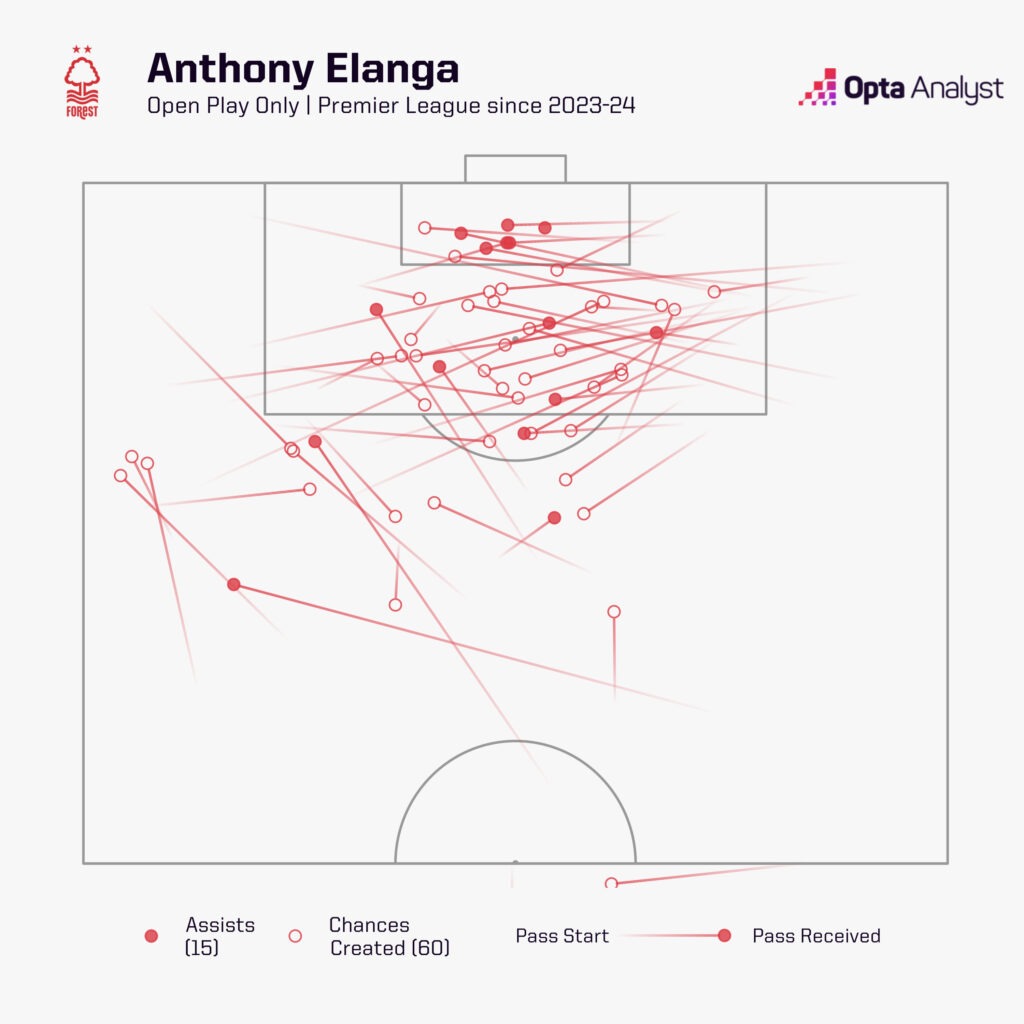
Standardising Elanga’s creative numbers helps paint a more
positive picture, however. When looking at open-play expected
assists (xA) last season and averaging xA per 100 open-play
passes to create a level playing field that reduces the influence
of team playing styles, Elanga starts to rise up the rankings.
Expected assists are essentially a more accurate metric to
analyse pass quality, rewarding players who pass into dangerous
areas, regardless of whether the receiver takes a shot or not. Just
like expected
goals (xG), expected assists are measured on a scale of
0.0-1.0, where 0.0 represents a pass that will never result in an
assist and 1.0 equates to a pass the receiver would be expected to
score from every single time.
Still some way off players like Salah (0.74 xA per 100 open-play
passes) and Bukayo Saka (0.80), Elanga averaged 0.39 xA per 100
passes. That’s level with Ødegaard, slightly below Antoine Semenyo
and Eberechi Eze (both 0.40), and above Trent Alexander-Arnold
(0.38) and teammates Morgan Gibbs-White (0.38) and Callum
Hudson-Odoi (0.30).
It might seem alarming that Murphy’s average (0.65) is nearly
double that of Elanga’s 0.39, but combining the data with the eye
test – where most can see Elanga is clearly a talented attacker –
should give some optimism that Newcastle’s style of play will help
Elanga reach, or even exceed, Murphy’s average from 2024-25.
Catch Him if You Can
A lot of Elanga’s threat comes from being one of the Premier
League’s most effective players at moving the ball up the pitch at
pace.
Among the 306 players to play at least 1,000 minutes in 2024-25,
the Swedish winger ranked top in the Premier League for the average
distance of his ball carries (14.3m), the average distance each of
his carries progressed the ball upfield (11.9m) and the proportion
of total distance covered per carry that was progressive
(75.5%).
That directness was an effective weapon for Nuno Espírito Santo
at Forest, who encouraged his team to attack at pace whenever
possible en route to securing seventh place last season.
Elanga’s most eye-catching run with the ball in 2024-25 came in
Forest’s home win over his former club Manchester United in April,
when from the moment he first touched the ball to the point from
where he shot, Elanga travelled 54.1 metres in 16 seconds. That,
unsurprisingly, was the longest distance any player carried the
ball before scoring in the Premier League last season.

For anyone who watched that goal, it’ll come as little surprise
to learn Elanga achieved the top recorded speed of any winger or
forward in the Premier League last season (36.7 km/h).
Frighteningly, for opponents facing Newcastle next season,
Elanga will join forces with Anthony Gordon at St James’ Park,
creating one of the potentially hardest-working attacking
partnerships in the English top flight.
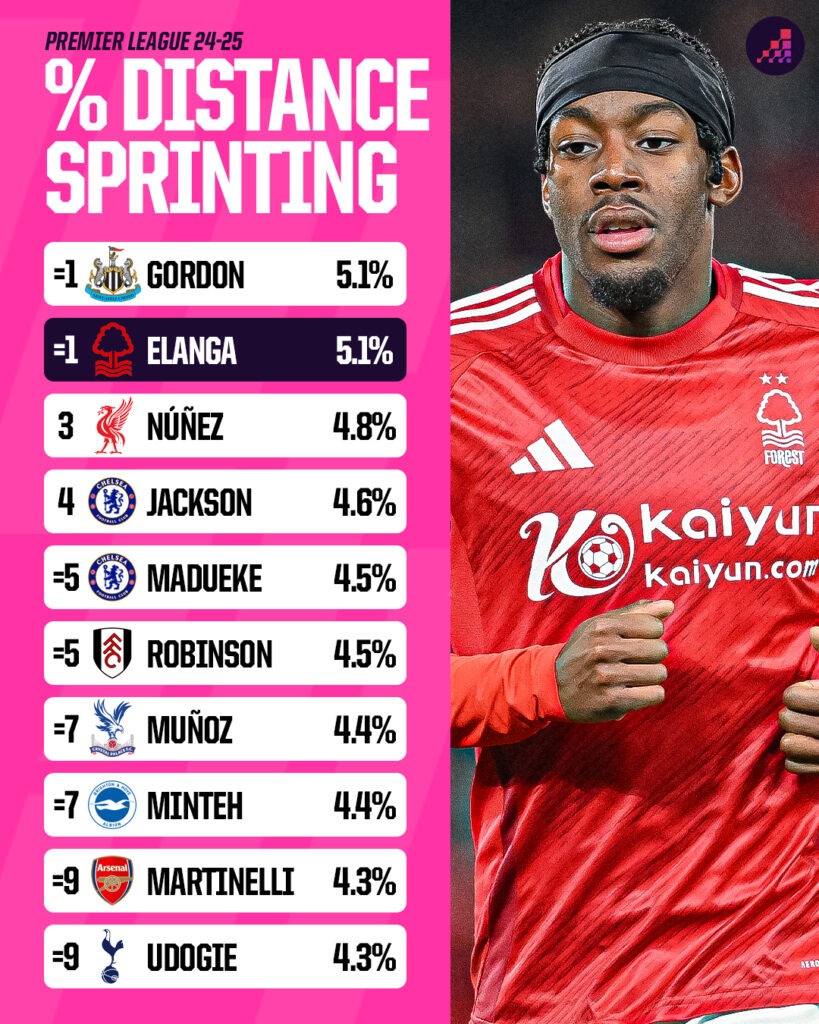
Among players to have played at least 1,000 minutes of Premier
League football last season, Elanga ranks third for sprints per 90
(26.2) and joint top for the proportion of distance run while
sprinting (5.1%).
Top in both categories is Gordon (28.8 sprints/90, 5.1% of
distance sprinting), while Tino Livramento – who could be deployed
behind Elanga at right-back – ranks inside the top 20 for both
categories.
One criticism of Elanga when analysing his effectiveness on runs
and with dribbles, however, is that he had a below-average take-on
success rate, succeeding with just 28% of them (25/90) compared to
the Premier League average for wingers and forwards (38%). This
does support the idea he’s more effective with ground to run into
rather than in tight spaces.
Two-Footed Finisher
Elanga may have only scored six goals in the Premier League last
season, but he did show signs of improvement with his shooting.
His goal tally was one more than in 2023-24 at Forest (5) but
came from 10 shots fewer (44 vs 54), meaning he converted a
career-best 13.6% of his shots into goals. He also found the target
with a much higher proportion of his shots (55%) than in his first
season at the City Ground (43%) despite his chances being of a
lower quality on average (0.10 xG per shot) than in 2023-24
(0.12).
It goes without saying that these numbers aren’t anywhere near
substantial enough or over a long enough period to meaningfully
assess if this if an upward trajectory that we should expect to see
him continue at Newcastle. But the Magpies will hope Elanga can
increase his shot volume to become a much more rounded attacking
threat.
It’ll be helpful to Newcastle that Elanga is one of the most
two-footed shooters in the Premier League, with the winger able to
adjust to different shooting positions without needing to switch
the ball to his ‘strong’ foot, which can potentially risk taking
too many touches in crucial moments.
Last season saw him attempt 65% of non-headed shots with his
right foot and the remaining 35% with his left. That made him one
of just nine players to attempt 40+ non-headed shots (62 players)
and have a proportional difference of 30 percentage points or fewer
between shots taken with each foot.
Across his whole Premier League career, that proportional
difference is even closer (23 percentage points), with 61% of his
non-headed shots coming via his right foot and the remaining 39%
coming off his left.

That ability to use both feet could conceivably mean he’d be
comfortable filling in on the left as well, and that versatility
will be key to Newcastle in 2025-26 as they look set to play
considerably more games than they did last season.
Having not qualified for Europe last term, they now face eight
additional matches to play before the end of January after sealing
a place in the UEFA Champions League.
In 2024-25, only Forest (23) used fewer players in the Premier
League than Newcastle, while only Brentford (20) started fewer than
Howe’s side (22) in the competition. So, expect them to be busy in
the market in the next two months.
Elanga is the first senior signing by the club this summer, and
it’s not a bad place to start.
Subscribe to
our football
newsletter to receive exclusive weekly content. You should
also follow our social accounts over on X, Instagram, TikTok and Facebook.